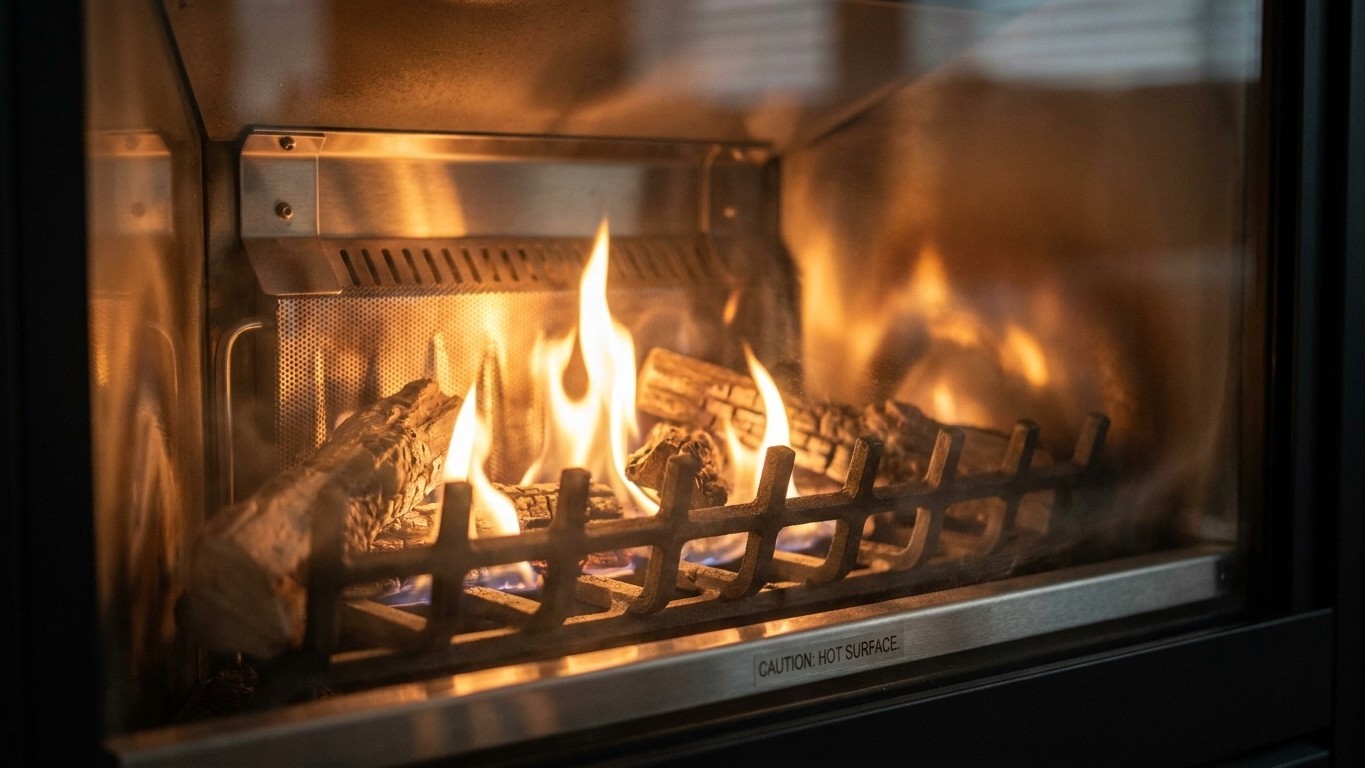

Most gas fireplace sounds are the metal cabinet expanding and contracting as it heats up and cools down, and that ticking is nothing to worry about. The one sound that deserves attention is a rapid clicking at start-up that never stops, which means the igniter is sparking but the flame isn’t catching. Everything else, from a rattling blower to a whistling vent, points to a specific, fixable part.
Metal expands, and that is most of it

Steel and cast iron don’t sit still when they get hot. The firebox, the log grate, the heat shield behind the glass, all of it grows by a fraction of an inch as the metal warms, and shrinks back down once the burner shuts off. That movement between components, metal sliding against metal or against a mounting bracket, is what produces the ticking or light clicking that owners hear during the first several minutes of operation.
The giveaway that this is thermal expansion and not something mechanical or electrical is timing. It follows the heat, not the flame. Turn the fireplace on and the ticking usually starts a minute or two into the burn cycle, once the firebox has had time to climb in temperature. It doesn’t sync with the igniter’s spark pattern, and it doesn’t happen the instant you flip the switch or press the remote.
Why it keeps going after shutdown
The same noise often continues for a stretch after the fireplace is turned off, and that’s expected too. Cast iron and steel don’t cool instantly just because the gas valve closed. A firebox that ran for an hour can take a genuine while to drop back to room temperature, and as it does, the metal contracts back toward its original shape. That contraction produces the same kind of tick, sometimes described as louder or sharper than the warm-up version because the house has gone quiet and the fireplace is the only thing making noise.
Twenty minutes of intermittent ticking after shutdown is within the range owners commonly report and isn’t, by itself, a sign of a failing part. What would change that assessment is ticking that starts fresh hours later with no heat source, or a grinding or scraping sound layered on top of the tick, which suggests something is rubbing rather than simply flexing.
New fireplaces and newly installed units tend to be noisier in this respect for the first several burn cycles. Fresh metal, fresh welds, and components that haven’t yet settled into their final resting positions against brackets and clips all make more noise than the same fireplace after a season or two of use. If the ticking is loudest in the first few weeks and gradually quiets down, that’s the system breaking in, not breaking down.
One more variable worth naming: the log set. Ceramic or refractory logs sit loose in the firebox by design, resting on a metal grate, and they expand at a different rate than the steel underneath them. A faint tick coming specifically from the log area, distinct from the firebox walls, is usually just the logs settling against the grate as both pieces heat unevenly. It’s cosmetic, not structural.
The clicking that should stop
There’s a second kind of clicking, and it sounds different once you know what to listen for. Instead of the slow, irregular tick of expanding metal, this one is fast and rhythmic, a rapid-fire clicking that happens the moment you turn the fireplace on. That’s the electronic igniter sparking, trying to light the pilot or the main burner, and in a healthy system it should stop within a matter of seconds once the flame is proved and the control senses it’s burning.
The word “proved” matters here. Every gas fireplace with an electronic ignition system has a flame sensor that confirms combustion actually happened before it lets the igniter stand down. When everything works correctly, you hear a burst of clicks, then silence, then the whoosh of the burner catching. The whole sequence takes seconds, not minutes.
When the clicking won’t quit
Clicking that continues well past that window, especially clicking that keeps going in cycles, on and off and on again, means the appliance is trying to light and failing, or lighting and then losing the flame before the sensor confirms it. The igniter isn’t broken in this case; it’s doing exactly what it’s supposed to do, which is keep attempting to spark because nothing downstream is telling it to stop.
The instinct to keep pressing the ignition button or flipping the switch off and on repeatedly is understandable, but it’s the wrong move. Repeated retries don’t fix whatever is preventing ignition, and they can push unburned gas into a space that isn’t venting it. If the fireplace clicks and clicks without ever catching, or catches briefly and then goes out, stop trying to force it. That’s the point where troubleshooting the actual cause, whether it’s a pilot assembly issue, a gas supply problem, or a sensor out of position, needs to happen before another attempt.
Anyone in this situation should stop and read through the dedicated gas fireplace will not light guide rather than continuing to cycle the ignition switch, since the causes for a no-light condition are specific enough that guessing usually just burns through more attempts without results.
One distinction that matters here: whether the unit is vented, direct-vent, or vent-free changes some of what happens downstream of ignition, but the clicking itself, the igniter sparking and waiting for flame proof, works the same way across all three configurations. The difference shows up later, in how combustion byproducts are handled once the flame is actually burning.
The rest
Past the two big categories, thermal ticking and igniter clicking, there’s a shorter list of sounds that come from specific parts rather than the appliance as a whole. Each one has its own likely cause:
- A rattling blower — the circulating fan that pushes warm air into the room can develop a rattle when a blade is loose, dusty, or slightly out of balance, and it typically only rattles while the blower is actually running.
- A loose log or ember — ceramic logs and the loose ember material scattered on the burner pan can shift position over time, especially after cleaning or moving the unit, producing a soft clunk or scrape rather than a click.
- A vibrating glass frame — the glass front panel is held in a metal frame, and if that frame’s fasteners have loosened, the blower’s air movement or the burner’s operation can set the glass humming or buzzing against the frame.
- A whistle from a restricted vent — air moving through a vent or flue that’s partially blocked, kinked, or undersized for the appliance can produce a thin whistling sound, particularly noticeable when the blower or draft is strongest.
Most of these have a mechanical fix rather than a wait-it-out one. A rattling or humming blower is worth checking against the dedicated gas fireplace blower noise page, since blower issues range from a simple dust buildup to a fan that needs replacing, and the fix depends on which one it is. A whistle tied to airflow points toward the venting itself, and the gas fireplace venting page covers how vented, direct-vent, and vent-free systems move air differently and what a restriction in each looks like.
Whatever the source, the U.S. Fire Administration’s basic clearance guidance still applies regardless of which sound brought you to the appliance in the first place: “Keep anything that can burn at least 3 feet from all heat sources including fireplaces, wood stoves, radiators, space heaters or candles.” An unusual noise is a good reminder to glance at what’s sitting near the unit, not just what’s happening inside it.
And if any of these sounds shows up alongside a smell of gas, the noise stops being the priority. Leave the house and call your gas utility or 911 from outside. No sound diagnosis is worth doing from inside a home that smells like gas.
Common questions
Why does my gas fireplace click after I turn it off?
The firebox and its metal components are cooling down and contracting back toward their original size, which produces the same kind of tick heard during warm-up. This can continue intermittently for a while after shutdown as the metal keeps losing heat.
Is it normal for a Gas Fireplace to click for a long time before lighting?
No. The igniter’s rapid clicking should stop within seconds once the flame is proved by the sensor. Clicking that continues means the appliance is attempting to light and failing, and repeated retries aren’t the fix.
Should I keep trying to light it if it keeps clicking?
Stop instead of repeating the attempt. Continued failed ignition attempts don’t resolve the underlying cause, and it’s better to work through the specific troubleshooting steps than to keep cycling the switch.
Does the type of gas fireplace change which sounds are normal?
The ticking from metal expansion and the clicking from the igniter behave the same whether the unit is vented, direct-vent, or vent-free, since those relate to the cabinet and ignition hardware rather than how combustion air and byproducts move. Whistling tied to airflow is more specific to how each system vents, so it’s worth checking which configuration you have before troubleshooting that sound.