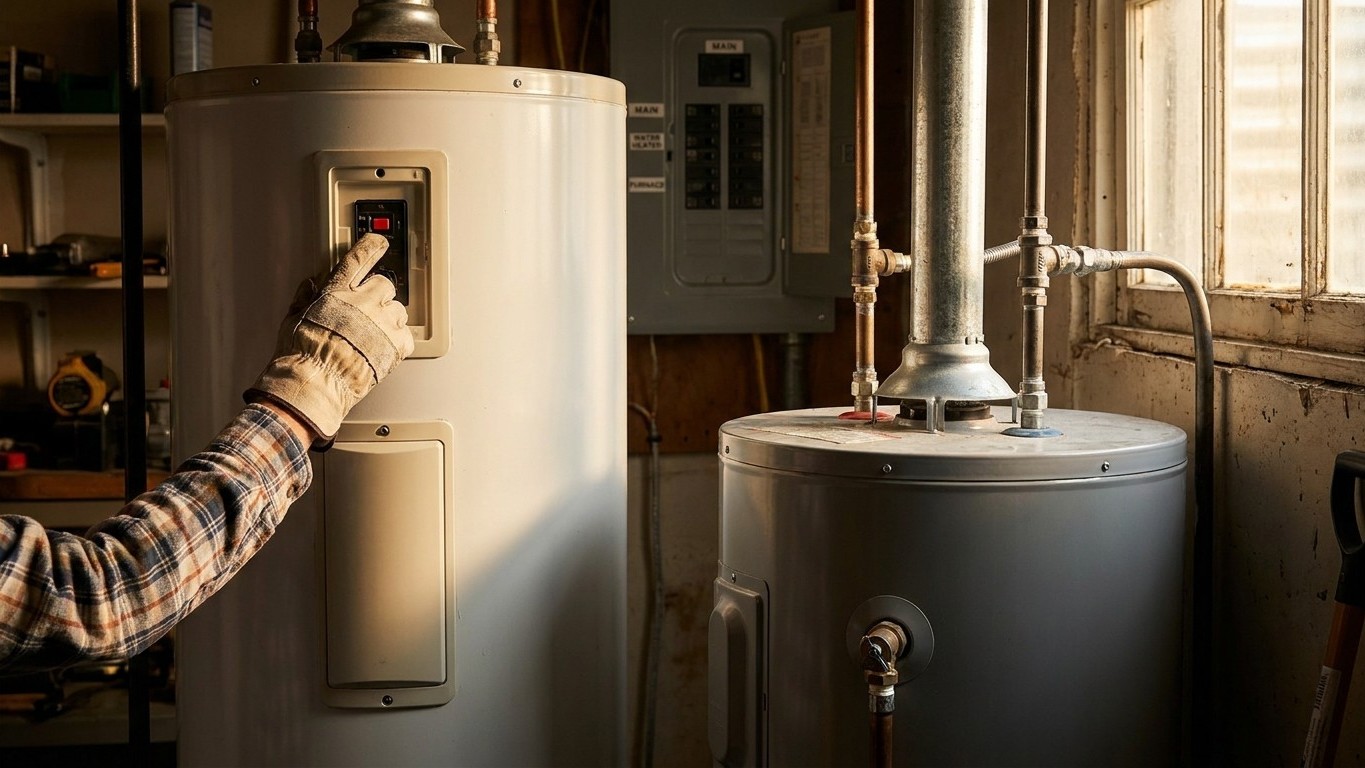

When a water heater delivers nothing but cold water, the cause almost always sits in one of two places: the power or fuel reaching the tank, or a single failed part inside it. Electric and gas units fail in different ways, so the first move is figuring out which type sits in the utility closet or basement. From there, a short list of checks usually points to the problem before anyone touches a wrench.
Electric or gas decides the checklist
Everything that follows splits along one line: what powers the tank. On an electric water heater, the two things worth looking at first are the breaker in the electrical panel and the red reset button on the upper thermostat, usually hidden behind a small access panel on the side of the tank. On a gas water heater, the equivalent checks are the pilot light or electronic igniter, and whether gas is actually reaching the unit at all.
A tripped breaker is the simplest explanation and the easiest to rule out. Flip it fully off, then back on. If it trips again immediately, something downstream is pulling too much current, and that’s a job for a technician, not a second or third reset. The reset button on the upper thermostat is a high-limit safety switch. It pops when water inside the tank gets hotter than it should, which usually means a stuck thermostat or a failing element rather than a random glitch.
Gas units hinge on a different chain: pilot lit, thermocouple sensing that flame, gas valve turned to “on,” and gas actually flowing from the meter. Relighting a pilot according to the instructions printed on the tank’s own label is typically within an owner’s reach. Opening the gas valve assembly, adjusting the regulator, or working on the burner itself is not. That’s the line worth drawing clearly: check, observe, relight if the label says so, then call a licensed plumber or the gas utility if the flame won’t hold or won’t light at all.
| Fuel type | First check | Owner stops here |
|---|---|---|
| Electric | Breaker, then reset button on upper thermostat | Wiring inside the junction box or repeated breaker trips |
| Gas | Pilot light or igniter, gas valve position | Gas valve internals, burner assembly, venting |
The Department of Energy notes that amended federal efficiency standards have pushed common electric storage water heaters, particularly larger residential tanks manufactured in recent years, toward the efficiency level of an entry-level heat pump water heater. That matters less for today’s no-hot-water problem and more for what happens next: a tank old enough to have failed outright may already be behind current efficiency expectations, which is worth knowing before simply swapping in an identical replacement.
One element, or both
Electric water heaters rely on two heating elements stacked inside the tank, an upper one and a lower one, each controlled by its own thermostat. Which one has failed shows up in a distinct pattern of symptoms, and that pattern is the fastest way to narrow down the problem without opening the tank.
Lose the upper element and the result is total: no hot water at all, right from the first draw. The upper element is responsible for heating the top portion of the tank, the water that gets pulled first when a faucet opens. If it’s dead, cold water sits at the top no matter how much hot water theoretically remains lower down. This is the scenario that matches the header of this article most directly, and it’s also the one that most often trips the reset button described above, since a shorting element can push tank Temperature past the high-limit switch’s threshold before it fails completely.
Lose the lower element instead, and the symptom looks different: a burst of hot water, enough for a short shower or a load of dishes, followed by a slide into cold. That’s a distinct problem with its own troubleshooting path, covered in detail on this site’s not-enough-hot-water page, since it’s a matter of reduced capacity rather than total failure.
What the reset button is telling you
A reset button that pops once and stays reset after being pushed is a different story than one that trips again within minutes. The first pattern suggests a one-time fluke, maybe a brief power surge. The second points to a genuinely failing element or a bad thermostat sensor, and pushing the reset over and over without addressing the underlying part isn’t a real fix, it’s a delay.
Thermostat setting plays into this too. The Department of Energy recommends setting a water heater’s thermostat to 120°F, describing that setting as comfortable for most household uses. It’s worth being clear that this is a recommendation, not a safety code or a manufacturer requirement, and it exists as a compromise: a lower setting saves energy and reduces scald risk, while a higher one increases both. Water heating overall accounts for roughly 14% to 25% of the energy consumed in a typical home, according to the DOE, so the thermostat dial has more influence on a utility bill than most homeowners assume.
There’s a genuine tension worth naming honestly here. Turning the temperature down helps the energy bill and lowers the odds of a scald injury. But water stored at too cool a temperature is a recognized concern for bacterial growth in a tank, including legionella. No single threshold is settled enough to print here, and households with a vulnerable occupant, an infant, an elderly resident, someone immunocompromised, should raise the question with their doctor or their local water utility rather than guess.
On a gas unit
Gas water heaters fail through a narrower set of doors, but each one has a distinct fix, or a distinct reason to stop and call someone. The most common is simply a pilot that’s gone out. A pilot that won’t relight, or won’t stay lit after relighting, usually points to a failed thermocouple, the small sensor that proves to the gas valve that a flame is actually present before it allows gas to flow.
Beyond the pilot, gas supply itself can be the culprit. That covers everything from a manual shutoff valve bumped closed during other work nearby, to a broader interruption from the utility. Checking that the valve handle lines up with the pipe, indicating open, is a reasonable owner step. Anything beyond confirming that position, actual repair of the valve or the line, belongs to a professional.
The third path is less obvious: a venting problem. Gas water heaters rely on proper draft to carry combustion byproducts out of the home, and many models include a safety sensor that shuts the gas valve if venting is blocked or drafting incorrectly. A pilot that lights, then goes out again within a minute or two, especially after any work near the flue or vent pipe, points here more than toward a simple thermocouple failure.
Where carbon monoxide changes the rules
A gas or propane Water Heater Is a fuel-burning appliance, full stop, and that brings the same carbon monoxide precautions that apply to any combustion appliance in the home. CO is colorless and odorless, which is precisely why a functioning CO alarm near sleeping areas isn’t optional. An electric or heat pump water heater burns nothing and doesn’t carry this risk, which is one more reason the electric-versus-gas split matters from the very first check.
One rule overrides every troubleshooting step above: if there’s ever a smell of gas near the water heater, the response isn’t to keep investigating. Leave the house and call the gas utility or emergency services from outside. That instruction holds regardless of how confident anyone feels about identifying the source.
Common questions
Can I reset my water heater’s breaker or reset button more than once?
Resetting once to rule out a fluke is reasonable. If the breaker or the reset button trips again shortly after, that’s a sign of a real fault rather than a random event, and repeated resetting without addressing the cause isn’t a solution.
How do I know if it’s the upper or lower heating element that failed?
The symptom pattern is the clue: a complete loss of hot water from the first draw points to the upper element, while a short burst of hot water followed by cold points to the lower one, a scenario covered separately on the not-enough-hot-water page.
Is it ever safe to relight a gas pilot myself?
Many manufacturers print step-by-step relighting instructions directly on the tank, and following those is generally within an owner’s reach. If the pilot won’t hold a flame after relighting, or if there’s any smell of gas, that’s the point to stop and call a professional rather than keep trying.
Should I lower my water heater’s temperature to save money?
The Department of Energy’s 120°F recommendation is a reasonable starting point for most households and can meaningfully affect energy use given that water heating represents roughly 14% to 25% of a home’s total energy consumption. Households with infants, elderly residents, or immunocompromised family members should weigh that against bacterial growth concerns in stored water and check with a doctor or their water utility first.