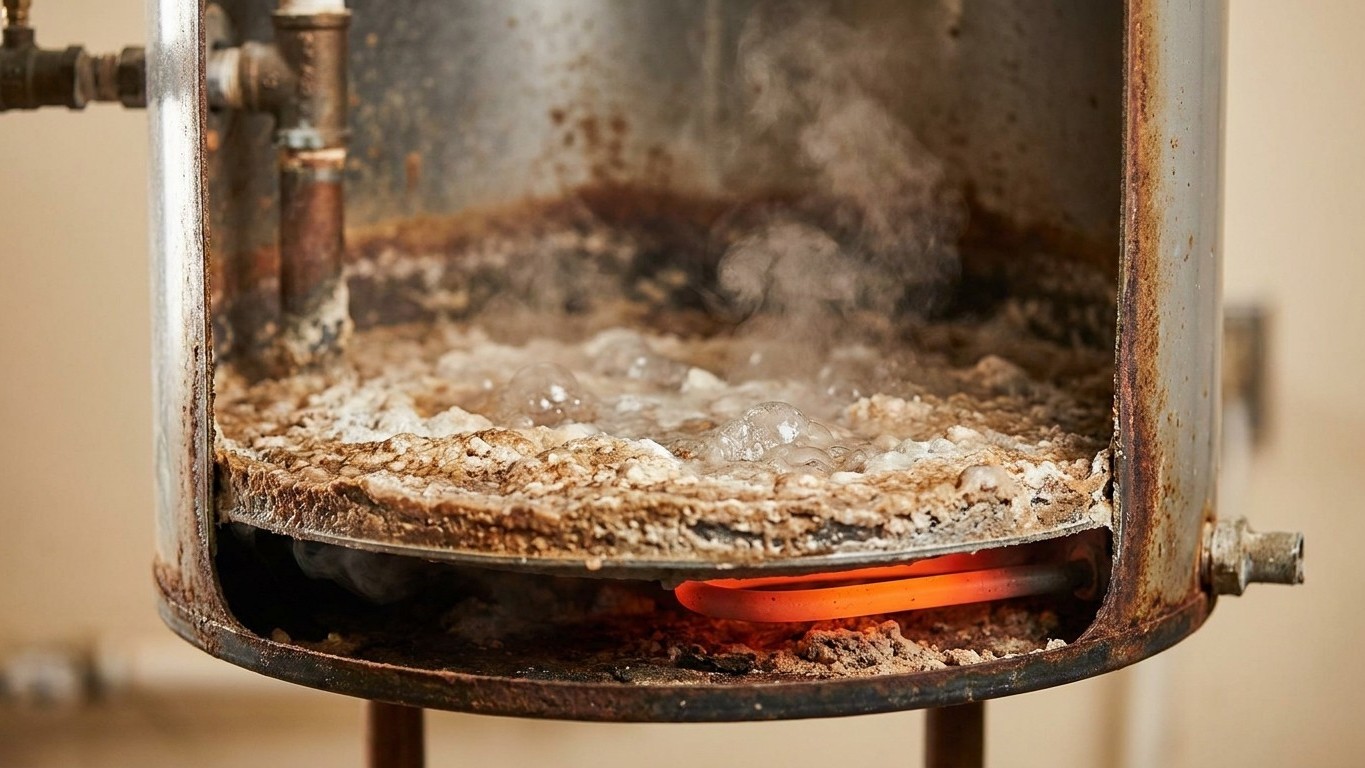

A water heater speaks in a limited vocabulary: rumbling, ticking, popping, screeching, banging. Each sound points to a specific mechanical cause, and most of them are harmless. The one exception, a low rumble that gets louder over months, usually means sediment has built up on the tank floor and is quietly costing you money every time the burner fires.
Rumbling is sediment boiling
Tank-style water heaters, gas or electric, sit water in a steel container that never fully empties. Over months and years, minerals in the water supply, mostly calcium and magnesium, settle out and collect on the bottom of the tank. In areas with hard water this layer can build fast. Once it thickens into a crust, something odd starts happening underneath it.
Water gets trapped between that mineral layer and the hot metal of the tank bottom. When the burner or the lower heating element fires, that trapped water boils before the rest of the tank does, because it’s sitting right against the heat source with nowhere to circulate. The steam bubbles that form have to fight their way up through the sediment crust to escape. That escape is what you’re hearing: a rumble, a series of pops, sometimes a sound close to a small pot boiling over. It’s mechanically similar to what happens in a kettle that’s scaled up inside, just contained in a sealed tank instead of an open pot.
What the noise is actually costing
The financial part matters more than the noise itself. A gas burner or an electric element under a sediment layer is spending part of every heating cycle warming mineral deposits instead of water. Heat has to pass through that insulating crust before it ever reaches the water above it, so the unit runs longer to hit the thermostat setting. Water heating already accounts for roughly 14% to 25% of the energy used in a typical home, according to the U.S. Department of Energy, and a heavily sedimented tank pushes a given household toward the higher end of that range simply by running less efficiently than it should.
There’s a second cost that shows up later: sediment sitting against the tank bottom accelerates corrosion in that spot, since it holds moisture against bare metal and can interfere with the sacrificial anode rod’s ability to protect the tank surface evenly. The rumbling isn’t dangerous by itself, but it’s a fairly reliable early warning that a maintenance step has been skipped. Draining and flushing the tank, a task most manufacturers recommend on some regular schedule, removes the loose sediment before it hardens into the kind of crust that causes the noise in the first place. If you haven’t flushed yours and the rumble has been building for a while, that’s the logical next step before assuming something’s actually broken.
Ticking and creaking
Most of the noises a water heater makes have nothing to do with sediment, corrosion, or anything approaching a repair. They’re the sound of metal responding to heat, which is exactly what metal does. Copper and steel pipe expand slightly when hot water runs through them and contract again as they cool. Where a pipe passes through a wooden joist, a plastic clamp, or a metal strap, that tiny movement produces a tick, a creak, or a soft pop as the pipe rubs or slips against the fastener. It’s the same physics behind hardwood floors creaking as a house’s Temperature shifts through the day, just happening inside a wall cavity instead of underfoot.
Heat traps built into the inlet and outlet nipples on top of many tanks do something similar. These small devices are designed to stop unwanted convection, hot water rising up and out of the tank through the pipes when nothing is even running, which would otherwise waste energy around the clock. As they open and close with temperature changes, they can produce a faint ticking of their own. It’s a sign the part is functioning, not failing.
Where the thermostat setting fits in
Temperature swings are part of why these sounds happen at all, and how high you set the thermostat has a real effect on how often the tank cycles through heating and cooling. The Department of Energy recommends a thermostat setting of 120°F, describing that setting as comfortable for most household needs. It’s presented as a compromise rather than a fixed rule: a lower setting reduces both energy use and the risk of scalding at the tap, while a higher setting increases both. Households with someone especially vulnerable to scalding, young children or older adults, often lean toward the lower end of that range for that reason alone.
There’s a competing concern worth naming honestly. Water sitting in a tank at a cooler setting for long stretches is a recognized concern for bacterial growth, including Legionella, and this creates a genuine trade-off rather than a simple answer. No single temperature threshold is settled enough to print here, and any household with immune-compromised or medically vulnerable occupants should raise the question directly with a doctor or with the local water utility rather than relying on a general rule. For most healthy households, the 120°F guidance is the standard starting point, adjusted based on comfort and the specific people in the house.
One more note on why newer units may run differently than an older tank did: amended federal efficiency standards have pushed common electric storage water heaters toward the efficiency level of an entry-level heat pump water heater. A heat pump unit moves heat rather than generating it directly, and it can produce a low hum or a fan-like sound during operation that an older standard electric tank never made. That’s a different noise profile, not a malfunction, and it’s worth knowing if a newly installed unit sounds different from the one it replaced.
The ones that mean something else
A short list of sounds fall outside the normal rumble-and-tick pattern and are worth paying closer attention to. None of these are necessarily emergencies, but each one points to something mechanical that benefits from a look:
- A screech or whistle when water is running usually means a valve somewhere in the system, often the shutoff valve on the cold inlet, is only partially open. Water forced through a narrow opening creates the sound the same way air through a narrow gap makes a whistle. Checking that the inlet valve is fully open is the first, simplest step.
- A sharp bang right when a faucet or appliance shuts off is a different mechanism entirely, closer to a plumbing issue than a water heater issue. That’s the classic signature of water hammer, a pressure spike that happens when moving water is stopped abruptly. It’s covered in more depth in the site’s material on banging pipes, since the fix usually involves the plumbing system rather than the tank itself.
- A steady hum from an electric unit that wasn’t there before can be normal, especially on newer heat pump models, but a hum that’s new, louder than before, or paired with the unit running constantly is worth having checked, since it can point to an electrical component working harder than it should.
Gas and propane water heaters add a layer that electric units simply don’t have. A fuel-burning appliance produces carbon monoxide as a byproduct of combustion, and that gas is colorless and odorless, detectable only with a working alarm. Any household running a gas or propane water heater should have a carbon monoxide alarm installed and tested, regardless of what noise the tank is or isn’t making. An electric or heat pump water heater doesn’t burn fuel and doesn’t carry that particular risk. If a gas unit’s noise is paired with a smell, a pilot light that won’t stay lit, or soot around the burner access panel, that combination is a different category of problem than the noises covered above and calls for a qualified technician rather than a wait-and-see approach.
For most sediment-driven rumbling, the practical fix loops back to routine maintenance rather than replacement. The site’s guide on flushing a water heater walks through draining the tank and clearing loose sediment before it hardens, which is the step that resolves the majority of noise complaints without any parts replacement at all.
Common questions
Is a rumbling water heater dangerous?
Not immediately, but it signals sediment buildup that reduces efficiency and can accelerate tank wear over time. It’s a maintenance flag rather than an emergency, and it’s worth addressing before the sediment layer hardens further.
Why does my water heater tick after the hot water shuts off?
That’s almost always pipe or heat-trap movement as the metal cools and contracts. It’s one of the most common and least concerning sounds a water heater makes.
Should I lower my water heater’s temperature to stop the noise?
Temperature affects how often the unit cycles, and the Department of Energy’s 120°F recommendation is a reasonable starting point for most households. But noise reduction is a side effect, not the main reason to adjust it, and households with vulnerable occupants should weigh the scald-risk and bacterial-growth trade-offs with their doctor or water utility rather than adjusting based on sound alone.
Does an electric water heater need a carbon monoxide alarm?
No. Carbon monoxide is a byproduct of burning fuel, so the concern applies to gas and propane units, not electric or heat pump models, which don’t combust anything to produce heat.