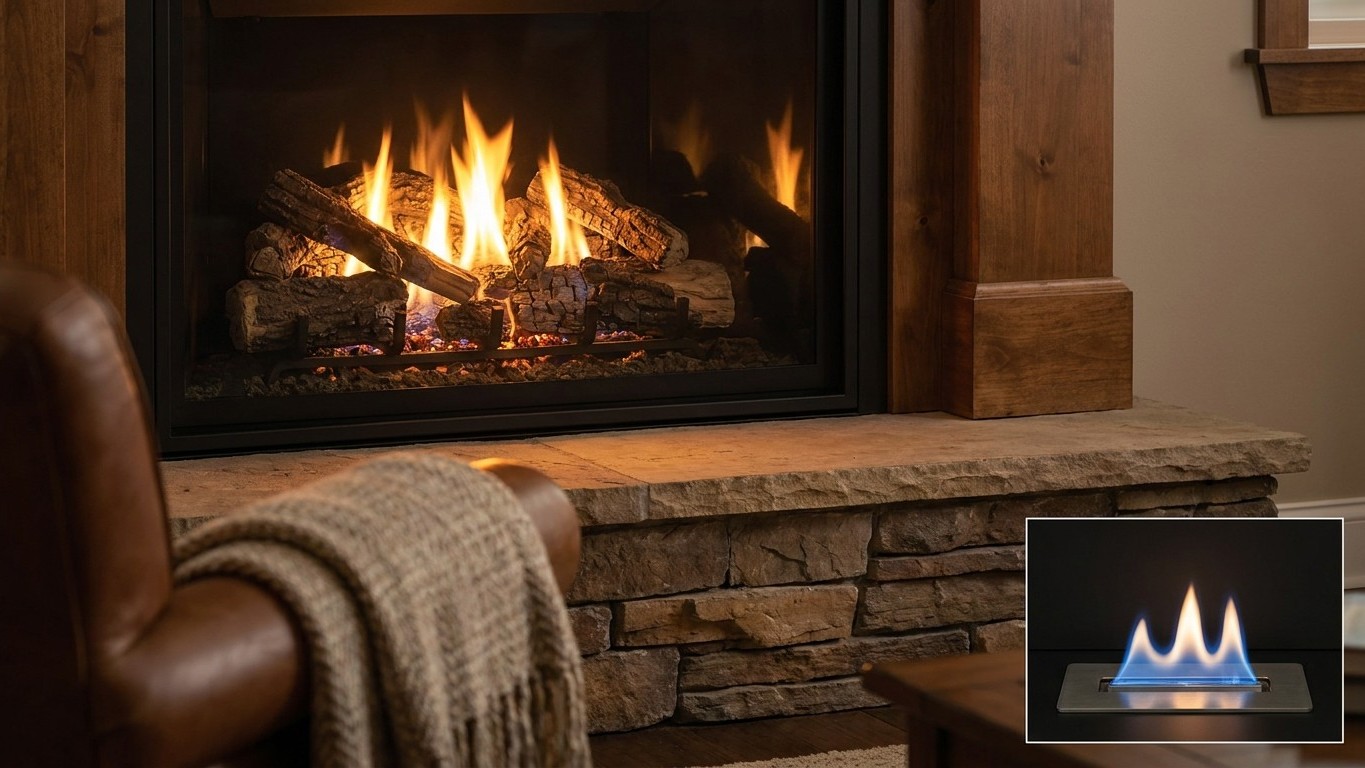

A yellow flame in a Gas Fireplace is often exactly what the manufacturer intended, not a warning sign. The real question isn’t “is it yellow,” it’s “does it look different from how it looked the day it was installed.” Height, steadiness, soot, and pilot light color all matter more than the base hue. When something has clearly shifted, that’s information for a technician, not a cue to start turning knobs yourself.
Yellow is not automatically wrong here

Anyone who grew up watching a gas cooktop learned a simple rule: blue means clean combustion, yellow means something’s off, maybe the burner needs cleaning or the gas-air mix is wrong. That rule is correct for a cooktop. It is the wrong rule for a decorative gas fireplace, and applying it leads a lot of homeowners to worry about an appliance that’s working exactly as designed.
A cooktop burner has one job: heat a pan efficiently, with no audience. A gas fireplace has a different job. It’s built to look like a wood fire, and wood fires burn yellow and orange, with flames that flicker, lean, and lick around logs unevenly. Manufacturers design the burner ports, the log placement, and the air mix specifically to produce that lazy, uneven, yellow-orange flame. A gas fireplace burning with a tight, uniform blue flame would look like a furnace pilot bolted into your living room wall, not a hearth.
Comparison over time, not a color chart
This is why there’s no universal “correct” flame color to check your fireplace against. The only meaningful comparison is your own appliance against itself. If it burned yellow and orange with occasional blue at the base when it was new, and it still does that a year later, nothing has changed. The flame pattern established at installation, on that specific log set, with that specific burner and air shutter setting, is the baseline. Everything else is read against that baseline, not against some ideal photo from a manufacturer’s brochure.
Some blue at the base of the flame is common and often desirable, since it usually reflects the air mixing efficiently with the gas right at the burner ports before the flame rises and takes on color from the log material and combustion further up. Vented gas fireplaces, which send combustion products outdoors through a flue, and vent-free units, which release everything including water vapor directly into the room, can both show this pattern. The distinction that matters isn’t blue versus yellow. It’s stable-and-consistent versus suddenly-different.
None of this replaces professional judgment. It just means a homeowner staring at orange and yellow flickering flames doesn’t need to assume the worst. That said, once a flame pattern actually changes, from what it was, the conversation shifts entirely, and that’s a different situation with different stakes.
What a change means
A stable flame pattern that suddenly shifts is the signal worth paying attention to. Not because a homeowner needs to diagnose the cause, but because a documented change is exactly the kind of detail a service technician needs to hear before they even walk in the door. The goal here isn’t fixing anything. It’s noticing accurately and reporting clearly.
The observations that actually matter, if you notice them, are worth writing down or photographing right away:
- Flames noticeably taller or shorter than they’ve been on the same setting
- Flames lifting off the burner instead of sitting close to it
- Soot appearing on glass, logs, or nearby surfaces where there was none before
- A pilot light that has shifted from blue to yellow
Each of these points to a possible change in the air-to-gas ratio, a partial blockage, a ventilation problem, or a component that’s drifted out of adjustment. A pilot flame turning yellow is particularly worth flagging, since the pilot burns in a much more controlled, isolated environment than the main flame, so a color shift there tends to be a cleaner signal than variation in the larger, more decorative main burner flame.
Report it, don’t adjust it
These four signs are reports for a technician, not adjustments to make yourself. This distinction matters. A homeowner who sees lifting flames and reaches for the air shutter or gas valve is troubleshooting a combustion appliance without the equipment to measure carbon monoxide output, verify venting, or confirm the burner orifice is sized correctly for the gas type in use. That’s a technician’s job, and it’s why the U.S. Fire Administration recommends that heating equipment and chimneys be “cleaned and inspected each year by a professional.”
Unvented appliances raise the stakes on this kind of observation. Because these units have no outside vent for combustion byproducts and rely entirely on ordinary room ventilation, according to the U.S. Consumer Product Safety Commission, a change in flame behavior can be an early clue that airflow or burner adjustment has drifted from safe operating conditions. Currently manufactured unvented gas room heaters include an oxygen depletion sensor under the industry’s voluntary standard, designed to shut off gas flow before carbon monoxide reaches a life-threatening level. That sensor is a backstop, not a reason to skip noticing changes yourself. Carbon monoxide has no color and no smell, so a working alarm in the home remains the only real detection method a household has, sensor or no sensor.
If at any point you smell gas rather than just seeing a flame change, none of this applies. Leave the house and call from outside. That situation outranks every observation about flame color.
Log position changes the flame
The single most common reason a gas fireplace’s flame looks different after months of looking fine is also the least dramatic: someone moved the logs. It happens almost every time a fireplace gets cleaned. The glass panel comes off, dust gets wiped away, a log shifts an inch to reach a corner, and it goes back down in a slightly different spot. The flame afterward can look taller in one place, shorter in another, or lick around a log edge in a way it never did before.
This isn’t cosmetic drift. The log position is part of the certified appliance, tested and approved by the manufacturer as a complete system, burner plus logs plus their exact placement. Moving a log even slightly can redirect where the flame contacts material, change how much yellow coloring the flame picks up from that contact, and in some cases affect how completely the gas burns. A log resting where it shouldn’t can also create the sooting or lifting flames described in the previous section, without any actual mechanical fault in the burner itself.
Photograph before you touch anything
The fix for this is almost embarrassingly simple, and it has nothing to do with adjusting valves or air shutters. Before cleaning, dusting, or doing anything else that involves handling the logs, take a photo of exactly how they sit, from more than one angle if possible. That photo becomes the reference for putting everything back exactly where it was, which is the surest way to keep the flame pattern consistent from one season to the next.
For the full rundown on what routine gas fireplace maintenance should and shouldn’t involve, including how logs, glass, and vents fit into an annual service visit, see our gas fireplace maintenance guide. The U.S. Fire Administration’s broader safety guidance applies here too: keep anything that can burn “at least 3 feet from all heat sources including fireplaces, wood stoves, radiators, space heaters or candles,” a rule worth remembering any time logs, screens, or nearby furniture get rearranged during cleaning.
If logs were recently moved and the flame now looks off in one of the ways described earlier, taller, lifting, sootier, or paired with a pilot that’s changed color, the first step is simply comparing against that pre-cleaning photo. Often, repositioning the logs back to their original spot resolves the change without any technician visit at all. If it doesn’t, that photo is also useful information to hand over when you do call for service.
Common questions
Should a gas fireplace flame ever be completely blue?
Not necessarily, and for most decorative log-set fireplaces, a fully blue flame would actually look wrong, since these appliances are designed to mimic a wood fire’s yellow-orange color. Some blue at the base is normal and often a sign of good air mixing at the burner.
Is a yellow pilot light as normal as a yellow main flame?
No. The pilot burns in a smaller, more controlled setting, so a shift from blue to yellow there is a more direct signal worth reporting to a technician than color variation in the larger main flame.
Can I adjust the flame myself once I notice a change?
That’s not recommended. Flame height, lifting, and sooting point to combustion or ventilation issues that need a technician’s tools and training to diagnose properly, particularly on unvented appliances where room ventilation plays a direct role in safety.
Does moving a log really change how the fireplace burns?
Yes. Log position is part of the certified appliance design, and shifting a log even slightly can change flame height, color, and contact points enough to look like a completely different fire, without any actual fault in the burner.