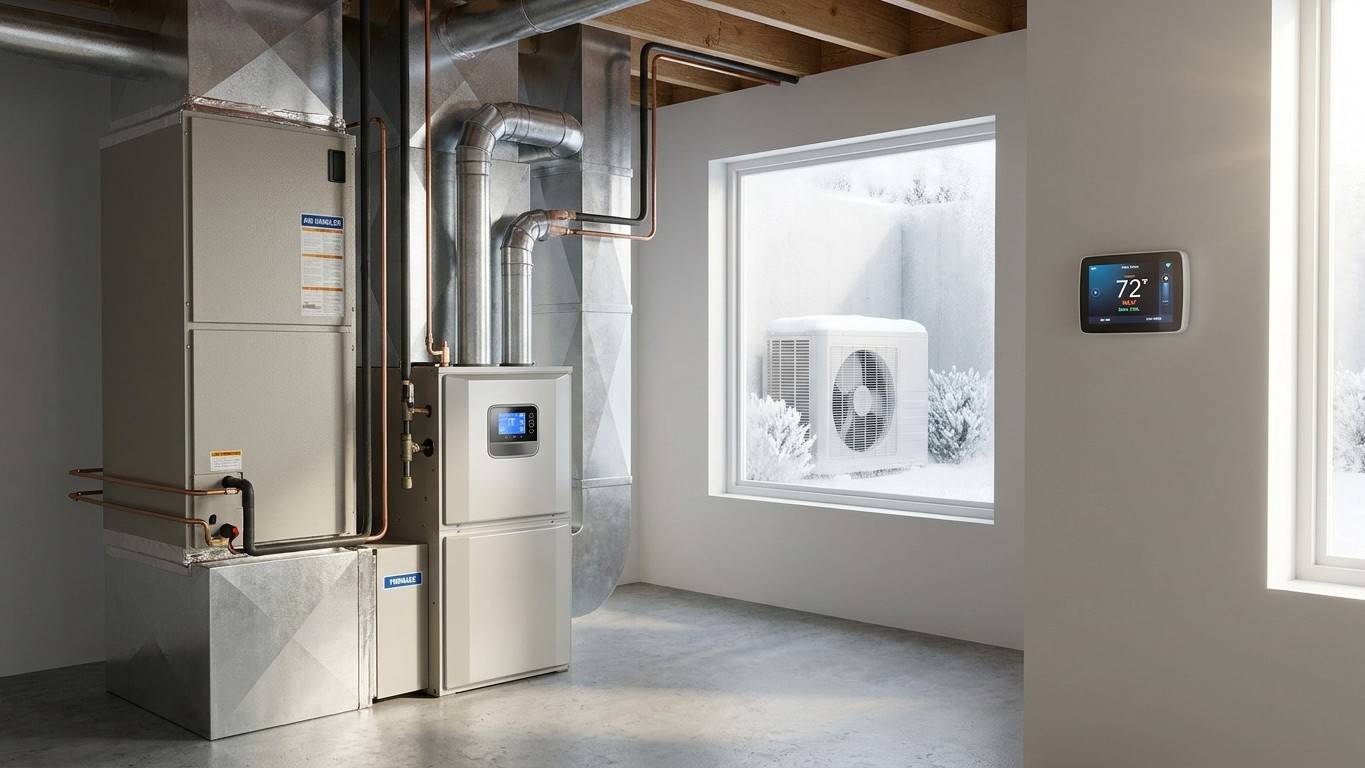

A dual-fuel heat pump system pairs an electric heat pump with a fuel-burning furnace, wired to a single Thermostat that decides which one runs. The heat pump handles heating on all but the coldest days, since it moves heat rather than creates it. When outdoor temperatures drop past a point the installer programs into the control, the system hands the job to the furnace, which burns gas, oil, or propane to produce heat directly. Both share the same ductwork.
Two heat sources, one Thermostat
The mechanical part is simple enough to picture: an outdoor heat pump unit and an indoor furnace sit in the same air handler cabinet, or close to it, both tied into the same duct system. A control board, sometimes built into the thermostat and sometimes a separate module, watches the outdoor temperature and the call for heat, then routes power to whichever unit is supposed to be working at that moment. The homeowner sees one thermostat. Behind the wall, two entirely different machines are taking turns.
A heat pump moves heat rather than generating it. It pulls warmth out of outdoor air, even cold outdoor air, and pumps it inside using the same refrigeration cycle that runs an air conditioner in reverse. That process is efficient, but it has a physical limit: as outdoor air gets colder, there is less heat in it to extract, so the amount the heat pump can deliver per hour falls off. A furnace does not have that problem. It burns fuel and produces heat directly, at a rate that barely changes whether it is 40°F or well below freezing outside.
Putting the two together lets a house use the heat pump where it does its best work, on mild and moderately cold days, and lean on the furnace only when outdoor conditions push past where the heat pump’s output starts to shrink. That is the entire logic of a dual-fuel setup. It is not about running both machines at once, and it is not a backup system sitting idle waiting for the other to fail. It is a scheduled handoff, decided ahead of time by whoever commissioned the system, based on the heat pump’s own capacity curve and the house’s heating needs.
Homeowners sometimes assume the furnace is there for emergencies, the way a generator waits for a power outage. That is not quite right in a dual-fuel design. The furnace is a planned, recurring participant. In a place where several weeks a year run colder than the heat pump is expected to handle well, the furnace might carry a meaningful share of the season’s total heating hours, not just a rare backup shift. How large that share turns out to be depends entirely on the local climate and on where the changeover point was set, which is the subject of the next section.
The changeover point, and who sets it
Every dual-fuel system has a changeover point: a control setting that tells the system to stop calling for the heat pump and start calling for the furnace instead. It sounds like a fixed engineering fact, something baked into the equipment. It is not. The changeover point is a number entered into the thermostat or control board during installation, and it can be changed afterward by anyone with access to the settings.
That distinction matters more than it looks like it should. Two identical heat pump and furnace combinations, installed in two identical houses, can be programmed with two different changeover points, and both installations would be considered correctly done. The number an installer picks depends on several things at once: how the specific heat pump model’s output declines as outdoor air gets colder (a curve found in that unit’s own performance specifications, not a rule of thumb), how well the house holds heat, and the relative cost of running the heat pump on electricity versus running the furnace on its fuel, a comparison that shifts whenever utility rates or fuel prices move.
Moving the changeover point lower, so the heat pump keeps running into colder weather before the furnace takes over, leans harder on the heat pump and shrinks the furnace’s share of the season. Moving it higher does the opposite, handing more cold-weather hours to the furnace and using the heat pump only in milder conditions. Neither direction is automatically right. It is a tradeoff between how much each machine works, not a safety setting, and there is no equipment failure risk in setting it too low or too high within the range the manufacturer allows.
This is also one of the more useful things to raise directly with an installer, before or after the system goes in. Three questions cover it: what is the changeover point currently set to, what reasoning went into that number, and can it be revisited later if fuel prices shift or the house’s Insulation changes. A number chosen once, during a single week of installation, is not necessarily the number that still makes sense two winters later. Reputable installers can usually explain their reasoning and adjust the setting without any hardware changes, since it lives in software, not in the machines themselves.
None of this touches the separate question of how cold is too cold for the heat pump half to keep up at all. That depends on the specific unit’s own capacity curve, published in its performance data, and on how the house loses heat. The manufacturer’s specification sheet, not a general rule, is what answers that for any particular installation.
The half that burns something
A dual-fuel system is really two systems stacked together, and only one of them burns fuel. The heat pump half burns nothing at all. It runs on electricity, moving heat rather than producing it through combustion, and it generates no carbon monoxide under any operating condition. Anyone whose home runs on a straight heat pump, with no furnace attached, does not need to read the rest of this section as it applies to their equipment.
The furnace half is a different story, because it burns gas, oil, or propane to produce heat, and any appliance that burns fuel indoors carries a carbon monoxide risk if it is not maintained or vented properly. This is where combustion safety practices apply, in full, to the furnace side of a dual-fuel system even though the heat pump side sitting right next to it is exempt from all of it.
The U.S. Consumer Product Safety Commission puts the maintenance expectation plainly: “CPSC urges consumers to schedule a yearly professional inspection of all fuel-burning home heating systems, including furnaces, boilers, fireplaces, wood stoves, water heaters, chimneys, flues and vents.” In a dual-fuel setup, that sentence is about the furnace, its venting, and its flue, not about the outdoor heat pump unit standing beside it. The heat pump doesn’t need a combustion inspection because it has no combustion to inspect.
Working carbon monoxide detectors near sleeping areas remain part of the standard advice for any home with a fuel-burning appliance, dual-fuel or not. For the fuller picture on where to place detectors, what symptoms to watch for, and how furnace venting problems develop, the carbon monoxide guide on this site covers it in more depth than fits here. The short version for a dual-fuel household: treat the furnace half exactly as you would a standalone furnace, because for safety purposes, that is what it is.
When it makes sense, and when it does not
Whether a dual-fuel setup is worth considering depends heavily on what is already sitting in the house and what the local climate and fuel market look like. Federal survey data gives a sense of how differently households already heat, even within the same broad region. According to the U.S. Energy Information Administration’s 2020 Residential Energy Consumption Survey, Maryland households heat 64% with a furnace and 19% with a central heat pump. In Washington state, it’s 47% furnace and 9% central heat pump. Maine runs 46% furnace, with 31% on a steam or hot-water boiler, and its central heat pump figure was not reported in the survey, which means the sample was too small or the estimate too unreliable to publish, not that the number is zero.
Those differences reflect climate, fuel availability, and housing stock built up over decades, and they hint at where a dual-fuel arrangement tends to get considered versus where it rarely comes up.
| Situation | How it tends to fit a dual-fuel setup |
|---|---|
| House already has a working furnace and ductwork | Often the most straightforward case: the furnace stays, a heat pump is added to the existing ducts |
| House is on an expensive heating fuel | A common reason to add a heat pump alongside the existing furnace, so the furnace runs less often |
| Mild climate where a furnace would rarely run | The furnace ends up as a small, occasional contributor rather than a major heat source |
| No gas supply or fuel delivery to the house at all | Dual-fuel doesn’t apply; the choice is a straight heat pump or another all-electric option |
None of this settles the question on its own. A furnace that is already old and near the end of its service life changes the calculation, and so does a house with ductwork in poor condition, but those are separate considerations from the dual-fuel arrangement itself. The RECS figures above are a starting point for understanding how common each heating pattern already is in a given region, not a formula for deciding what any one household should install.
Common questions
Does the furnace run at the same time as the heat pump?
No. In a standard dual-fuel setup, the control hands the heating load from one to the other; both units are not producing heat simultaneously under normal operation.
Can the changeover point be adjusted after installation?
Yes. It’s a setting in the thermostat or control board, not a fixed property of the hardware, and an installer or qualified technician can revisit it.
Does the heat pump half need a yearly combustion inspection?
No. The heat pump burns nothing and produces no carbon monoxide. The yearly inspection recommendation applies to the furnace half of the system.
What decides how cold it can get before the furnace takes over?
The heat pump’s own capacity curve, published in its manufacturer specifications, combined with how the house holds heat. There’s no single temperature that applies across all models.