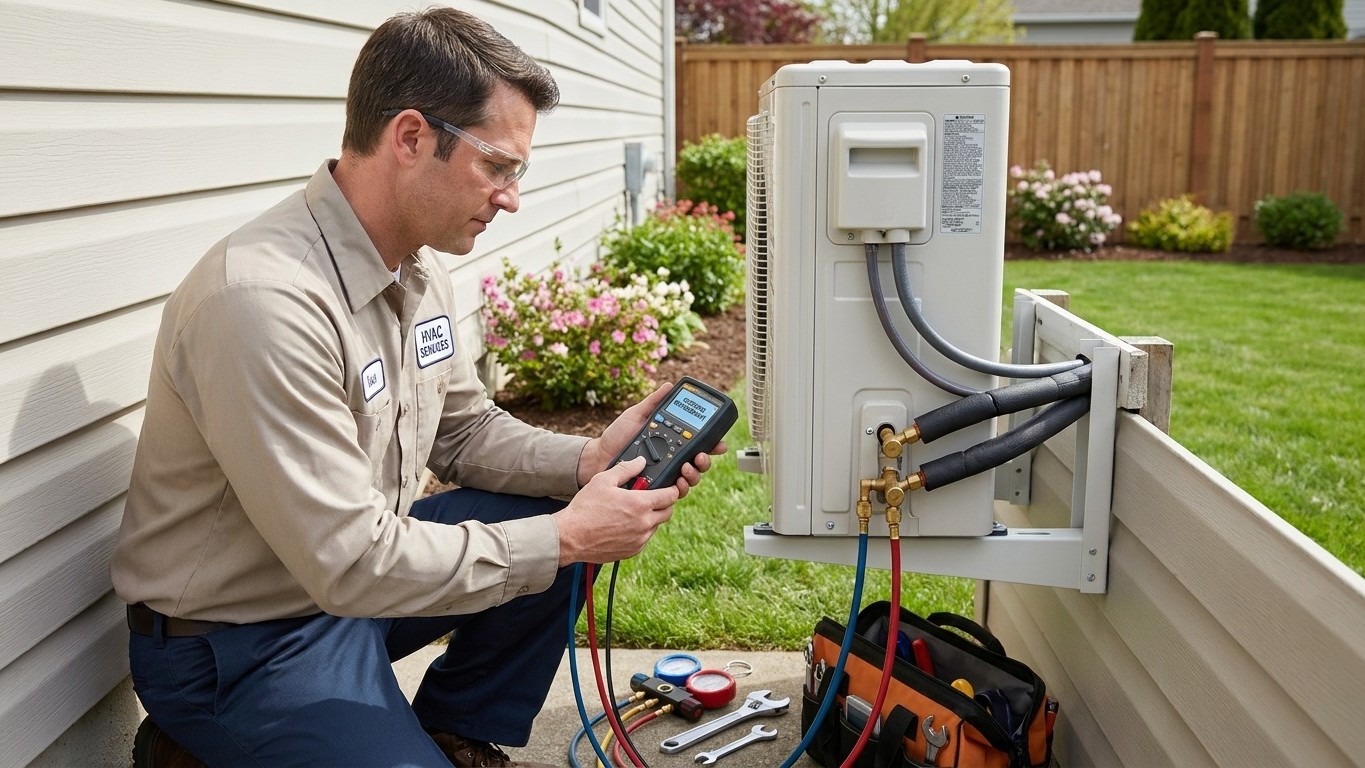

A heat pump needs a professional look twice a year, not once, because it never gets a season off. It heats the house in January and cools it in July, running through both extremes with no downtime to expose a slipping refrigerant charge or a dirty coil before it becomes a habit. The owner’s side of the work happens monthly. The professional side happens at each seasonal changeover, once before cooling season and once before heating season, because each changeover asks a different half of the machine to carry the load.
It works all year, so it is serviced twice

A furnace shuts down for the summer. A cooling-only condenser sits dormant all winter, which is why it gets its own winterizing routine. A heat pump does neither. The same outdoor unit that cools the house in August is heating it in December, using a reversing valve to flip the refrigerant cycle from one job to the other. There is no idle season during which a small problem quietly waits to be found. Whatever is wrong keeps running.
That continuous duty is exactly why the maintenance calendar splits in two. A spring visit, ahead of cooling season, checks the side of the system about to carry summer load. A fall visit, ahead of heating season, checks the side about to carry winter load, including the defrost cycle that a cooling-only system never has to manage. Skipping one visit doesn’t just delay a checkup, it lets six months pass on the untested half of the machine.
The one job that belongs to the owner, every month, in every season
Before any professional visit matters, the filter has to be clean, and this is the rare case on this site where a national guideline names the heat pump directly instead of talking around it. The U.S. Department of Energy’s ENERGY STAR program puts it plainly: “Inspect, clean, or change air filters once a month in your central air conditioner, furnace, and/or heat pump.” Most consumer advice defaults to furnaces and air conditioners and leaves heat pumps as an afterthought. This one doesn’t. A heat pump moves air through the same ductwork and the same filter slot as a furnace or central AC, and it does it twelve months a year instead of six, which means a filter that would last a season on a furnace clogs twice as fast on a heat pump simply from added run hours.
What the owner does
Between the two professional visits, a short list of owner tasks keeps the system from drifting into trouble on its own. None of it requires opening the unit.
The monthly and seasonal checks
- Filter, monthly. Inspect, clean, or replace it on the same schedule ENERGY STAR recommends above. A heat pump’s continuous duty cycle makes this the single most consequential item on the list.
- Clearance around the outdoor unit, as specified. The manufacturer’s label on the unit states the required clearance for airflow on all sides. That label governs, not a generic rule of thumb, because clearance needs vary by model and cabinet design.
- Leaves and debris off the coil and base. Grass clippings, cottonwood fluff, and fallen leaves settle into the outdoor coil fins and pile up around the base pan. Clear them by hand or with a soft brush; a garden hose can rinse the coil from the inside out if the manufacturer’s guidance allows it.
- Base drain kept clear. The pan under the outdoor unit needs a path for condensate and defrost water to leave. A blocked drain lets water pool and refreeze around the cabinet.
- Registers and returns unblocked indoors. Furniture, rugs, and curtains pushed over a supply register or return grille choke airflow just as effectively as a dirty filter does.
Airflow is not a minor detail here. ENERGY STAR is specific about the cost of ignoring it: “Airflow problems can reduce your system’s efficiency by up to 15 percent.” A single blocked return or a filter overdue by a few months is enough to reach that range.
Before you touch anything outside
Power the unit off at the outdoor disconnect before clearing debris, rinsing the coil, or reaching near the base pan. Leave the electrical compartment closed. A run capacitor inside stores an electrical charge even after the unit is switched off, and that charge is a job for a licensed technician, not a homeowner with a garden hose.
The things that only matter in winter
Most maintenance checklists in circulation were written with air conditioners in mind, then relabeled for heat pumps without updating the details that actually change. Winter is where the gap shows up, because a heat pump’s outdoor unit has to keep functioning through conditions a cooling-only condenser never sees.
Snow, meltwater, and drainage
The unit needs to stand clear of accumulated snow and of its own meltwater, not just fallen leaves. A defrost cycle periodically melts frost off the outdoor coil and sends that water down through the base pan, so the drain path has to stay open through freezing weather, not just through a summer thunderstorm. Nothing should drip onto the unit from a roof edge or a gutter above it either; that runoff refreezes on the cabinet and around the base, working against the same defrost cycle that’s supposed to keep the coil clear.
Why covering it is the one mistake specific to a heat pump
Covering a central air conditioner for the winter is standard advice, and this site has a separate guide for winterizing a cooling-only condenser that walks through exactly how. None of that applies to a heat pump. A cooling-only condenser sits idle all winter and a cover keeps debris out of a machine that isn’t running. A heat pump is running, heating the house, cycling through defrost, and moving air through that same outdoor coil in January. A cover traps moisture against the cabinet, blocks the airflow the unit needs to operate, and turns a routine defrost cycle into a real problem. If a winterizing checklist tells you to cover the outdoor unit, it was written for the cooling-only half of the industry, not for a heat pump.
What a professional visit adds
Everything in the owner’s list keeps the system from choking on the obvious. It doesn’t measure what’s happening inside the sealed refrigerant circuit or confirm that the controls are making the right decisions, and that gap is what a professional visit is for.
What actually gets checked
A technician checks the refrigerant charge against the manufacturer’s specification, verifies that the defrost control is cycling correctly rather than running too often or not enough, measures actual airflow across the coil rather than assuming the filter and clearance checks were enough, inspects the reversing valve to confirm it switches cleanly between heating and cooling modes, and checks that backup heat stages actually stage in sequence rather than all firing at once or not firing when needed.
For a ducted system, there’s a documented reason to also look at the duct system itself. ENERGY STAR notes: “In a typical house, however, about 20 to 30 percent of the air that moves through the duct system is lost due to leaks, holes, and poorly connected ducts.” That number describes ductwork, not the heat pump itself, and it has nothing to do with a ductless system, which delivers air directly into the room and has no duct run to leak from.
Get it in writing
Ask for the findings from each visit in writing, refrigerant readings, defrost cycle notes, airflow measurements, whatever was checked. A written record from the spring visit is the baseline the fall technician compares against, and vice versa. No price should be part of that conversation here; what matters is what was measured, not what it cost.
Common questions
Is it normal for the outdoor unit to have frost on it in winter?
Yes. Frost forms on the outdoor coil during normal winter operation and clears on its own during a scheduled defrost cycle. A thin, temporary frost layer is expected behavior, not a fault.
Why does the air from the vents feel cool even when the heat pump is heating?
A heat pump delivers air at a lower temperature than a furnace does, over a longer run time, which is normal for the technology and not a sign the system is failing to heat the house.
Does a ductless heat pump need the same duct check as a ducted one?
No. The duct-leak figure from ENERGY STAR applies only to systems with ductwork. A ductless unit has no ducts to leak from, so that part of a professional visit doesn’t apply.
Should I cover the outdoor unit during a winter storm?
No. A heat pump keeps operating through the winter, and a cover blocks the airflow and defrost function it needs. Covering applies to cooling-only condensers that sit idle all winter, not to a heat pump.