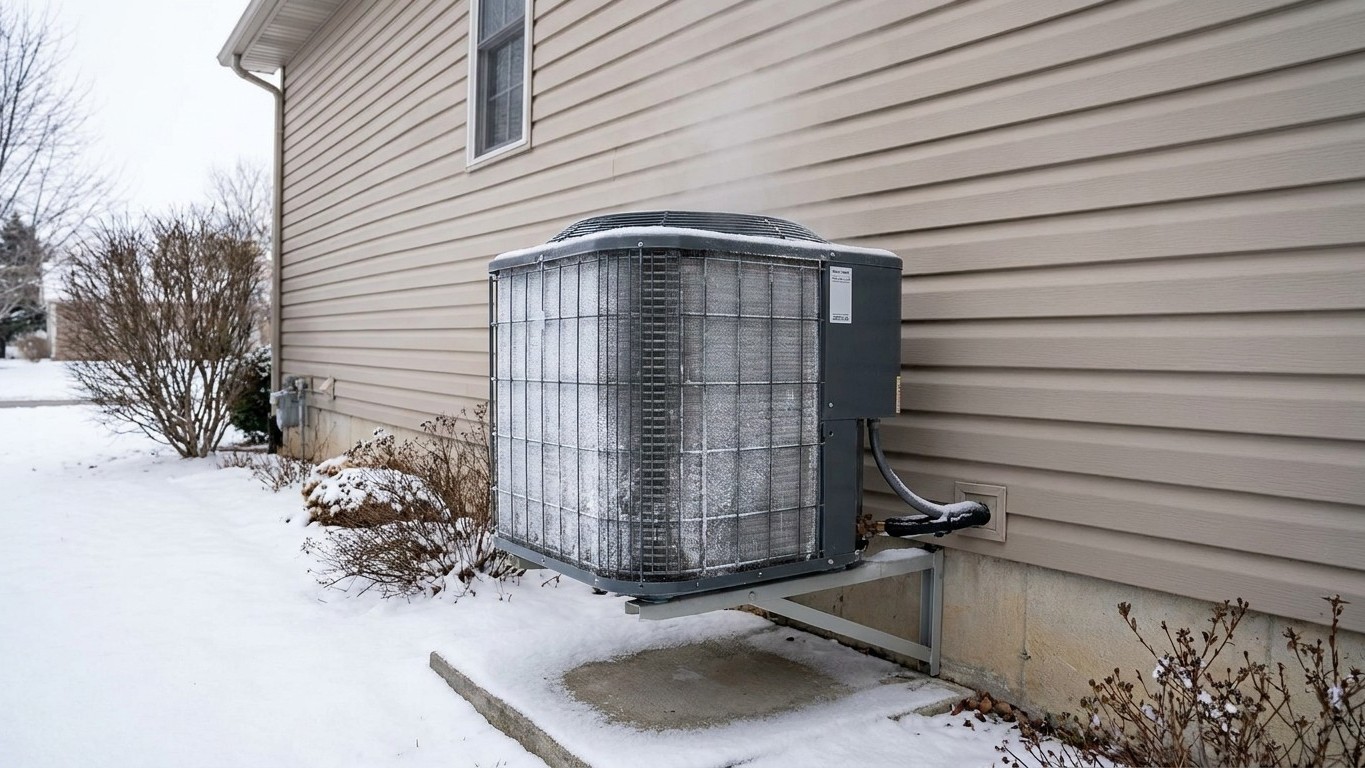

A heat pump that seems to have quit is usually doing exactly what it’s designed to do. Warm-but-not-hot air, a pause with steam curling off the outdoor unit, frost on the coil, near-constant running on a cold day: all four are normal behavior, not failure. The real test isn’t how the air feels at the register. It’s whether the house is actually losing ground, or the system just hasn’t caught up yet. This piece sorts the four common false alarms from the checks worth doing yourself, and draws the line where a technician needs to take over.
Four things that look like faults

Most calls about a “broken” heat pump start with the same complaint: the air coming out of the vents doesn’t feel hot. That’s expected. A heat pump moves heat rather than burning fuel to create it, so supply air typically runs warm, somewhere in the 90s Fahrenheit, rather than the blast of hot air a gas furnace produces. Warm is the design, not a symptom.
The second false alarm is the defrost cycle. Every several minutes on a cold, humid day, the outdoor unit may briefly stop, and you might see what looks like steam rising off it. That’s the unit clearing frost off its coil so it can keep pulling heat from the outdoor air. During defrost, the indoor blower may pause or blow cool air for a short stretch. It’s a built-in maintenance step, not the compressor giving up. For the mechanics of when and why this happens, the defrost cycle guide on this site walks through it in detail.
Third: frost or a thin layer of ice on the outdoor coil, especially on damp, near-freezing days. Some frost is routine and gets cleared by the defrost cycle described above. It only becomes a problem when ice builds up thick and stays there between cycles, which points to a different issue than the system simply running.
Fourth, a heat pump that runs almost continuously in cold weather isn’t laboring. Unlike a furnace that fires, satisfies the Thermostat, and shuts off, a heat pump is often more efficient running longer at a lower output than cycling on and off hard. Long runtimes on a cold day are how the equipment is meant to behave.
The actual test
Two questions separate normal behavior from a real fault. Does the system resume on its own after a defrost pause, without you touching anything? And is the house actually losing ground, meaning the indoor temperature keeps dropping below the setpoint, rather than just taking a while to catch up on a cold morning? If defrost ends and the system resumes, and the house is holding steady even if slowly, nothing here needs a call.
The free checks, in order
Once you’ve ruled out the four normal behaviors above, work through these checks before assuming the equipment has failed. They’re ordered cheapest and fastest first.
- Confirm the Thermostat is set to HEAT, not AUTO or COOL. It sounds obvious, but a thermostat left in the wrong mode is a common, invisible cause of “no heat.”
- Check that the setpoint is actually above the current room temperature. A setpoint sitting at or below room temperature won’t call for heat at all.
- Inspect the filter. The U.S. Department of Energy’s ENERGY STAR program is direct about this: “Inspect, clean, or change air filters once a month in your central air conditioner, furnace, and/or heat pump.” That’s one of the few places where guidance names the heat pump specifically, rather than treating it like a furnace or an air conditioner by default.
- Look for blocked return grilles and closed or furniture-covered registers throughout the house. Airflow that’s choked off anywhere in the system drags down performance everywhere.
- Walk outside and check the outdoor unit for leaves, snow drifts, or an overgrown shrub crowding the cabinet. Airflow across that unit is how it exchanges heat with outdoor air, and anything smothering it cuts that exchange short.
- Check both breakers. Heat pump systems typically have separate breakers for the indoor air handler and the outdoor unit, and a tripped breaker on either half will stop the system, sometimes without any other obvious sign.
Airflow problems don’t just cause a total stoppage. They quietly erode performance long before anything seems wrong. ENERGY STAR puts a number on it: “Airflow problems can reduce your system’s efficiency by up to 15 percent.” That’s a meaningful loss from something as simple as a dirty filter or a blocked return, and it’s fully preventable with the monthly check above.
When the backup is doing all the work
The most expensive failure mode is also the hardest to spot, because nothing feels wrong inside the house. The heat pump itself has quietly stopped heating, and a backup heater, usually electric resistance strips or, on a dual-fuel setup, a furnace, has taken over the entire load. The rooms stay warm. The thermostat reads normal. Nothing seems out of place until the utility bill arrives in February and the number is startling.
A few signs give it away if you know to look. An AUX or EM indicator on the thermostat that stays lit for long stretches, rather than flashing on briefly during a defrost cycle or a sharp temperature swing, is one. An outdoor unit that never runs at all during cold weather, when you’d expect to see or hear it cycling, is another. And a sudden shift in how the supply air feels, from the usual warm-but-not-hot heat pump air to noticeably hot air, can mean the backup has taken over rather than the heat pump ramping up.
Catching this early matters because the backup heat isn’t a fault in itself; it’s designed to supplement or, in a real pinch, replace the heat pump temporarily. The problem is when it becomes the only source of heat for days or weeks without anyone noticing, because that’s when the electric bill (or the fuel bill, on a dual-fuel system) climbs fast, and it’s also often a sign the heat pump has an underlying issue that needs attention rather than the backup permanently covering for it. The guide to auxiliary heat on this site covers how the two systems are supposed to hand off, and what a normal amount of backup use actually looks like versus one running around the clock.
Where it stops being yours
Some parts of a heat pump are fair game for a homeowner to check: filters, breakers, clearance around the outdoor unit, thermostat settings. Others aren’t, and pretending otherwise risks turning a manageable repair into a bigger one. The reversing valve, which switches the system between heating and cooling by redirecting refrigerant flow, is sealed equipment. The refrigerant charge itself is regulated and requires certified handling to service. The compressor is the heart of the system and not something to open up. And the defrost control board, which manages those cycles covered earlier, is electronics best diagnosed by someone with the right equipment. If a technician tells you the system is “low on refrigerant,” that’s not something that happens on its own over time in a properly sealed system; it means there’s a leak somewhere that needs finding and fixing, not just a top-off.
One thing this article won’t do is hand you a temperature number below which a heat pump “stops working.” That threshold doesn’t exist as a single figure, because it depends entirely on the specific equipment and the specific house. Here’s the mechanism, though, and it’s straightforward: a heat pump extracts heat from outdoor air, so as that air gets colder, there’s simply less heat available to move indoors, and the system’s heating capacity falls as a result. Where that falloff starts to matter for your house, meaning where the heat pump alone can’t keep up and backup heat has to fill the gap, is answered by the equipment’s own specification sheet, not by a rule of thumb. That sheet is the accurate source for your specific model.
Before calling a technician, gather a few things that will speed up the visit: the model and serial number off the outdoor unit’s nameplate, a clear description of when the problem started and what you’ve already checked (filter, breakers, thermostat mode), the outdoor temperature at the time, and whether an AUX or EM light has been on. That short list often turns a diagnostic visit into a repair visit on the same trip.
Common questions
Is it normal for a heat pump to blow cool air sometimes in winter?
Yes, briefly. During a defrost cycle the indoor blower may pause or deliver air that feels cool for a few minutes while the outdoor coil clears frost. If cool air continues well beyond that short window, or the system never returns to warm air on its own, that’s worth a closer look rather than something to wait out.
Why does my heat pump run all day when it’s cold outside?
Long, steady runtimes in cold weather are typical behavior for this equipment, which is often more efficient running continuously at lower output than cycling hard on and off like a furnace. Long runtime alone isn’t a sign of trouble; a house that keeps losing ground despite that runtime is.
What’s the difference between the heat pump and the backup heat kicking in?
The heat pump produces warm, not hot, air and the outdoor unit runs to support it. Backup heat (electric strips or a furnace on a dual-fuel system) produces noticeably hotter air and often shows as an AUX or EM light on the thermostat. If that light stays on for extended periods and the outdoor unit sits idle in cold weather, the backup may be carrying the whole load.
Can I just add refrigerant myself if the heat pump seems weak?
No. Refrigerant handling requires certification, and a system that’s “low” on charge means refrigerant has leaked out somewhere, since a properly sealed system doesn’t lose charge on its own. Topping it off without finding and repairing the leak just delays the same problem.