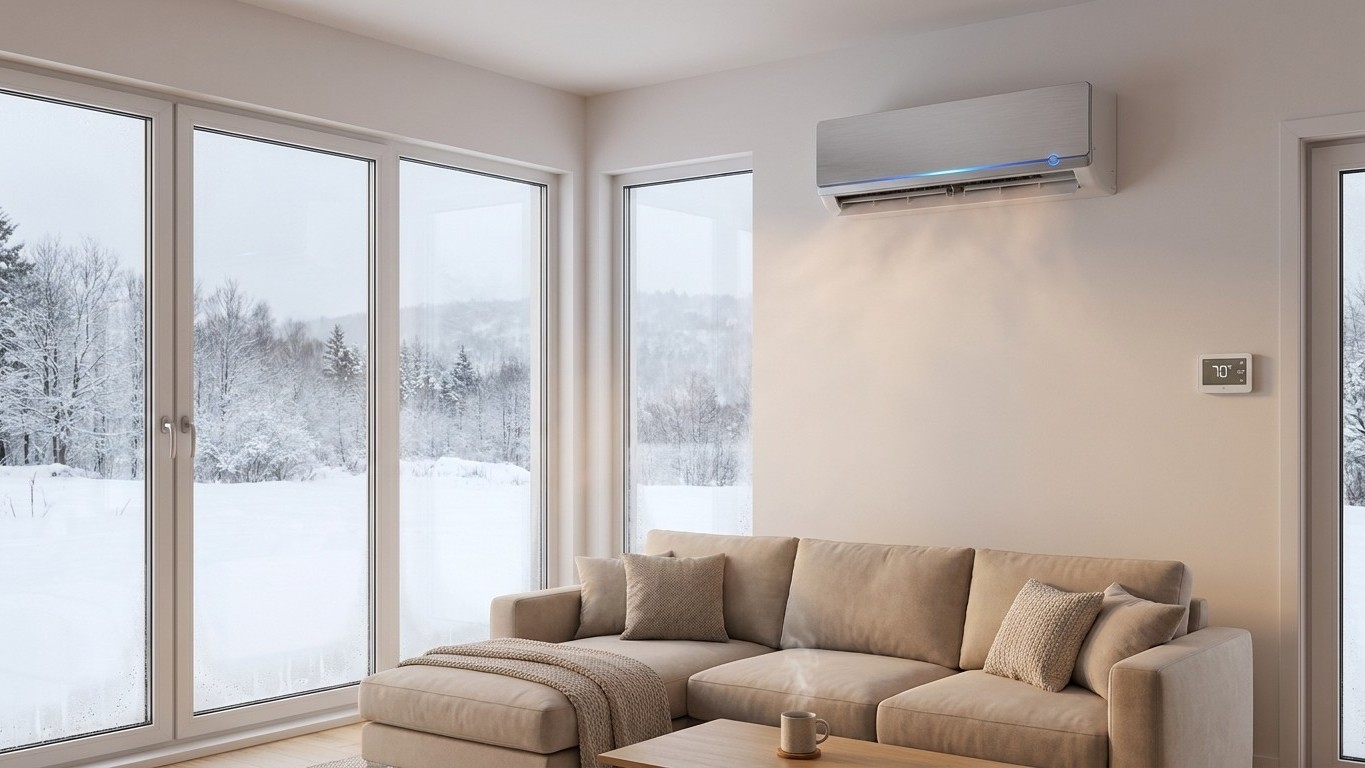

A heat pump that runs nonstop on a cold day is usually doing exactly what it was built to do. Furnaces cycle on and off because they blast heat in short, hot bursts. Heat pumps deliver a gentler, steadier stream of warmth, so they often run for hours, sometimes most of the day, without that being a fault. The real test isn’t the run time. It’s whether your house is holding its temperature while the system works.
It is designed to run long

Most people learned how heating equipment “should” behave from a furnace. A furnace fires, heats the air fast, satisfies the Thermostat, and shuts off. Quiet stretches feel like proof it’s working correctly. A heat pump doesn’t operate that way, and judging it by furnace habits sets you up to worry over nothing.
A heat pump moves heat rather than generating it in a quick burst. It pulls warmth out of the outdoor air and delivers it indoors at a lower, steadier temperature than a furnace’s hot blast. On a mild fall afternoon that’s plenty to keep up with the house’s heat loss, and the system might cycle on and off like you’d expect from older equipment. On a cold winter day, the outdoor air holds less usable heat, so the system has to work longer and harder to move the same amount indoors. Running for hours at a stretch, or all day, is the machine compensating for a harder job, not a machine in distress.
This is also why installers size and program these systems to run at lower speeds for longer periods rather than blasting and stopping. A heat pump running at a moderate speed continuously is often more efficient than one cycling on and off at full power, because starting and stopping wastes energy and never lets the system settle into its steady groove.
None of that means every long run time is fine to ignore. The honest question isn’t whether the system runs continuously in cold weather. It’s whether the house is holding its set temperature while it does. If the Thermostat reads close to what you asked for and stays there, a long run time is the design working as intended. If the temperature keeps sliding backward while the unit runs flat out, something downstream of “it’s cold outside” is going on, and that’s worth chasing down.
When continuous running is a symptom
The distinction between normal and worth-checking comes down to what else is happening while the system runs. A few patterns show up again and again, and each one points somewhere different.
| What’s happening | What it points to | Where to look next |
|---|---|---|
| Running constantly, holding the set temperature | Normal cold-weather operation; the system is matched to the load | No action needed |
| Running constantly, losing ground on temperature | Capacity shortfall: undersized system, failing component, or unusual heat loss | Sizing guide; technician inspection |
| Running constantly in mild weather | Airflow restriction, thermostat setting, or a system that isn’t actually undersized but is being asked to do more than it should at that outdoor temperature | Filter and airflow checks below |
| Running constantly with the backup heat lit | Outdoor temperature has dropped below the heat pump’s efficient range for that model, or the system can’t keep pace on its own | Dual-fuel and backup-heat guide (backup-heat half only) |
| Short cycling: turning on and off frequently instead of running long | The opposite complaint, usually oversizing, a thermostat problem, or a refrigerant or electrical fault | Short-cycling guide |
The middle rows are where most confusion happens. A system running constantly in weather that isn’t particularly cold often has an airflow problem rather than a capacity problem. Something is restricting the amount of air the unit can move, so it has to run longer to push the same amount of heat through the house. That’s mechanically different from a system that’s simply too small, and it’s usually far cheaper to fix.
Backup heat kicking on is its own case and deserves its own read, since it involves a second heat source working alongside the heat pump rather than the heat pump itself. If your system pairs a heat pump with a furnace or electric resistance backup, treat that as a separate question from the heat pump’s own performance; the two operate under different rules and the backup-heat guide walks through when that pairing is normal.
Short cycling deserves a mention here mainly so it doesn’t get confused with this issue. It’s the mirror image: a system that won’t settle into a long run and instead starts and stops repeatedly. That points to different causes entirely, and mixing the two up sends you chasing the wrong fix.
The causes worth checking
When a heat pump is running long in weather that doesn’t obviously call for it, or losing ground on temperature while it runs, a handful of causes account for most cases. Check them in order of cost and effort, cheapest first.
- The filter. A dirty filter is the single most common airflow restriction, and it’s the cheapest to fix. ENERGY STAR advises to “Inspect, clean, or change air filters once a month in your central air conditioner, furnace, and/or heat pump.” That monthly habit alone resolves a surprising share of “why is this running so much” calls.
- Blocked returns and registers. Furniture pushed against a return grille, a closed register in a rarely used room, curtains draped over a vent: all of it restricts the air the system needs to move efficiently. ENERGY STAR notes that “Airflow problems can reduce your system’s efficiency by up to 15 percent,” and a blocked register is airflow trouble just as much as a dirty filter is.
- The outdoor unit obstructed. Leaves, snow drifts, tall grass, or anything piled against the outdoor cabinet limits how much outdoor air the unit can pull in and process. Keep the area around it clear according to the manufacturer’s guidance for that model.
- The thermostat set higher than the system can currently reach. Pushing the setpoint up when the house feels cool can make the system run continuously chasing a target it was already working toward. Give it time before assuming it’s failing.
- The house losing heat faster than usual. A door left cracked, an attic hatch not latched, a fireplace damper left open: any of these lets conditioned air escape and pulls in cold air, and the system will run harder trying to compensate for a loss that has nothing to do with the equipment itself.
- Duct losses, on systems that use ducts. Leaky or poorly sealed ductwork lets heated air escape into an attic, crawlspace, or wall cavity before it ever reaches a room, and the system runs longer to deliver the same comfort at the thermostat. This applies to ducted systems only; a ductless system doesn’t have this failure point.
Working through this list usually surfaces the cause within an afternoon, and most of the fixes cost nothing beyond a filter or a few minutes clearing debris. If you’ve gone through all of it and the system still can’t hold temperature in cold weather, the answer may not be a fix at all.
Or the system is simply too small for the house
Sometimes the honest conclusion is the one people resist: a heat pump that never quite satisfies on the coldest days, even with a clean filter, clear vents, and an unobstructed outdoor unit, may be correctly working and simply undersized for the space it’s asked to heat. That’s not a defect. It’s a mismatch between equipment and load, and it can happen even when the system was sized correctly at installation.
Houses change. A finished attic, a converted garage, a room addition, or even swapping single-pane windows for something less airtight in one direction and more airtight in another all shift how much heat the house loses on a cold day. A system sized for the house as it existed years ago may be perfectly matched to a floor plan that no longer exists. The equipment hasn’t gotten weaker; the job got bigger.
A heat pump works by pulling heat out of outdoor air and moving it inside, and as that outdoor air gets colder, there’s simply less heat available to move. Capacity naturally falls as the temperature drops. Exactly where that fall starts to matter for your house depends on the specific model and on how much heat your house loses on a cold day, and that’s a question the equipment’s own specification sheet is built to answer, not a rule of thumb. If you’re troubleshooting a specific unit’s cold-weather limits, that documentation is the place to look rather than a general guideline.
Settling the sizing question for good means running an actual load calculation for the house as it stands today, not as it stood when the system went in. That calculation accounts for square footage, Insulation levels, window performance, air leakage, and local climate together, and it’s the only reliable way to know whether a system is undersized, correctly sized for a harder job than it used to have, or fine and simply doing what cold weather asks of it. The sizing guide on this site walks through how that calculation works and what it takes into account.
Insulation and air sealing change the answer more than most homeowners expect. Tightening up an attic, sealing gaps around ducts and penetrations, or upgrading insulation in a converted space can reduce the heat loss enough that an existing system, once thought too small, turns out to be adequate after all. Before assuming new equipment is the fix, it’s worth working through the insulation guides on this site, since the cheaper fix sometimes lives there rather than in a bigger unit.
Common questions
Is it normal for a heat pump to run 24 hours a day in winter?
Yes, on the coldest days this is common and expected. What matters is whether the house holds its set temperature while the system runs continuously. If it does, the long run time reflects the system’s design, not a problem.
Does constant running mean my heat pump is working harder or wearing out faster?
Constant running in cold weather reflects outdoor conditions asking more of the system, not necessarily excess wear. Frequent starting and stopping is generally harder on equipment than a steady, sustained run.
Why does my heat pump run more than my neighbor’s on the same cold day?
Differences in house size, insulation, air sealing, window performance, and equipment capacity all affect how long a system needs to run to hold the same indoor temperature. Two houses on the same street can have very different heat loss.
Should I turn the thermostat down if the heat pump won’t stop running?
Only if the house is actually overheating past the setpoint, which would be unusual. If the house is holding at or near the set temperature, the system is doing its job and lowering the setpoint won’t tell you anything useful about whether it’s working correctly.