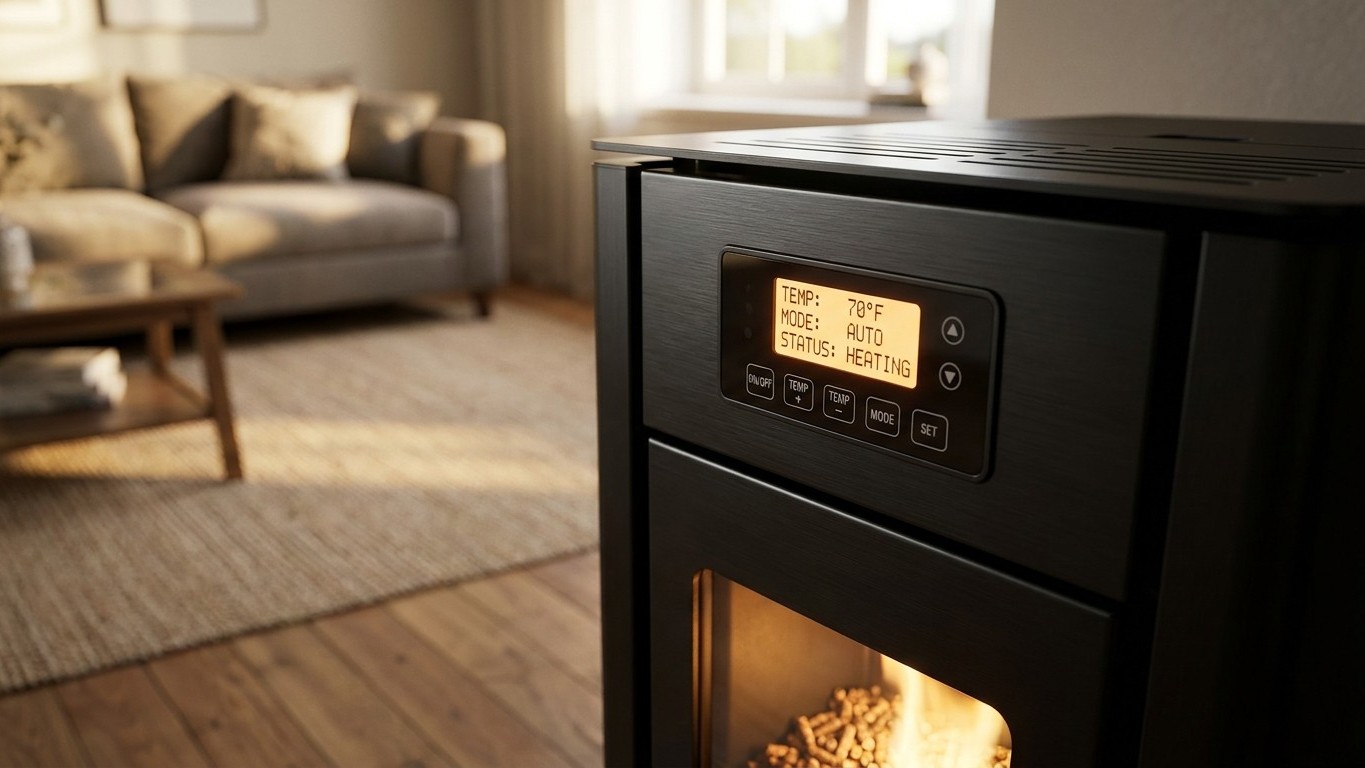

A pellet stove Thermostat works by cycling the stove or adjusting its feed rate to hold a room at a set temperature, instead of you turning a dial every time the room feels cold or stuffy. Whether that means better comfort or higher pellet bills depends entirely on which of three control modes the stove is running, and where the sensor doing the measuring actually sits.
Three ways to run it

Every pellet stove control setup falls into one of three categories, and mixing them up is where most owners get frustrated. Manual mode means you set a fixed feed rate yourself, the auger drops pellets at that pace regardless of room temperature, and the stove keeps burning at that level until you change it. Thermostat on-off mode lets a sensor decide when the fire lights and when it shuts down entirely, based on whether the room is above or below your target. Thermostat modulating mode keeps the flame burning continuously but raises or lowers the feed rate in small steps to track the target temperature, without ever fully extinguishing the fire.
These three do very different things to the appliance and to your pellet bag. Modulating control is gentler on the stove’s mechanical parts because the igniter, which is one of the highest-draw components in the whole unit, rarely has to fire up cold. It also tends to use fuel more efficiently over a full day, since the stove is making small adjustments around a steady burn rather than restarting from zero repeatedly. On-off cycling, by contrast, is harder on the hardware and less efficient over time, even though it can feel more responsive in short bursts because the stove ramps up hard right after ignition.
Manual mode sits in an odd middle ground. It’s not “smart” in any sense, but it avoids the ignition cycle problem entirely, since you’re not asking the stove to shut off and relight throughout the day. The tradeoff is comfort: a manually set feed rate that’s right for a 20-degree morning will overheat the room by afternoon if the sun comes out, and you’re the one who has to notice and adjust it.
What this means for your setup
If your stove supports modulating thermostat control, that’s generally the mode worth using for a room you heat most of the day. On-off control still has a place, which the next section covers, but it’s not the default choice for a main living space that needs steady heat for six or eight hours at a stretch. Check your owner’s manual for which modes your specific unit actually supports. The U.S. EPA notes that it currently certifies over 90 different pellet stoves, and control options vary meaningfully between models even within the same efficiency range.
Why repeated ignition costs more than it saves
Starting a pellet stove is not a low-power event. The igniter is an electric-resistance element that has to heat up enough to combust pellets from a cold or near-cold firebox, and that draw is far higher than what the stove pulls during steady-state burning. Every time an on-off thermostat cycles the stove off and then back on a half hour later, it’s asking the appliance to repeat that expensive startup, over and over, all day.
The cost isn’t just electrical. Cold starts tend to burn less cleanly than an already-hot fire, and the EPA is direct about the fuel side of that equation too: “Pellets can differ significantly in how well they’re made and how well they burn. Lower quality pellets may provide less heat and create a fine dust. Higher quality pellets tend to burn cleaner and produce less ash.” A stove that’s constantly restarting compounds whatever quality issue already exists in the pellets, since incomplete combustion during ignition adds ash and residue on top of whatever the pellets themselves would produce during a steady burn. More ash means more frequent cleaning, and the EPA is specific that maintenance isn’t optional: “Pellet stoves need to be regularly cleaned to ensure that the stove runs efficiently and safely. Additionally, you should have your stove professionally cleaned at least once a year.” A stove cycling on and off dozens of times a week is going to need that attention sooner than a stove running a steady modulating burn.
None of this means on-off control is a bad idea in every case. It makes real sense in a shoulder season, say early October or late April, when the heating demand is light and intermittent, and the room only needs a boost now and then rather than sustained output. It also fits a room you use occasionally, a den or a guest room where nobody’s sitting for hours, where the alternative (running the stove continuously at low output) would waste more fuel than the occasional restart costs. The rule of thumb is really about duty cycle: light, occasional demand favors on-off, sustained daily heating favors modulating control if the stove offers it.
There’s also an electrical dependency worth remembering here, because it shapes why ignition draw matters at all. The EPA points out that “pellet stoves need an electrical supply to work because they use motorized components to feed the fire and blow out hot air.” Every restart pulls on that same electrical supply for the igniter, the auger motor, and the combustion blower simultaneously, which is part of why frequent cycling shows up on a power bill even when the pellet bag doesn’t seem to be emptying any faster.
Where the thermostat goes
None of the mode Differences above matter much if the thermostat itself is reading the wrong temperature. Placement is the detail that decides whether a modulating or on-off setup actually delivers steady comfort or just cycles erratically because the sensor is fooled by its surroundings.
A few placement mistakes come up constantly. Mounting the sensor directly above the stove means it reads radiant heat from the appliance itself, not the room’s actual air temperature, so the stove throttles down long before the far side of the room has warmed up. Putting it in a draft, near a door, window, or return-air vent, means it reacts to brief cold gusts rather than the room’s real average, causing the stove to ramp up and down erratically. Direct sunlight on the sensor does the opposite: it reads artificially warm on a sunny afternoon and can shut the stove down while the room is genuinely still cold in the shaded corners.
The fix is straightforward even if it takes some trial and adjustment: put the thermostat in the room whose temperature you actually care about, at a normal seated or standing height, away from the stove’s direct heat plume, away from doors and windows, and out of direct sun for any part of the day. For a full walkthrough of sensor height, wall placement, and how far from the stove is far enough, see our guide on pellet stove thermostat location.
Placement interacts with the maintenance side too. The U.S. Fire Administration recommends you “keep anything that can burn at least 3 feet from all heat sources including fireplaces, wood stoves, radiators, space heaters or candles,” which applies just as much to a wall-mounted thermostat unit and its wiring as it does to furniture or curtains. And whatever mode or placement you land on, annual professional service isn’t optional: the Fire Administration is clear that you should “maintain heating equipment and chimneys by having them cleaned and inspected each year by a professional,” a step that catches feed-rate drift, sensor wear, and venting issues that no thermostat setting can compensate for.
Common questions
Does a pellet stove thermostat control the flame directly?
No. It controls the feed rate (how fast pellets drop from the hopper into the burn pot) and, in on-off mode, whether the stove is running at all. The EPA describes the basic mechanism plainly: “The pellets are poured into a hopper, which automatically feeds into the stove.” The thermostat sits upstream of that process, telling the auger motor how often to turn, not adjusting the flame itself.
Will a thermostat lower my pellet stove’s efficiency rating?
The rating itself, which the EPA places in the “70-83% efficiency range” for certified units, is a lab measurement tied to the appliance’s design, not to how you run it day to day. But real-world fuel use absolutely responds to control mode, since frequent on-off cycling burns pellets less cleanly during each restart than a steady modulating burn does.
Can I use manual mode and a thermostat at the same time?
Not on most units. The two are typically either/or settings in the stove’s control panel, since manual mode fixes the feed rate regardless of temperature, while thermostat mode hands that decision to the sensor. Check your specific model’s manual, since some newer units offer manual with a high-temperature safety override, which is a different feature from true dual control.
Does heating capacity affect which thermostat mode makes sense?
It can. The EPA notes certified units span “heating capacities range from 8,000-90,000 Btu per hour,” and a stove sized at the high end for a large open floor plan may benefit more from modulating control, since a full on-off cycle at that capacity means a bigger swing in room temperature between the “off” and “just restarted” phases than a smaller unit would produce.