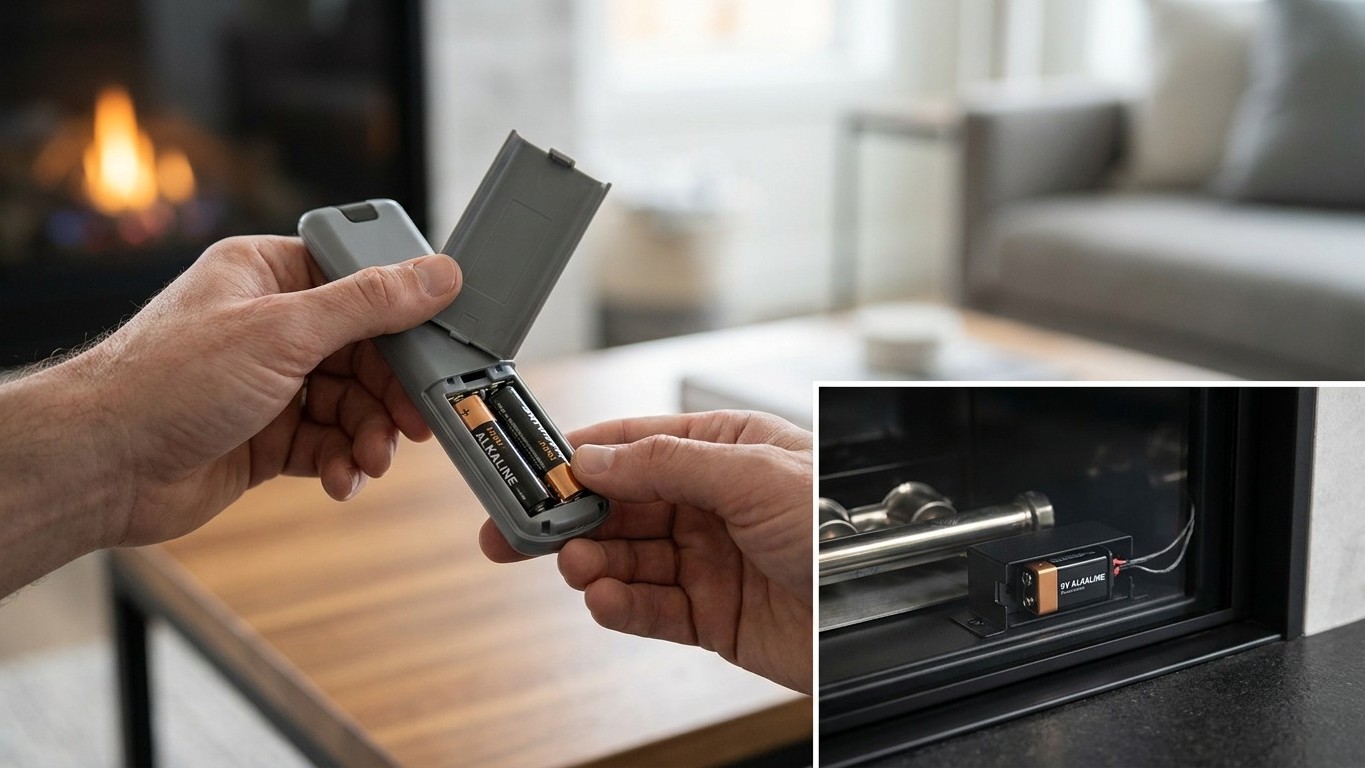

a Gas Fireplace remote that won’t respond almost always traces back to one of three things: a dead battery you haven’t found yet, a wiring setup that pits the wall switch against the remote receiver, or a real fault somewhere between the control and the gas valve. Work through the checks in that order before calling for service. Most no-response calls end at the second battery compartment nobody knew existed, tucked inside the appliance rather than the handheld unit.
Two sets of batteries, not one

This troubleshooting sequence applies across vented, direct-vent, and vent-free (ventless) gas fireplaces alike, since all three rely on the same battery-powered receiver and valve module. Only the venting path differs: a vented unit sends combustion byproducts outdoors through a flue, a direct-vent model draws combustion air from outside and exhausts through a sealed wall terminal, and a vent-free unit releases everything it produces, water vapor included, straight into the room. None of that changes how the remote system is wired, which is why the same fixes apply regardless of which one sits in your living room.
The handset in your hand takes batteries, usually two or three AAA or AA cells. That’s the set almost everyone checks first, and it’s often not the problem. Inside the appliance, mounted near the burner assembly or clipped to the gas valve, sits a separate receiver box with its own battery pack, typically a 9-volt or a set of AA cells. You’ll find it behind the lower louvre or the decorative grille at the base of the fireplace, sometimes tucked to one side where it’s easy to miss on a quick glance.
A dead receiver behaves differently than a dead handset. With fresh batteries in the remote, you’ll still see nothing happen: no click from the valve, no spark, no pilot response, no flame movement at all. If pressing “on” produces total silence from the appliance itself, not even a faint relay click, the receiver batteries are the first suspect, not the handset. Pull the lower panel, locate the battery holder, and check for corrosion at the terminals as much as for a dead cell. Leaked alkaline batteries leave a white or greenish crust that breaks the circuit even when a fresh battery is dropped in, and that residue needs to be cleaned off with a dry cloth or a bit of contact cleaner before a new battery will make a difference.
Some owners cycle through three or four sets of handset batteries over several months, convinced the remote itself is failing, when the actual fault sat behind the louvre the entire time. If you own the appliance manual, it will usually show the receiver’s exact location and battery type. If you don’t, a quick visual sweep behind the lower access panel, following the wiring from the gas valve, will get you there.
Remote, wall switch, or both
Many gas fireplace systems are built to accept either a wall switch or a remote receiver, not both running at the same time. That single design choice causes a fair number of “the remote stopped working” calls that have nothing to do with batteries at all. If a wall switch was installed or left connected, and it’s sitting in the “on” position, it can hold the circuit open in a way that defeats the remote’s signal entirely, or it can do the opposite and keep the valve from responding no matter what the handset sends.
Work through these checks in order before assuming a component has failed:
- Locate the wall switch, if your fireplace has one, and confirm it’s fully in the “off” position, not just close to it.
- Check the appliance manual or the wiring label near the valve to see whether the switch and the remote receiver share the same two terminals or use separate ones.
- If the switch wires directly into the millivolt terminals that the receiver also uses, the two are almost certainly meant to be mutually exclusive, and having both connected can cause erratic behavior rather than a clean failure.
- Look for a jumper wire or a spade connector near the receiver. Some models ship with a jumper installed at the factory for wall-switch-only operation, and it needs to be removed for the remote receiver to take over.
- If a switch and a receiver are both wired in, but the switch is off, and the remote still doesn’t respond, move on to a receiver battery check rather than assuming the switch is the culprit.
This is one of those areas where a five-minute look at the wiring diagram saves an unnecessary service call. Installers sometimes leave both a switch and a receiver connected during a remodel or an appliance swap, assuming a homeowner will pick one or the other later, and that decision gets forgotten. If your fireplace worked fine with a wall switch for years before a remote was added, that’s the first place to look.
Testing without the electronics
Once batteries are confirmed good and the wiring conflict between switch and receiver is ruled out, there’s one diagnostic step that separates a control-side problem from a valve-side one on a millivolt system. Briefly bridging (touching together) the two switch terminals on the gas valve, using a jumper wire rather than a metal tool, tells you which half of the system is at fault. If that brief bridge lights the pilot and main burner, the valve and pilot assembly are working correctly, and the fault sits upstream, in the remote, the receiver, the wall switch, or the wiring connecting them. If bridging the terminals produces no response at all, the problem is downstream, in the valve itself, the thermocouple, the thermopile, or the pilot assembly.
That distinction matters because it tells a technician exactly where to start, which shortens a service visit considerably. It’s information to relay, not a repair to attempt. Touching the gas valve, its wiring, or the millivolt terminals is not a homeowner task, and this step is described here only so you can describe the result accurately to whoever comes to look at the unit. A gas valve is a safety-critical component, and opening it up or misconnecting its terminals can create a leak or a malfunction that a battery swap never could.
If at any point during troubleshooting you smell gas, stop everything. That smell outranks every diagnostic step in this article. Leave the house and call your gas utility or fire department from outside, not from a phone near the appliance. The U.S. Fire Administration also recommends a basic habit that applies whether your remote works or not: “Maintain heating equipment and chimneys by having them cleaned and inspected each year by a professional.” An annual inspection catches valve and pilot issues long before they show up as a dead remote.
Common questions
Can I test the gas valve myself if bridging the switch terminals doesn’t light the fireplace?
No. That test is meant to give you information to pass along to a qualified technician, not a starting point for a repair. Gas valves, thermocouples, and thermopiles should be serviced by someone trained to work on them.
Is it safe to keep troubleshooting if I smell gas near the fireplace?
No. A gas smell always takes priority over any remote or wiring check. Leave the house and call your gas utility or fire department from outside. Carbon monoxide, unlike a gas leak’s odor, is colorless and odorless, so a CO alarm in the home is the only way a household would detect it.
Does a dead remote or receiver affect the safety features built into my gas fireplace?
No, those systems operate independently of the remote. According to the U.S. Consumer Product Safety Commission, currently manufactured unvented gas-fired room heaters carry an oxygen depletion sensor (ODS) under the industry’s voluntary standard, which shuts off gas flow before carbon monoxide can reach a life-threatening level. The CPSC revoked its own mandatory standard in 1984, by which point 95 to 100 percent of manufacturers had already complied voluntarily, and that sensor’s function has nothing to do with whether your remote or receiver batteries are working.
Does it matter whether my fireplace is vented, direct-vent, or vent-free when the remote stops working?
Not for the troubleshooting steps themselves, since all three use the same battery-powered receiver and valve. It matters more for ongoing safety. A vented unit sends combustion products outdoors through a flue, a direct-vent model draws outside air and exhausts through a sealed wall terminal, and a vent-free (unvented) unit relies entirely on room ventilation, since it has no outside vent for its combustion products. The CPSC notes that inadequate airflow or a maladjusted burner in an unvented appliance can allow fatal levels of carbon monoxide to build up, which is exactly why a working CO alarm matters regardless of what’s happening with your remote. And whatever type you have, the U.S. Fire Administration’s basic rule still applies while you’re working near it: “Keep anything that can burn at least 3 feet from all heat sources including fireplaces, wood stoves, radiators, space heaters or candles.”