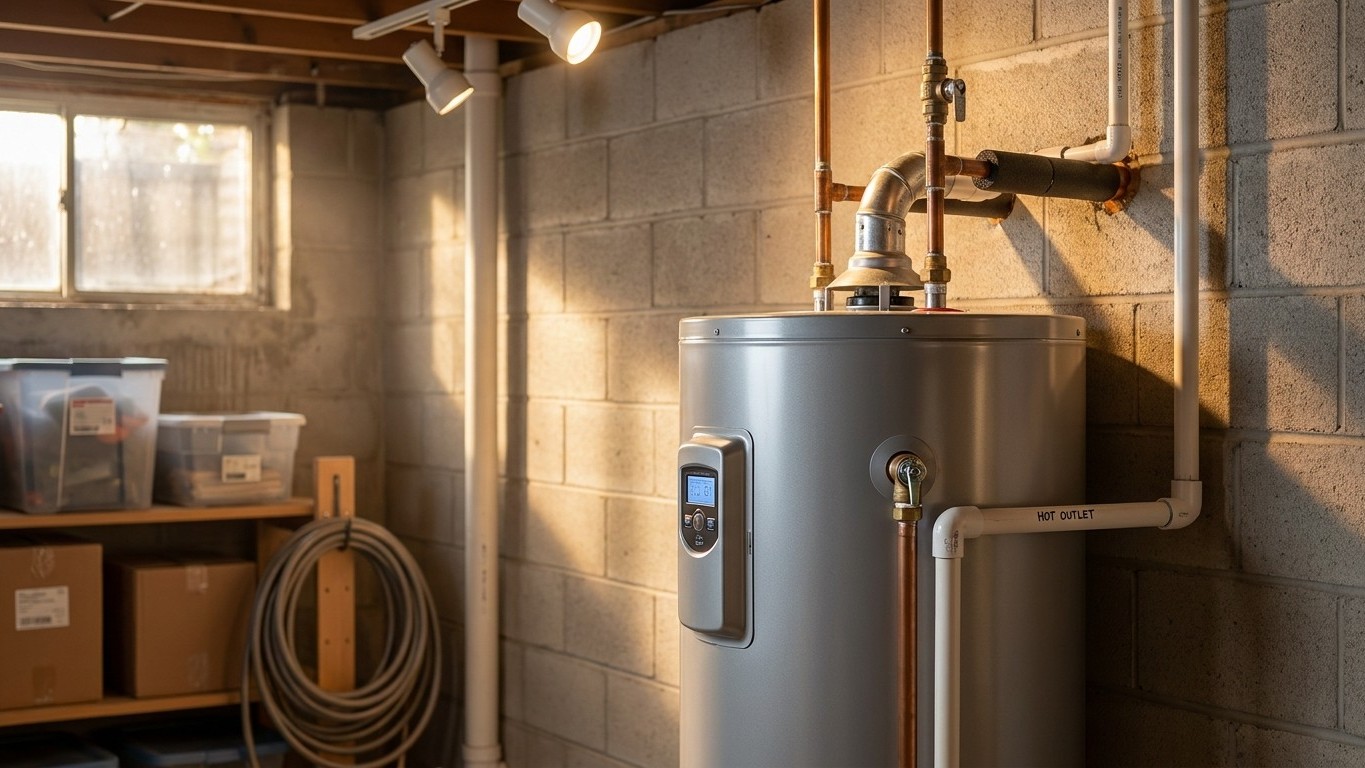

A water heater’s job is simple to state and easy to get wrong in practice: heat water, store or deliver it on demand, and do so safely for years without much thought from the household. The real answer to “which one, how big, what fails” depends on fuel type, household size, and how the unit is installed and maintained. The U.S. Department of Energy estimates water heating makes up roughly 14% to 25% of the energy used in a typical home, which is why the choice matters more than most people assume.
What the appliance does
Every water heater does one of two things: it keeps a reserve of hot water ready in a tank, or it heats water the instant a tap calls for it. Storage tank units, the kind most American homes have had for decades, hold anywhere from a small under-sink reserve to a full-size tank in a utility closet or basement. Tankless units skip the reserve entirely and fire a burner or heating element only when water is flowing. Heat pump water heaters take a third approach, pulling heat from the surrounding air and moving it into the tank rather than generating it directly, which is why they carry different clearance and space needs than a standard tank.
The fuel source splits the field again. Gas and propane units burn fuel to produce heat, which means they vent combustion byproducts outside and require the same carbon monoxide precautions as any fuel-burning appliance in the home: colorless, odorless, and only detectable with a working CO alarm. Electric storage tanks and heat pump units burn nothing, so that particular risk doesn’t apply to them, though they carry their own electrical safety considerations.
Which type suits a given household comes down to questions this hub doesn’t answer directly, because each one has enough nuance to deserve its own page. How does a tankless unit actually compare to a storage tank for a family of four? What does a heat pump water heater need in terms of surrounding air volume and Temperature to work efficiently? Is a gas unit worth the added venting complexity over electric, given local utility rates? And for homes considering a swap, what does it take to convert from one fuel type to another, or from tank to tankless, without redoing the whole utility room? Those are the decisions that follow once the basic job of the appliance is understood.
Why the type matters more than the brand
Two tanks that look identical on a showroom floor can behave very differently depending on recovery rate, insulation quality, and how the amended federal efficiency standards apply to them. Those standards, updated to bring common electric storage water heaters up to the efficiency level of an entry-level heat pump water heater, affect newer production models more than older ones still in service, and the practical result is that a household replacing a tank today faces a different market than one that replaced a tank a decade ago.
Choosing and sizing
Picking a water heater starts with capacity, and getting that number wrong is the single most common regret homeowners report after installation. A tank sized for two people struggles when a third teenager starts taking twenty-minute showers. The page on storage tank sizing walks through how to match gallons to household habits rather than just household headcount.
Tankless changes the sizing question entirely, because there’s no reserve to run out, only a flow rate the unit can sustain. Anyone comparing a tankless unit to a tank should read the dedicated page on tankless sizing and flow demand, since undersizing here doesn’t mean running out of hot water, it means multiple fixtures competing for the same limited output at once.
Heat pump water heaters bring a location problem most buyers don’t anticipate. They need a certain volume of surrounding air to draw heat from efficiently, which rules out cramped closets that work fine for a standard tank. The page on heat pump water heater placement covers what a space needs before one of these units makes sense.
Fuel availability narrows the field before efficiency ratings even enter the conversation. A home without existing gas service faces a different cost calculation than one with a gas line already run to the water heater closet, and the comparison page on gas versus electric water heaters lays out that trade-off directly.
Finally, anyone replacing an aging unit should factor in the amended federal efficiency standards mentioned above, since a modern electric storage tank now performs closer to a heat pump unit than the electric tanks sold a generation ago, a shift covered on the page dedicated to efficiency standards and what they mean for replacement timing.
What goes wrong
The most frequent complaint is also the simplest: No Hot Water at all, or not enough of it. On gas units this often traces back to a pilot or igniter problem; on electric units it’s frequently a failed heating element or tripped thermostat. The page on diagnosing no hot water walks through the checks in order, starting with the ones a homeowner can safely do before calling a technician.
Leaks rank second, and they range from a loose fitting to a failing tank that’s reached the end of its service life. Because a slow leak can go unnoticed inside a closet for weeks, the page on spotting and responding to tank leaks covers what to look for during routine checks.
Sediment buildup is quieter but just as costly, gradually settling at the bottom of a tank and reducing efficiency while producing the popping or rumbling sounds many homeowners notice long before they connect it to a maintenance issue. That’s addressed on the page about sediment, flushing, and the noises a tank makes.
Temperature setting sits at the center of a real trade-off, and it’s worth naming honestly rather than glossing over. The Department of Energy recommends setting the thermostat to 120°F, describing that setting as comfortable for most household uses. Lower settings save energy and reduce the risk of scalding, particularly for households with young children or older adults. But water stored too cool is a recognized concern for bacterial growth, including Legionella, and that concern doesn’t disappear just because a lower setting is more efficient. Households with vulnerable occupants, whether due to age, illness, or a compromised immune system, should raise this specific question with their doctor or their local water utility rather than guess. The full discussion of that balance lives on the page about thermostat settings and the Legionella trade-off.
Corrosion, usually tied to a spent anode rod, and tankless-specific error codes round out the remaining common faults, each covered on its own page rather than compressed here.
Keeping it going
Most of what keeps a water heater running falls well within an owner’s reach. Setting the thermostat, watching for rust-colored water or unusual noises, and periodically flushing sediment from the bottom of a storage tank are all tasks that don’t require a license, just attention and a manual. The unit’s own label and installation manual govern the specifics of that maintenance schedule, since tank size, fuel type, and manufacturer all shape what’s recommended and how often.
The boundary shifts once gas lines, venting, or the pressure relief valve enter the picture. Because a gas or propane Water Heater Is a fuel-burning appliance, any work touching the burner, gas connection, or venting falls under the same rules that apply to every combustion appliance in the home: it should involve a licensed technician, and the home should already have a working carbon monoxide alarm nearby regardless of who last touched the unit. Electric and heat pump units remove that particular risk since they burn no fuel, but they still carry electrical connections that aren’t a casual DIY project.
When in doubt about what’s permitted without a permit or a professional, the local code office remains the authority, not a general rule of thumb. That’s especially true for anything involving venting changes, fuel line work, or relocating a unit to a new part of the house.
Common questions
How often should a water heater be flushed?
The unit’s manual sets the recommended schedule, since tank size and local water hardness both affect how quickly sediment accumulates. Homes on well water or in areas with harder water tend to need more frequent attention than the manual’s baseline suggests.
Is 120°F too low for a household with an older adult in the home?
The Department of Energy presents 120°F as comfortable for most household uses, but it’s a recommendation, not a safety code requirement. Households with vulnerable occupants should discuss the right balance between scald risk and bacterial concerns with their doctor or local water utility rather than rely on a single number.
Do electric water heaters need a carbon monoxide alarm nearby?
No. Carbon monoxide risk applies to fuel-burning appliances, meaning gas and propane water heaters. An electric or heat pump unit burns no fuel and doesn’t produce combustion byproducts, though a CO alarm is still worth having in a home with any other fuel-burning appliance.
Why do newer electric water heaters look and cost differently than the ones sold years ago?
Amended federal efficiency standards have brought common electric storage water heaters up to the efficiency level of an entry-level heat pump water heater, which changes both the size and design of many models currently sold compared to older vintages still in service in many homes.