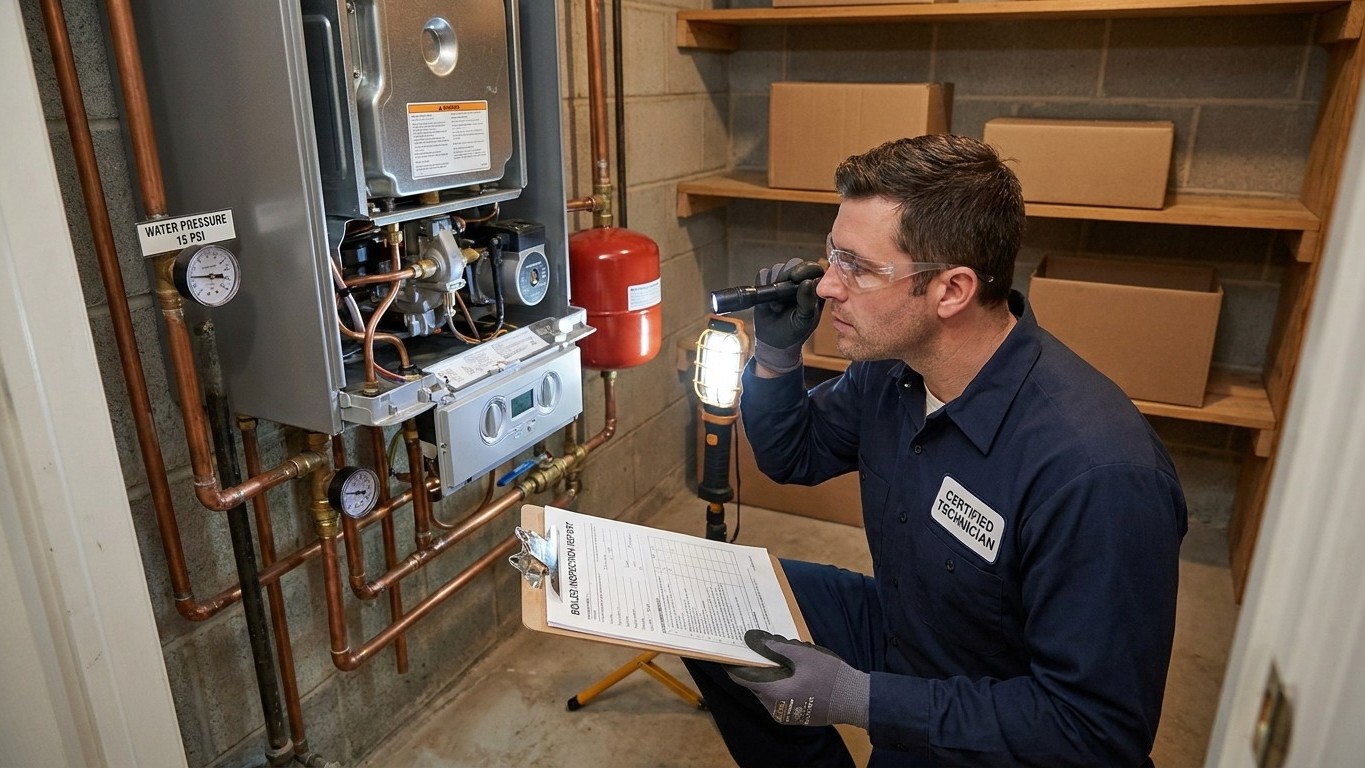

A proper boiler annual service covers combustion analysis, cleaning of the burner and heat exchanger, a check of the flue and terminal, the system’s pressure and expansion vessel charge, a test of every safety device, and a real inspection of the pump, valves, and controls. If an invoice only lists “annual service” with no breakdown of what was checked, something was skipped.
It is a combustion appliance in a cupboard

The U.S. Fire Administration puts it plainly: “Maintain heating equipment and chimneys by having them cleaned and inspected each year by a professional.” That sentence carries extra weight for a boiler specifically, because a boiler is a fuel-burning appliance that usually lives out of sight, tucked into a cupboard, a closet, or a basement corner, where nobody glances at it between one winter and the next. A furnace at least announces itself with airflow and duct noise. A boiler just sits there, quietly converting gas or oil into heat, and quietly producing combustion byproducts that need somewhere to go.
That “somewhere to go” is the flue. When it works, exhaust gases leave the house. When a seal degrades, a joint corrodes, or a bird builds a nest in the terminal outside, gases can end up going somewhere else. Nobody notices until the appliance starts short-cycling, or worse, until a carbon monoxide alarm sounds. A boiler tucked into a closet is not a design flaw, but it does mean the appliance gets less casual attention than one sitting in the middle of a utility room, and an annual service is the one guaranteed moment each year when someone actually looks.
Controls are guessed at more often than owners assume
It is not just the mechanical parts that drift out of tune. The U.S. Department of Energy’s study “Optimizing Hydronic Heating for Comfort and Performance” makes a point that applies well beyond the multifamily buildings it studied: “Unfortunately, control settings are often best guesses and are not typically optimized.” That study focused on central hydronic systems in multifamily buildings, and its savings figures (an average of 11% gas savings, a maximum of 33%) belong to that building type. They should not be treated as a promise for a single-family home. But the underlying finding still matters here: whoever set the controls when the system was installed may have used a reasonable estimate rather than an actual measurement, and nobody has touched the settings since. An annual visit is the moment to check whether those original guesses still make sense, not just whether the boiler fires up.
Put those two facts together and the appliance’s profile becomes clear. It burns fuel, it sits where it is easy to ignore, and its controls were likely never fine-tuned in the first place. That is exactly the kind of equipment a yearly professional inspection exists for, not a luxury add-on but the baseline the fire safety guidance describes.
What should be on the invoice
A service visit that only involves listening to the boiler run for five minutes and writing “serviced” on a sticker is not a service. The scope that should show up, in some order, looks like this:
- Combustion analysis, measuring the exhaust gases to confirm the burner is combusting fuel efficiently and safely
- Cleaning of the burner and heat exchanger, removing soot, scale, or debris that blocks heat transfer
- Inspection of the flue and terminal, checking for blockages, corrosion, or damage where the appliance vents outside
- Checking and, if needed, recharging the system pressure and the expansion vessel
- Testing every safety device, including pressure relief and flame safeguard components
- Inspecting the pump and valves for leaks, noise, or seizing
- Actually checking the controls, rather than assuming the original settings are still correct
Several of those steps should hand the customer an actual number, not just a checkmark. Combustion analysis produces readings for things like flue gas temperature, oxygen or carbon monoxide content, and efficiency, figures that a technician can compare against the manufacturer’s specification for that model. A pressure check should tell you what the system pressure reads at that moment, with the appliance’s own label and manual, not a generic figure, setting the acceptable range. The expansion vessel charge is another figure worth having in writing, since a vessel that has lost its charge is a common, quiet cause of pressure problems later in the season.
Why AFUE sometimes comes up during a service
Technicians sometimes reference AFUE (annual fuel utilization efficiency) when discussing whether an aging boiler is still performing as designed. AFUE is the ratio of a boiler’s annual heat output to the total annual fossil fuel energy it consumes: an AFUE of 90% means 90% of the fuel’s energy becomes heat in the home, and 10% leaves up the flue and elsewhere. The U.S. Department of Energy’s Federal Energy Management Program notes that an ENERGY STAR-qualified residential gas boiler meets 0.90 AFUE, and its own worked example compares models at 0.84, 0.90, and 0.97 AFUE. That guidance is written for federal purchasers, and its cost figures assume federal procurement rather than a household replacement decision, so it is worth knowing as background rather than as a shopping rule. What matters at service time is simpler: does the combustion analysis suggest the boiler is still performing near its rated efficiency, or has that number drifted downward with age.
If a technician cannot produce readings for combustion, pressure, and the expansion vessel charge, ask why. Those three numbers are the difference between “we looked at it” and “we tested it.”
What the owner does between visits
An annual service is not a substitute for paying attention the other 364 days of the year. A boiler is a fuel-burning appliance, and the carbon monoxide it can produce is colorless and odorless, which is exactly why a working CO alarm near the appliance is non-negotiable. An electric boiler burns nothing and does not carry this particular risk, but a gas or oil-fired unit does, every day it runs.
Between service visits, the honest list of what an owner should actually do is short:
- Watch the pressure gauge occasionally, and learn where it normally sits so a drop or spike is easy to notice; the guide to boiler pressure explains what shifts in that reading tend to mean
- Look around the base and pipework for damp patches or staining, both signs of a slow leak that has not yet become obvious
- Listen for new noises, especially banging or a knocking sound that was not there before; the kettling guide covers why a boiler starts making that kind of noise and what usually causes it
- Keep the area around the appliance clear of stored boxes, cleaning supplies, or anything flammable, since a combustion appliance needs airflow and unobstructed access
- Test the CO alarm on the same schedule as the household’s other alarms, and replace batteries when the alarm signals low power
None of these replace the annual visit. A pressure gauge reading tells you something changed, not why, and a new noise is a symptom, not a diagnosis. But together, they are the early-warning system that catches a developing problem months before it would otherwise surface, which is exactly the gap between one professional inspection and the next.
Common questions
How long does a boiler annual service usually take?
The time varies with the appliance’s condition and how much cleaning or adjustment is needed, so there is no single figure that applies to every unit. A technician working through the full scope, combustion analysis, cleaning, flue inspection, pressure check, and controls review, needs enough time to do each step properly rather than rush through them.
Does a service include cleaning the radiators or just the boiler itself?
A standard boiler service focuses on the appliance itself: the burner, heat exchanger, flue, pressure system, and controls. Radiators and the wider distribution system are a separate matter, and issues there, including the kind of noise covered in the kettling guide, are usually diagnosed and addressed independently of the annual boiler service.
Can I skip a year if the boiler seems to be running fine?
The U.S. Fire Administration’s guidance to have heating equipment cleaned and inspected each year by a professional does not include an exception for equipment that sounds fine. A boiler burning fuel with a degrading flue seal or a drifting combustion ratio can run without any audible symptom right up until it does not.
What is the difference between a service and a repair visit?
A service is scheduled maintenance covering the full scope regardless of whether anything appears wrong: combustion analysis, cleaning, safety testing, and a controls check. A repair visit responds to a specific fault, like a pressure drop, a noise, or a failure to fire, and addresses that fault directly rather than working through the whole checklist.