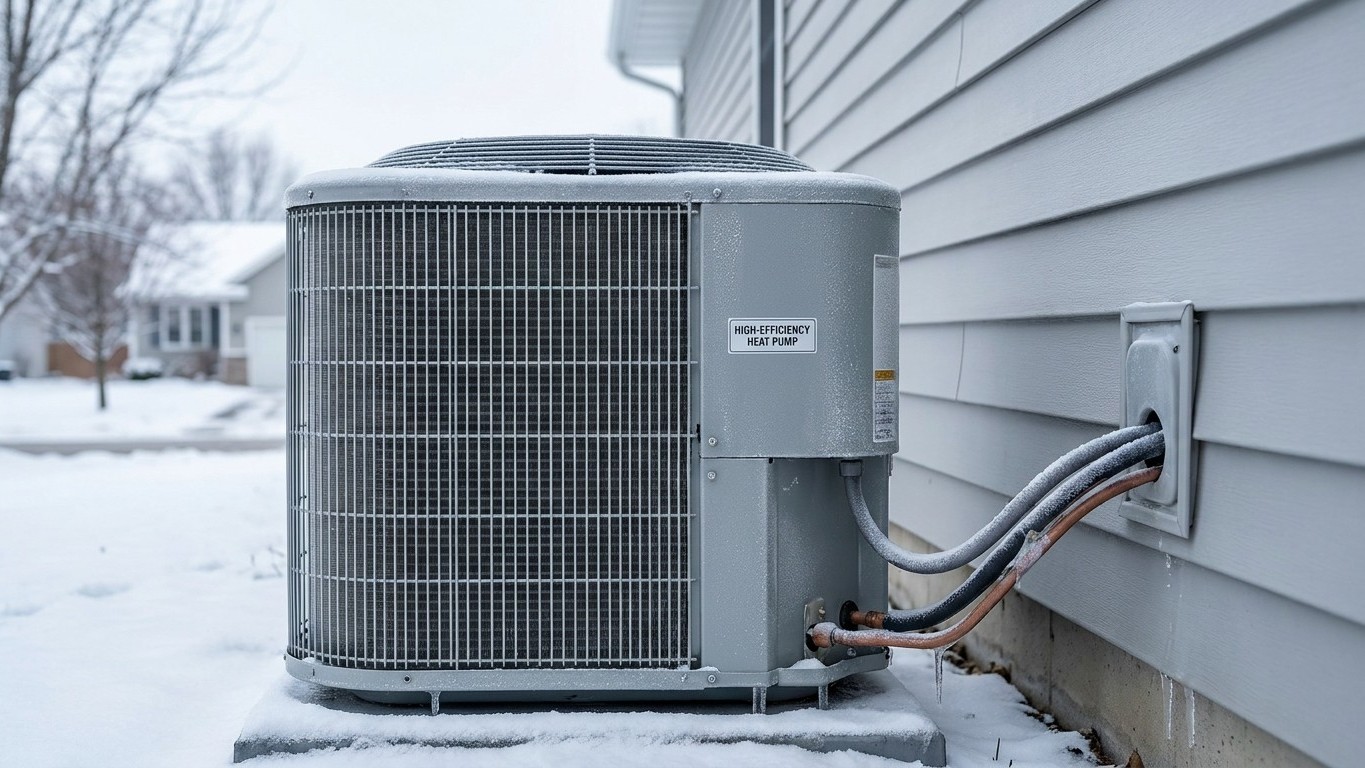

A heat pump warms a house by grabbing heat that’s already sitting in the outdoor air and pushing it inside, then reversing that flow in summer to pull heat out. No flame, no fuel burning anywhere in the box. That single fact explains almost everything people find strange about how these systems feel and sound compared to a furnace.
It moves heat, it does not make it

A furnace works by combustion. It burns gas or oil, and that reaction creates heat from scratch, which then gets pushed through the ducts. A heat pump does something entirely different: it uses a refrigerant loop to absorb heat from outdoor air, even air that feels cold to your skin, and concentrates that heat before releasing it inside the house. In summer, the same loop runs backward, pulling heat out of the indoor air and dumping it outside, the same job a central air conditioner does.
This is not a subtle distinction. It’s the whole reason a heat pump can deliver more heat energy into your living room than the electrical energy it consumes to run the compressor and fans. That sounds like it breaks a law of physics, but it doesn’t. The electricity isn’t creating the heat, it’s paying to move heat that already exists outdoors. A refrigerator does the same trick in reverse: it uses electricity to pull heat out of a box that’s already cold, not to manufacture cold. A heat pump is a refrigerator pointed at your house instead of at a block of ice.
Where the heat actually comes from
Even on a chilly day, outdoor air holds molecules in motion, and motion is heat energy. The Heat Pump’s Outdoor coil and refrigerant are engineered to extract some of that energy, compress it to raise its temperature further, and hand it off to the indoor coil. As the outdoor air gets colder, there’s simply less heat energy sitting in it to extract, so the system’s heating capacity drops as temperatures fall. That’s a straightforward consequence of the mechanism, not a malfunction. How much capacity a specific unit loses at a specific outdoor temperature depends on the model, and the equipment’s own performance specification is the document that answers that question for your house, not a general rule of thumb.
None of this involves combustion, so none of the carbon monoxide precautions that apply to gas furnaces have any bearing on a heat pump running in heating mode. Those concerns only resurface on dual-fuel systems, and only for the furnace half of that pairing, never for the heat pump itself.
Why the air from the vents is not hot
This is the complaint that sends most people looking for an explanation, and it’s worth saying plainly: it is not a sign something’s broken. A gas furnace produces a short, intense blast of very hot air, then shuts off until the thermostat calls again. A heat pump does the opposite. It produces a long, steady run of air that’s only gently warm, sometimes cooler than your own skin temperature, which is exactly why standing under a vent can feel like a draft even while the room around you is genuinely heating up.
The reason comes back to the mechanism already described. A heat pump isn’t concentrating combustion heat into a short burst, it’s continuously moving a moderate amount of heat over a longer stretch of time. Lower output, longer duration, same total heat delivered to the room. Furnaces are built to sprint. Heat pumps are built to jog for hours.
What changes for the person living with it
Once you know the long, gentle run is the design intent and not a weakness, a few habits make the system feel more comfortable rather than fighting it. Keep the fan on a setting that matches continuous, lower-velocity airflow rather than expecting the short bursts a furnace produces. Point vents so that gentle stream reaches the room instead of blowing directly on a couch or a desk chair where it registers as a draft. And resist the urge to judge the machine by holding a hand up to the register, since a temperature there that feels lukewarm can still be well above room temperature and doing exactly the job it’s supposed to do.
The other normal noise and behavior worth mentioning here: defrost cycles that briefly reverse the system to melt frost off the outdoor coil, occasional frost itself on that coil, and the fact that the unit runs for long, continuous stretches rather than cycling on and off like a furnace. All of that is ordinary operation, not the beginning of a repair bill.
The part that makes it two machines
A heat pump earns its name because a single outdoor and indoor unit can heat in winter and cool in summer, and the part responsible for that switch is called the reversing valve. In plain terms, it swaps which coil is absorbing heat and which one is releasing it. In cooling mode, the indoor coil absorbs heat from inside the house and the outdoor coil releases it outside, exactly like a standard air conditioner. Flip the valve, and the roles trade places: the outdoor coil now absorbs heat from the outside air, and the indoor coil releases it into the house.
Practically, that means the outdoor unit isn’t dormant all winter the way some people expect. It’s actively running, its fan spinning, its coil doing the work of pulling heat out of cold air, right through the coldest stretches of the season. Hearing the system change direction, sometimes as an audible whoosh or a brief pause followed by a shift in sound, is the reversing valve doing its job, not a sign of trouble.
This two-in-one design is also the cleanest way to tell a heat pump apart from a plain central air conditioner sitting outside your house, since the two units can look nearly identical from the yard. If you’re trying to figure out which one you actually have, the detailed comparison on telling a heat pump apart from a standard air conditioner walks through the specific clues, including what the reversing valve looks like and how the unit behaves when temperatures drop.
What the ENERGY STAR label certifies
The ENERGY STAR label on an air-source heat pump isn’t a single blanket number. It sets different minimum thresholds depending on how the system distributes air through the house, and reproducing those thresholds side by side shows an asymmetry that’s easy to miss.
| System type | Minimum HSPF2 | Minimum SEER2 |
|---|---|---|
| Split system, non-ducted | 8.5 | 15.2 |
| Split system, ducted | 8.1 | 15.2 |
| Single-package equipment | 8.1 | 15.2 |
Notice that the non-ducted split system has to hit a higher HSPF2 (8.5) than either the ducted split system or single-package equipment (8.1) to earn the same label. That’s not a typo and it’s not arbitrary. A ductless system delivers conditioned air directly into the room with no ductwork in between, so it has no duct losses eating into its output before that air ever reaches you. Because it starts from that advantage, ENERGY STAR simply asks more of it to earn the same certification. It’s a concrete argument for why the ducted and ductless categories aren’t judged on the same curve, not just a bureaucratic quirk.
What the label is not telling you
These figures are certification thresholds, the bar a model has to clear in testing to carry the ENERGY STAR mark. They aren’t a performance prediction for what a particular unit will do in a particular house, on a particular winter night, with a particular duct layout. Two labeled systems can both clear the same threshold and still behave differently once installed, depending on sizing, ductwork condition, and local climate. The label tells you the equipment met a testing standard. It doesn’t substitute for the manufacturer’s own performance specification when you’re trying to understand what a specific model will actually deliver at your address.
Common questions
Is it normal for the outdoor unit to be covered in frost?
Yes, some frost buildup on the outdoor coil during cold, humid weather is expected. The system runs periodic defrost cycles, briefly reversing to melt that frost, which is part of normal operation rather than a sign of a problem.
Why does the system seem to run almost constantly in winter?
A heat pump is designed for long, steady runtimes rather than the short on-off bursts typical of a furnace, since it’s moving a moderate amount of heat continuously rather than releasing a concentrated burst from combustion. Extended runtime by itself isn’t a red flag.
Does a heat pump stop working once it gets cold enough outside?
As outdoor air gets colder there’s less heat energy in it to extract, so capacity does decline with falling temperatures. Exactly where that decline becomes significant depends on the specific model, and the manufacturer’s performance specification for that unit is the source to check, not a general temperature rule.
Should I turn off power to the outdoor unit before doing anything near it?
Treat it the same way you’d treat a central air conditioner’s outdoor unit: the capacitor inside can hold a charge even after power is switched off, so shutting off power at the disconnect doesn’t make the internal components immediately safe to handle.