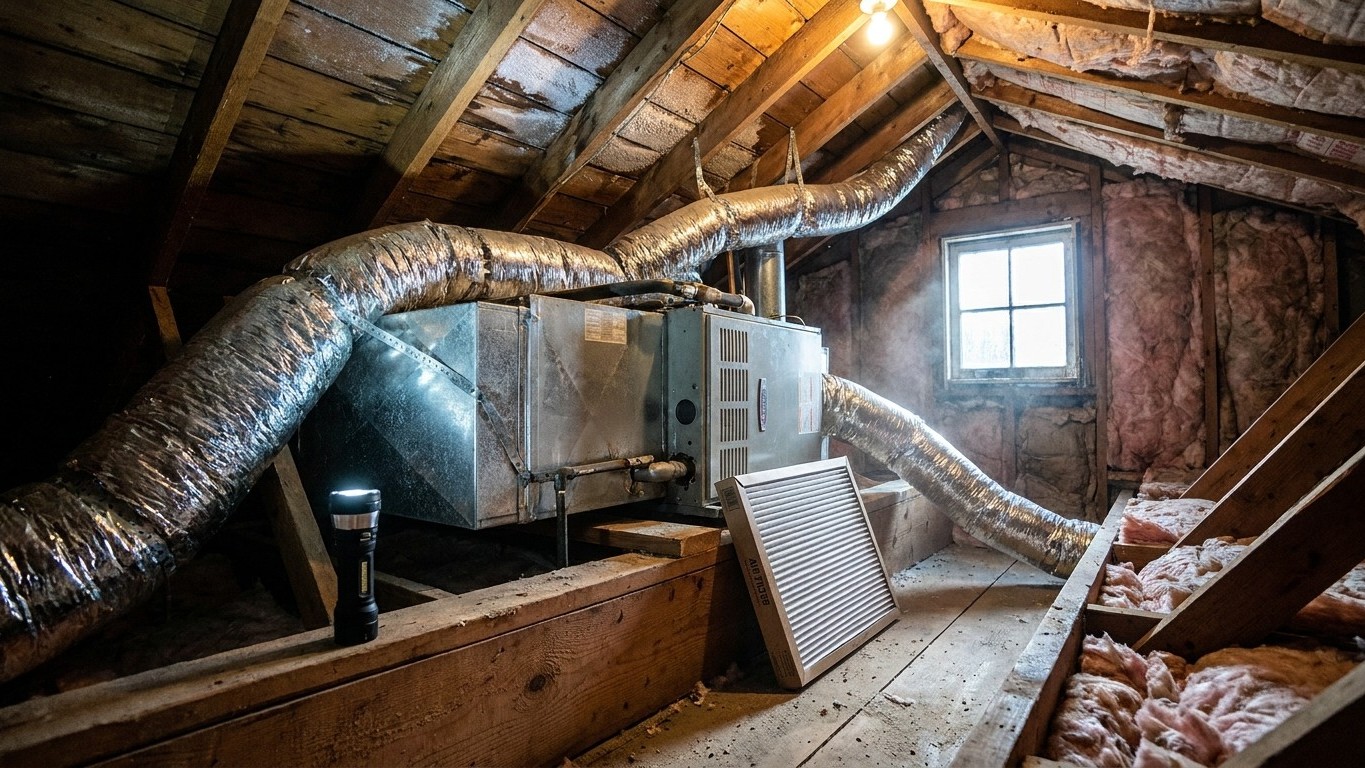

Putting a furnace in the attic solves a real problem in homes with no basement and a crawlspace too tight to work in. But that placement quietly changes four things: how much heat actually reaches your rooms, what happens when the system produces water, how it behaves in a hard freeze, and how much every filter change and repair will involve a ladder and a flashlight.
Why it is up there at all

Builders don’t put a furnace in the attic because it’s the best spot mechanically. They put it there because the house doesn’t offer a better one. Slab-on-grade construction, common across the Southeast, Southwest, and much of the Sun Belt, has no basement to hide equipment in. Crawlspaces exist in some of those same houses, but many are 18 to 24 inches high, too shallow for a technician to kneel in, let alone swap a blower motor. The attic, by comparison, has headroom, a flat platform across the joists, and enough space to route ductwork to every room below. Given the alternative of no mechanical room at all, it’s a defensible call.
The consequence is that the owner inherits a set of conditions the builder didn’t have to think about twice. The furnace cabinet sits outside the insulated envelope of the house, in a space that can swing from over 130 degrees on a summer afternoon to well below freezing on a winter night. The ductwork run through that same attic is exposed to the identical swing, for its entire length. Any water the system produces, whether from a high-efficiency furnace’s exhaust or from a cooling coil mounted in the same cabinet, sits above a finished ceiling instead of over a concrete slab. And every piece of routine work, from a filter change to a full replacement, happens through a scuttle hole or a hatch, across joists that were never meant to be a walking surface.
| Installation location | Inside insulated envelope? | Water risk if it leaks | Typical access difficulty |
|---|---|---|---|
| Basement | Yes, usually | Onto a floor or slab | Low, walk-in space |
| Conditioned closet | Yes | Onto flooring | Low to moderate |
| Crawlspace | No | Onto ground below | High, limited headroom |
| Attic | No | Onto a finished ceiling | High, hatch and joists |
None of this means an attic installation is a mistake. It means the owner of that house is managing a different set of risks than a neighbor with a basement furnace, and the rest of this piece walks through what each of those risks actually looks like.
Heat lost before it arrives
Ductwork loses conditioned air everywhere it’s installed, but where that air ends up matters. According to ENERGY STAR, “In a typical house, however, about 20 to 30 percent of the air that moves through the duct system is lost due to leaks, holes, and poorly connected ducts.” In a basement system, air that escapes a duct seam often stays somewhere inside the building. In an attic system, that same lost air is dumped into a space that’s scorching in August and freezing in January, gone for good rather than merely misplaced.
Leakage isn’t the only mechanism at work. Even ductwork with tight, well-sealed joints still loses heat through the metal or the duct board itself, by plain conduction, the same way a coffee cup loses heat through its wall even with the lid on. A furnace cabinet sitting in a 140-degree attic in summer or a 20-degree attic in winter is exchanging heat with that space through every surface, all day, regardless of how well the joints are taped. ENERGY STAR also notes that “Airflow problems can reduce your system’s efficiency by up to 15 percent,” and a duct system fighting extreme attic temperatures at both ends of the year is a prime candidate for exactly that kind of airflow trouble.
What can actually be done about it follows a rough order of priority:
- Seal the visible duct joints and connections first, since sealing addresses the leakage loss ENERGY STAR describes directly.
- Insulate the ductwork and the furnace cabinet itself, which reduces the conduction loss that sealing alone doesn’t touch.
- Where a renovation allows it, consider burying the ducts under attic insulation or bringing the attic itself inside the building’s thermal envelope, which removes the temperature extreme entirely rather than just resisting it.
For the mechanics of each step, the insulation and duct-sealing guides elsewhere on this site walk through the specifics in more depth than a single section here can cover.
Water, above a ceiling
A high-efficiency furnace condenses water vapor out of its own exhaust as part of how it extracts extra heat from combustion gases, and that water has to go somewhere. If the same air handler also houses a cooling coil for summer use, the water volume goes up substantially, since a coil pulling humidity out of household air in July produces far more condensate than a furnace does in heating mode. In a basement, that water dripping in the wrong spot lands on a floor. In an attic, it’s directly above a finished ceiling, with only the drywall and paint standing between a plumbing problem and a visible stain.
The equipment is built with that risk in mind, through a layered arrangement rather than a single line of defense. A primary condensate drain carries water away under normal operation. Beneath the unit, a secondary drain pan catches anything that overflows if the primary line clogs with the algae and sediment that build up in condensate lines over time. Inside that pan, a float switch is wired to shut the entire system down the moment water starts to accumulate. That switch is the actual barrier between a clogged drain and a ruined ceiling below, since neither the pan nor the primary line can stop water from building up once the main path is blocked, only the switch that cuts power in response.
A short seasonal routine keeps that arrangement doing its job:
- Before cooling season and again before heavy heating use, look at the secondary pan for any standing water, which signals the primary line is already partially blocked.
- Check that the condensate line has a visible, steady drip or flow when the system is running, rather than nothing at all.
- Confirm the float switch moves freely and isn’t stuck in a position where it can’t rise with the water level.
Never bypass the float switch to stop a nuisance shutdown. It is signaling exactly the condition it exists to catch, and the fix is clearing or repairing the drain, not disabling the one part designed to protect the ceiling underneath.
Freezing, and getting to it
In colder climates, an attic that isn’t part of the conditioned house can drop well below freezing for stretches of the winter, and a condensate line or trap sitting in that space can freeze solid. Once ice blocks the line, water has nowhere to go, the float switch does exactly what it’s supposed to do, and the furnace stops running, often on the coldest night of the stretch. It reads like a mysterious seasonal fault until you remember the equipment producing that water is sitting in an unheated space to begin with, at which point the cause is fairly obvious.
Access shapes almost everything else about owning this kind of system. Filter changes, coil inspections, and eventual replacement all happen through a hatch or scuttle hole, then across joists rather than a solid floor, which is slower and less comfortable work than the same task in a basement. That difficulty doesn’t change the schedule those tasks need, but it does mean many owners put them off longer than they would if the equipment were sitting at eye level in a utility room.
For furnaces that burn a fuel rather than run on electricity, that same hard-to-reach attic installation is also where carbon monoxide has to be taken seriously, since combustion happens up there along with everything else. The U.S. Consumer Product Safety Commission notes that “Each year, more than 200 people die from unintentional non-fire related carbon monoxide poisoning associated with consumer products. Heating equipment and portable generators are among the top contributors to CO deaths.” Their guidance is direct: “Install battery-operated CO alarms or CO alarms with battery backup on every level of the home and outside sleeping areas. Interconnected CO alarms are best; when one sounds, they all sound.” Every level includes the level the attic furnace sits on, which for most houses means an alarm placed where it can actually catch a problem at the source rather than only in the living space below.
Common questions
Does an attic furnace need an annual inspection more than one in a basement?
For a fuel-burning furnace, an annual inspection is standard regardless of location, since it checks the combustion process itself rather than the room the unit sits in. The attic location doesn’t change how often that inspection is needed, though it can make the inspection itself take longer given the access.
Can an electric furnace in the attic still cause a carbon monoxide risk?
No. Carbon monoxide comes from incomplete combustion of a fuel, so it applies to furnaces burning gas, oil, or propane, not to electric furnaces, which produce no combustion byproducts at all. An electric furnace in an attic carries the energy-loss and water-management issues described above, but not the CO concern.
Is a CO alarm the same thing as a propane leak detector?
No, and the two shouldn’t be substituted for each other. A CO alarm detects carbon monoxide, a byproduct of incomplete combustion, while a propane leak detector senses unburned propane gas itself. A home with a propane-fired attic furnace can reasonably use both, but one doesn’t cover the other’s job.
What’s the first sign that an attic furnace’s ductwork is losing too much air?
Uneven room temperatures are usually the earliest clue, particularly rooms farthest from the furnace running noticeably warmer or cooler than rooms nearby. That pattern lines up with the duct leakage ENERGY STAR describes, since air lost along the way never reaches the rooms at the end of the run.