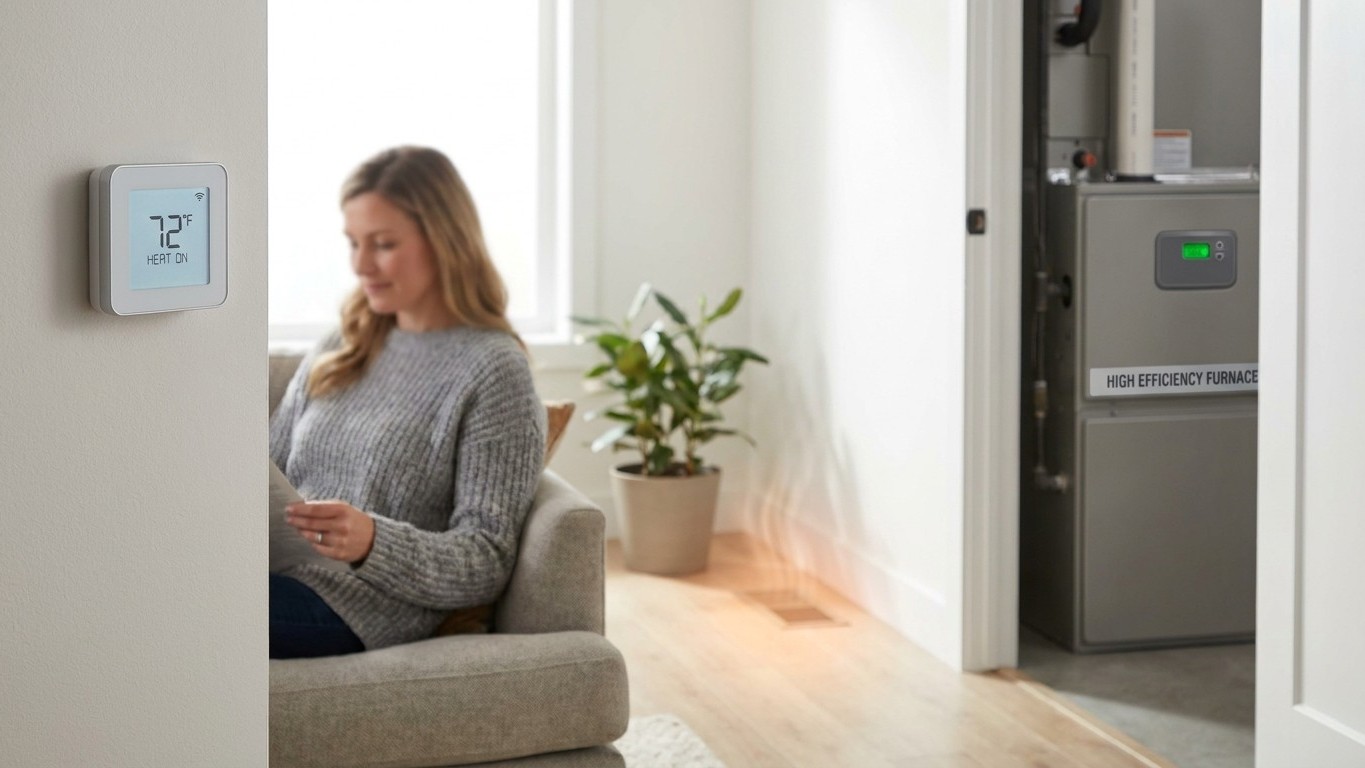

A single-stage furnace runs at one output: full blast, then off. A two-stage furnace spends most of its time at a reduced output and only opens up to full when the house genuinely needs it. A modulating furnace goes further, sliding up and down across a range instead of stepping between two settings. The practical difference lands in three places: how the air feels, how even the house stays room to room, and how much noise you hear when the burner kicks on.
A stage is how much fire

Strip away the marketing language and a “stage” is just a fixed amount of burner output the furnace is allowed to use. A single-stage furnace has exactly one: it’s either firing at full capacity or it’s off. There’s no in-between setting, no partial flame, no dial. When the thermostat calls for heat, the burner lights at full output, heats the house as fast as it can, then shuts off completely once the setpoint is reached. That’s a simple, reliable design, and it’s why single-stage equipment has been the default for so long.
A two-stage furnace adds a second, lower output level, usually somewhere around two-thirds of full capacity, and it defaults to that lower stage first. Only when the lower stage can’t keep up (a cold snap, a big call for heat after the thermostat has been set back) does the furnace step up to full output. Most of the time, especially on an average day, the two-stage unit just runs quietly on low and never needs the higher setting at all.
A modulating furnace removes the steps entirely. Instead of choosing between two fixed outputs, it adjusts the flame continuously across a range, inching output up or down in small increments to match exactly what the house is losing to the outside air at that moment. Where a two-stage furnace picks between “low” and “high,” a modulating one can sit anywhere between them.
What that means for the person living in the house isn’t abstract. A single-stage system produces short, hot bursts of air followed by silence, then another burst. A two-stage or modulating system produces longer, gentler runs at lower output, more often than not never reaching that hot-blast feeling at all. Same total heat delivered over the day, delivered on a very different curve.
What it actually feels like in the house
The difference shows up less in the thermostat reading and more in the texture of daily comfort: how much the temperature swings between cycles, how loud the startup is, whether the far bedroom ever catches up to the living room, and what the air feels like coming out of the vents.
| Comfort factor | Single-stage | Two-stage / modulating |
|---|---|---|
| Temperature swing between cycles | Wider; house cools noticeably before the next cycle fires | Narrower; low-stage runs more frequently and for longer, holding a tighter range |
| Noise at start-up | Full-output blower and burner kick in at once, more noticeable | Low-stage start is quieter; full stage sounds similar to single-stage when it does engage |
| Room-to-room evenness | Hardest-to-heat rooms lag behind, especially on the far end of ductwork | Longer, steadier airflow gives distant rooms more time to catch up |
| Feel of the air | Warm bursts, then nothing until the next call for heat | Milder, more continuous airflow; less of a hot/cold sensation |
| Mild-day performance (small load) | Still cycles full output on and off, even for a small heat call | Stays on low stage, matching the small load without overshooting |
That last row matters more than people expect. On a mild fall or spring day, when the house only needs a trickle of heat to hold its temperature, a single-stage furnace still has only one option: fire at full output for a short burst, then shut off. A two-stage furnace can match that small load with its low setting and just keep running quietly, which is where a lot of the comfort improvement actually comes from.
Here’s the honest part, though: on the coldest day of the year, when the house is losing heat as fast as the furnace can replace it, a two-stage furnace runs at full output almost the entire time, just like a single-stage unit would. Staging doesn’t add capacity, it adds flexibility. The biggest gains show up in mild weather and in houses with rooms that are naturally hard to keep even, not on the single worst night of January.
The blower is half of it
This is the part that gets glossed over in most comparisons: staging the burner without staging the blower only delivers half the benefit. If the burner can run at a lower output but the blower still pushes air at one fixed speed, the airflow doesn’t actually change to match. You get a quieter flame but the same rush of air through the ducts, which undercuts a lot of what makes low-stage operation feel different.
A variable-speed blower is the piece that completes the picture. It can slow down to move less air gently when the furnace is on its low stage, and ramp up to move more air when full output is needed. That’s what turns a two-stage burner into a genuinely different comfort experience rather than just a quieter version of the same thing. When people describe a two-stage furnace as feeling different in the house, they’re usually describing the blower behavior as much as the burner.
There’s a maintenance implication that comes with that upgrade, and it’s one worth taking seriously rather than skipping. A variable-speed blower is actively working to maintain a target airflow, which means it will ramp up its effort to pull air through a filter that’s getting clogged, rather than just quietly moving less air the way a fixed-speed blower effectively does. According to the U.S. Environmental Protection Agency’s ENERGY STAR program, “Airflow problems can reduce your system’s efficiency by up to 15 percent.” On a variable-speed system, a dirty filter doesn’t just reduce airflow, it makes the blower motor work harder to compensate, which is the opposite of what the upgrade is supposed to buy. Filter discipline matters more on this equipment, not less.
For a closer look at how blower speed interacts with duct design, filter selection, and airflow balance, see the guide to furnace blowers on this site.
When the extra complexity earns its place
Two-stage and modulating equipment adds moving parts, control logic, and cost compared to a single-stage furnace. That complexity is worth it in some houses and not really noticeable in others. A few situations where it tends to earn its keep:
- A house that swings noticeably between heating cycles, where the living room feels warm right after the furnace runs and cool again twenty minutes later.
- A house with rooms that never quite even out, particularly ones far from the furnace or with long duct runs, where longer, steadier airflow has more time to reach every register.
- A milder climate where the furnace spends most of the season on light loads and rarely needs to reach full output at all, which is exactly the condition where staging shows up most.
- The counter-case: a small, tightly built house where a single-stage furnace already runs long, steady cycles because the heat loss is low and gradual. In that house, staging has less room to show a difference, since the single-stage unit is already behaving somewhat like a staged one by necessity.
None of this is really a pure energy calculation, and it isn’t presented as one here. This brief carries no pricing information, no payback timeline, and no incentive figures, because those numbers vary by location and change over time in ways that would date a page like this almost immediately. What drives the cost of any given installation is the specific equipment, the ductwork it has to work with, and the labor involved, and none of that is something to guess at from a general article. A written quote is the only reliable way to settle it, and a good one will state the staging (single-stage, two-stage, or modulating) and the blower type (fixed-speed or variable-speed) as two separate line items, not bundled into one description. Those are two different upgrades that happen to often be sold together, and knowing which one a quote is actually offering is worth asking about directly.
Common questions
Does a two-stage furnace use less fuel than a single-stage one?
It can, by running longer at lower output instead of cycling on and off at full output, but this page isn’t the place for cost figures since those depend on the specific house, climate, and fuel source. The comfort difference (steadier temperatures, less noise, better room-to-room evenness) is often what people notice first.
Can a single-stage furnace be upgraded to two-stage later?
Not by adjusting the existing unit. Staging is built into the furnace’s burner and control board, so getting a second stage means replacing the furnace itself rather than modifying the one in place.
Is a variable-speed blower always paired with a two-stage furnace?
Not necessarily. Some two-stage furnaces still ship with a fixed-speed blower, which delivers a smaller version of the comfort benefit. Ask specifically about blower type when comparing quotes, rather than assuming it’s included.
Will a modulating furnace ever run at full output?
Yes, on the coldest days of the year when the house is losing heat as fast as it can be replaced, a modulating furnace will run near or at its maximum output, similar to how a single-stage or two-stage furnace behaves under the same conditions. Its advantage shows up on the milder days in between.