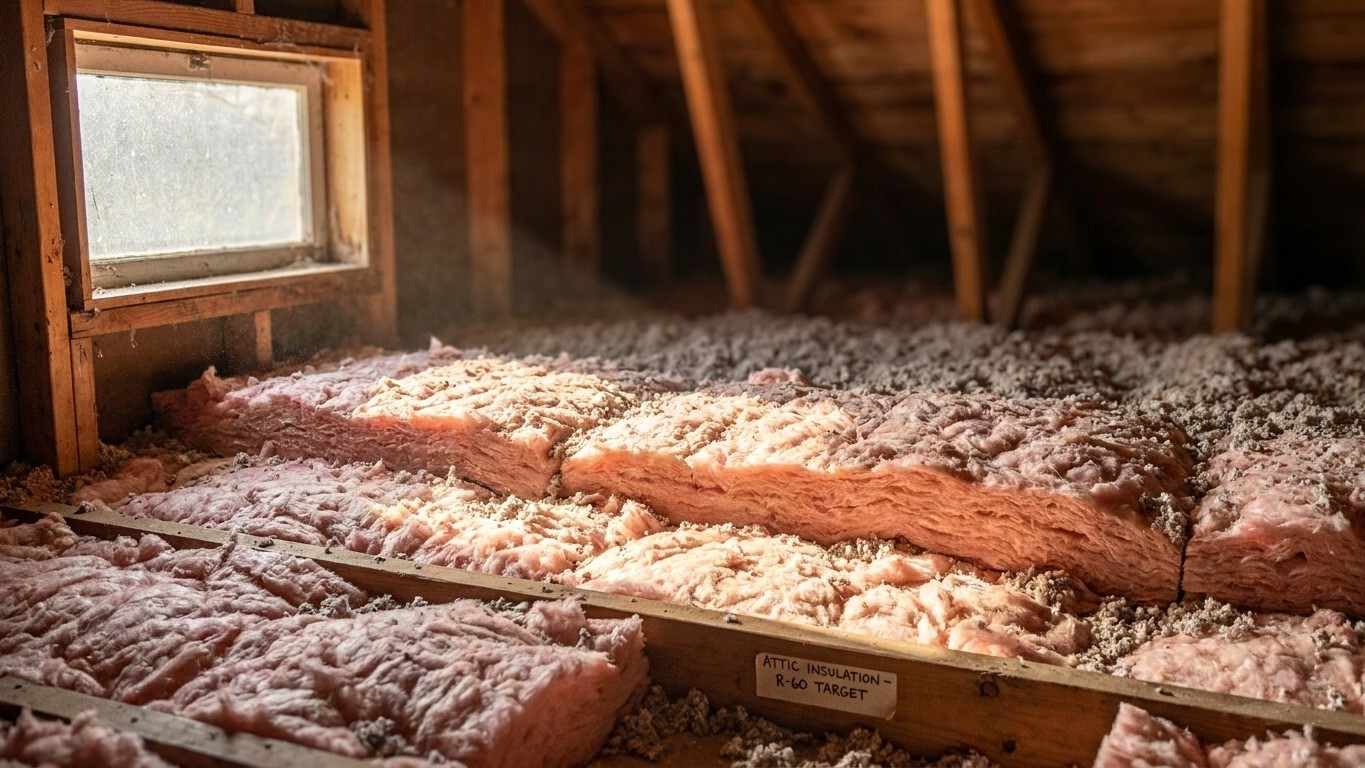

Kentucky sits entirely in IECC climate zone 4A, which means the ENERGY STAR retrofit table calls for R60 in an uninsulated attic (or R49 if you already have 3-4 inches up there) and R19 under the floor. That’s the number every homeowner in the state can use, no county lookup required. What follows explains where that figure comes from and why sealing has to happen first.
Which climate zone Kentucky is in

The 2021 International Energy Conservation Code lists Kentucky as a single entry: 4A (all). Every county, from the Mississippi River bottomlands in the west to the Appalachian foothills in the east, falls under the same designation. No exceptions, no split counties, no need to dig through a county-by-county table before buying Insulation.
That’s worth pausing on, because it’s rare. A lot of states stretch across two or three zones, and a homeowner has to find their own county on a map before they know which row of any Insulation chart applies to them. Kentucky doesn’t ask that of anyone. Whether you’re in Fayette County or Pike County, the zone designation is identical, and so is the Insulation guidance built on top of it.
What the zone number and letter actually mean
A climate zone number is a shorthand for how demanding the local climate is on a building, with lower numbers meaning milder winters and higher numbers meaning colder ones. The letter that follows describes moisture: A for moist, B for dry, C for marine. Zones 7 and 8, reserved for the coldest parts of the country, don’t carry a letter at all because the code treats them as a category of their own.
That letter isn’t decorative. The ENERGY STAR Insulation table groups zones by both number and letter, and 4A gets bundled with 4B in one row while 4C gets grouped with zones 5 and 6 in a different row entirely. A state in zone 4B would read the same attic number as Kentucky, but a state in 4C would not, even though both start with the digit 4. Getting the letter right is what puts you on the correct line of the table.
None of this tells an individual reader which zone their own house sits in, because in Kentucky’s case that question has already been answered for the whole state. If you’re comparing Kentucky to a neighboring state, or you want to see the official boundary lines for yourself, the 2021 IECC Table R301.1 and the ENERGY STAR zone map are the primary sources to check.
The Insulation levels that apply here
ENERGY STAR publishes a retrofit table for existing wood-framed homes, built on the 2021 IECC’s residential provisions. It’s organized by climate zone, and each zone carries three figures that get misread more often than they should. The header is merged: two of the three numbers cover the attic, and the third covers the floor. They are not three attic values stacked together.
| Zone | Attic if uninsulated | Attic if you already have 3-4 inches | Floor |
|---|---|---|---|
| Zone 1 | R30 | R25 | R13 |
| Zone 2 | R49 | R38 | R13 |
| Zone 3 | R49 | R38 | R19 |
| Zones 4A and 4B | R60 | R49 | R19 |
| Zones 6, 5 and 4C | R60 | R49 | R30 |
| Zones 7 and 8 | R60 | R49 | R38 |
Because Kentucky sits entirely in zone 4A, only one row of this table matters here: R60 for an uninsulated attic, R49 if there’s already 3-4 inches of existing material up there, and R19 for the floor. There’s no second row to check, no northern-county figure that differs from a southern one. A homeowner in Paducah and a homeowner in Ashland are working from the same numbers.
That’s a genuine advantage over states that straddle two or three zones, where a reader in the north of the state buys a materially different amount of insulation than a reader in the south. Kentucky doesn’t have that split. It also means these figures shouldn’t be averaged with anything else or nudged up or down based on which part of the state you’re in. The row for 4A is the row, full stop.
One more thing worth saying plainly: these are retrofit levels for existing wood-framed buildings, not new-construction code minimums. If you’re building new, the applicable requirement comes from a different part of the IECC. And nobody should try to convert these R-values into a number of inches. Depth depends entirely on the material, whether it’s fiberglass batts, blown cellulose, or spray foam, and that figure is printed on the product’s own packaging, not derived from an R-value alone.
Sealing comes before insulating
ENERGY STAR treats air sealing and insulation as two parts of a single project, and its own guidance puts attic air sealing before attic insulation, not after. That ordering isn’t arbitrary. Insulation slows heat moving through a material, whether it’s fiberglass, cellulose, or foam. It does nothing to stop air moving around that material, through gaps, cracks, and penetrations that a layer of insulation simply covers up rather than closes.
That distinction matters more than it sounds like it should. An attic with plenty of insulation but unsealed can openings, plumbing chases, or a poorly sealed attic hatch is still leaking conditioned air, and the insulation on top of those gaps hides the problem from view without solving it. Add material first and you’ve made the leaks harder to find later, not easier.
The practical order, following ENERGY STAR’s own sequence, looks like this:
- Seal air leaks in the attic first, before any insulation goes down or gets topped off
- Add or upgrade attic insulation to the recommended level
- Seal and insulate the rim joist, the band around the foundation where the house frame meets the basement or crawlspace
- Address the floor over an unconditioned crawlspace or basement
- Only then move to wall insulation, which is a more invasive and disruptive project
ENERGY STAR’s published savings estimate covers sealing and insulating together as one project, not sealing by itself, so there’s no separate number to attach to the sealing step alone. For the specifics of how each of these steps works in practice, the national insulation guides on this site walk through attic sealing, rim joist work, and crawlspace treatment in more depth than a state-level page like this one can cover.
What the winter here actually asks for
At Louisville International Airport, the NOAA 1991-2020 climate normal comes to about 3,936 heating degree days a year, against roughly 1,742 cooling degree days. Heating degree days aren’t a temperature reading. They’re a running total of how far the daily mean temperature falls below 65 F, added up across the whole year, and they function as a stand-in for how much fuel a house burns to stay warm. A location with twice the heating degree days of another needs roughly twice the heating input to hold a house at the same comfort level, all else being equal.
Kentucky’s number puts it solidly in furnace territory, and the equipment data backs that up. Statewide, 66% of homes heat with a furnace, and 22% use a central heat pump. Natural gas is the fuel behind 43% of homes, electricity behind 49%, and propane behind 4%. Figures for steam or hot-water boilers and for fuel oil or kerosene weren’t published, either because too few households reported them or because the estimate was suppressed as unreliable. That’s not the same as zero. It means the survey simply doesn’t have a publishable number for those categories in this state.
Two-thirds of Kentucky homes moving warm air through ductwork changes what a whole-house project should focus on. Ducts running through an unconditioned attic lose heat to that space constantly, and no amount of insulation laid across the attic floor fixes a leaky duct sitting above it. A house can hit the full R60 attic target and still bleed heat through ducts that were never sealed.
Given that pattern, a few priorities stand out for most Kentucky homes:
- Check and seal ductwork that runs through the attic or an unconditioned crawlspace before finishing the insulation project
- Confirm the attic hits R60 (or R49 over existing 3-4 inch insulation), since that’s the level this climate zone calls for
- Don’t overlook the rim joist and floor over any crawlspace, given the state’s furnace-heavy heating mix
The duct guides on this site go into the specifics of sealing and insulating ductwork in unconditioned spaces, which is where a furnace-dominant state like Kentucky tends to lose the most.
What the work is worth
ENERGY STAR’s own methodology page states it this way: “EPA estimates that homeowners can save an average of 15% on heating and cooling costs (or an average of 11% on total energy costs) by air sealing their homes and adding insulation in attics, floors over crawl spaces, and accessible basement rim joists.” Both numbers matter, and so does what each one is measuring. Fifteen percent applies specifically to heating and cooling costs. Eleven percent applies to total energy costs, a broader category that includes things like water heating and appliances alongside space conditioning.
These are averages pulled from energy modeling of a “typical” existing U.S. home, not a guarantee for any specific house in Kentucky or anywhere else. A home that’s already well-sealed and well-insulated has less room to gain than one that’s never been touched, and a home with unusual duct losses or an oversized heating system won’t necessarily track the model closely.
The estimate also names exactly where this work happens: attics, floors over crawl spaces, and accessible basement rim joists. It doesn’t cover wall insulation, window upgrades, or door replacement, and stretching the 15%/11% figure to include those areas isn’t supported by the source.
It’s worth keeping this number separate from two others that sound similar but measure different things. ENERGY STAR’s general program landing page cites “up to a 10% savings on your annual energy bills” for the same category of work, which is a different, looser claim built on a different denominator. Separately, the Department of Energy’s often-cited 10% figure has nothing to do with insulation at all. It refers to the savings from a thermostat setback of 7 to 10 degrees held for eight hours a day. Three legitimate numbers, three different claims, and mixing them together is how an accurate figure turns into a misleading one.