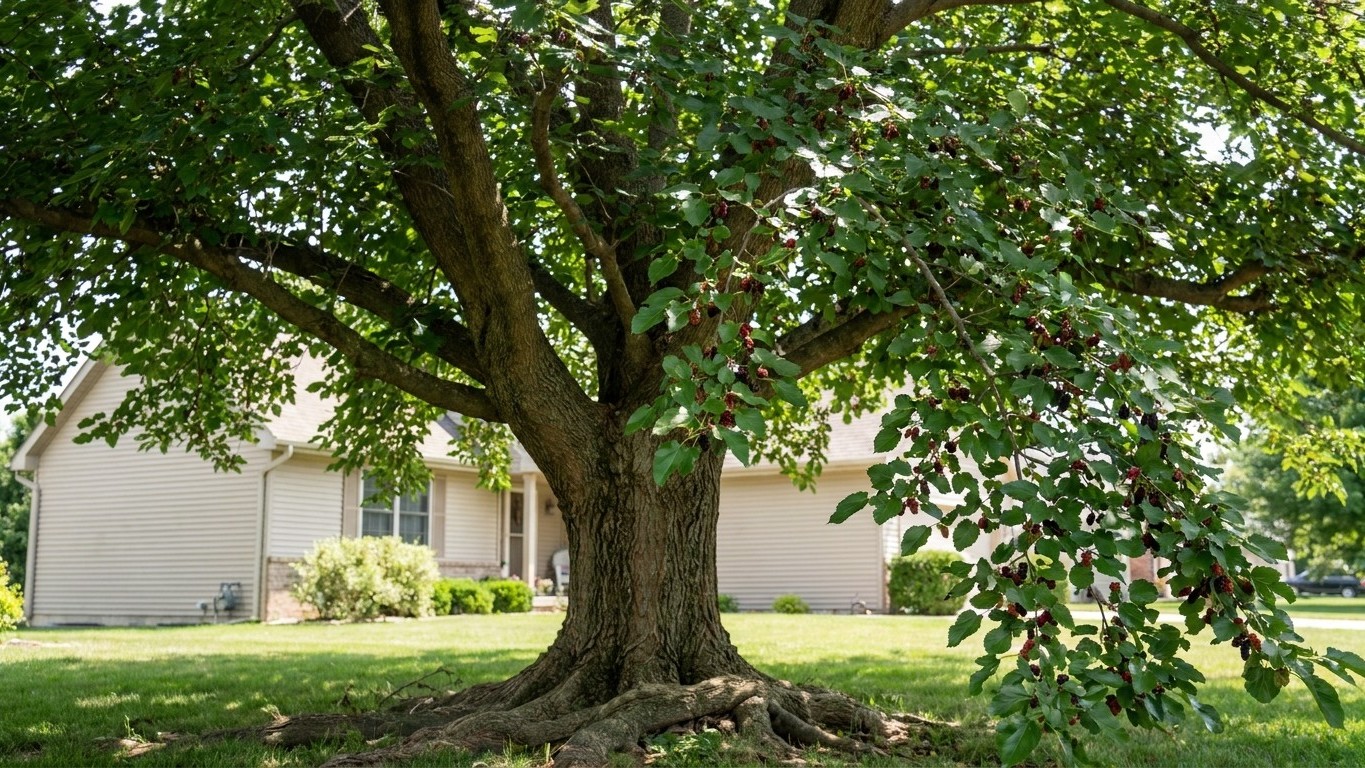

Morus rubra survives across USDA zones 4a-9b, tolerates deep shade to full sun, and grows into a 24- to 60-foot tree if left alone. But surviving and fruiting are two different questions. To get a crop, this native mulberry needs real sun, room to spread, and a site chosen with its mature size in mind, not its size at planting.
Where it will and will not survive
The USDA hardiness range for Morus rubra is 4a-9b. That number does the real work here: it tells you where this tree will not survive, and that is more useful than any list of places it might thrive. Below the bottom of that range, in colder zones than 4a, winter temperatures drop past what the species tolerates and the tree is likely to die back or fail outright. Above the top of it, past 9b, the summers run hotter and longer than what a tree adapted to a cooler climate typically handles well.
A hardiness range is a survival window, not a comfort zone. A tree rated to the warm edge of its range, 9b in this case, is not necessarily happy there. It may hang on through the heat without ever putting on the vigorous growth or heavy bloom it would show a few zones cooler. The same caution applies at the cold edge: surviving zone 4a winters is not the same as thriving in them.
None of this means much until you know your own zone, and that is not something to guess from a state name or a rough sense of climate. Zone boundaries shift with elevation, proximity to water, and local microclimate, sometimes within the same county. Before planting, check your specific zone using the hardiness zone guide on this site, which breaks the data down by state and county rather than by broad region.
What it is called, and why that matters here
The common names in circulation for Morus rubra are Common Mulberry, Mulberry, and Red Mulberry. They are listed here alphabetically, and none of them is the official name. That is exactly why this page uses the botanical name in its title: common names describe how people talk about a plant, not which plant they mean.
This is one of those cases where the ambiguity is worth naming rather than smoothing over. “Mulberry” by itself is not specific to this species. The genus Morus includes other species, white mulberry and black mulberry, that share the same common name and a broadly similar look, especially before the fruit ripens. Someone buying a “mulberry” from a description alone, without the botanical name attached, has no guarantee which species they are getting. “Common Mulberry” doesn’t resolve that either, since it is descriptive rather than exclusive to Morus rubra.
None of the three names is wrong, and none of them is more correct than the others. They are simply the names people use, inherited from regional habit rather than a single naming authority. If a nursery tag, a neighbor, or an online listing calls a tree “mulberry” with nothing else attached, the botanical name is the only way to know for certain it is Morus rubra rather than a related species sold under the same common word.
The site it needs to actually crop
Morus rubra tolerates a wide band of growing conditions. The table below separates what the source documents as tolerated from what actually predicts a good crop, and it is worth being honest about where the facts stop short.
| Condition | What is tolerated | What it means |
|---|---|---|
| Light | Deep shade, partial shade, full sun | Survival across the whole range; the source does not specify which level is needed for fruiting |
| Soil texture | Clay, high organic matter, loam, sand | Broad tolerance for survival and establishment |
| Drainage | Good drainage, moist, occasionally dry | Tolerates variable moisture once established |
| Soil pH | Not specified in the source | The facts do not settle a preferred pH range |
That light tolerance is worth flagging directly: a tree planted in deep shade can survive there. Whether it will ever set a meaningful crop of fruit in that light is not something the source data settles, and this page won’t guess past what it can defend.
Space at maturity
The source gives a mature size spanning 6 to 60 feet, broken into ranges of 6-12 feet, 12-24 feet, and 24-60 feet. That spread reflects how variable this tree’s ultimate size can be depending on site and growing conditions, and it is the single figure most likely to cause regret later. A tree that tops out near the 60-foot end, planted a dozen feet from a house, fence, or driveway, will eventually crowd or overhang structures the planter never accounted for. Growth rate is listed as rapid, so that size difference shows up faster than a slow-growing tree would reveal it. Planning for the top of that range, not the bottom, is the safer bet, and it also matters for the fruit itself: a tree that outgrows easy reach puts its crop higher than a hand or a short ladder can manage.
When it crops, and whether it needs a partner
Morus rubra blooms in spring, given here as a season rather than a calendar date because bloom timing shifts with latitude and elevation. A spring-blooming tree is, by definition, one whose flowers can be caught by a late frost in a cold snap after a warm stretch, the kind of weather pattern that costs an entire season’s fruit on trees that flower before the frost risk has fully passed. That risk is worth knowing going in, even without a specific date to plan around.
What this page cannot tell you, because the source data behind it does not include it, is whether Morus rubra needs a second, compatible tree nearby to set fruit, or whether a single tree bears on its own. Many fruiting trees require cross-pollination from a second plant; others are self-fertile and produce a full crop alone. Guessing based on the genus is not reliable, since related species and even different plants within the same genus can differ on this point.
The same gap applies to how many years pass between planting and a first meaningful crop. That number varies widely across fruiting trees, and nothing in the facts behind this page narrows it down for Morus rubra specifically.
Both of those are questions to settle before buying, not after. Ask a nursery or supplier directly: does this tree need a second tree to bear fruit, and how many years should I expect before it produces a real crop. Getting an answer to both before planting is the difference between a tree that fruits on schedule and one waited on for years with no clear reason why nothing showed up.
What the fruit is, and what it is for
The fruit is described as sweet, blackberry-like in appearance, reddish as it develops and ripening to dark purple. It appears on the tree from May to June. The source is direct about the flavor: the fruits are sweet and juicy, and they can be eaten straight off the tree.
That flavor profile, sweet rather than tart or astringent, is what makes the uses that follow make sense. The source lists the fruit as eaten raw, and also used in pies, jellies, and jams, as well as in breads, muffins, and cakes. That range covers the fruit fresh, cooked down, and baked into other foods, which lines up with a soft, juicy fruit that doesn’t hold its shape well once handled.
That last point matters practically. The source notes these fruits are not commercially sold, because they have very short shelf lives and pack and ship poorly. For a home grower, that is less a downside than a reason the fruit is worth growing at all: it is not the kind of thing you can buy at a store, so the tree is the only practical way to taste it. It also means fruit needs to be used quickly once picked, whether eaten fresh, cooked into jam or wine, or baked, rather than stored for later.
What it resists, and what it does not
Resistance, in a plant profile like this one, means a tendency to shrug off a given pressure, not immunity to it. A resistant tree can still be damaged under the wrong conditions; it is simply less likely to be than a susceptible one. For Morus rubra, the source tracks four resistance categories, and for all four it does not give a defined rating.
| Category | What the source says | What that means for a reader |
|---|---|---|
| Deer | Unspecified | No documented resistance level; assume no protection unless observed locally |
| Fire | Unspecified | No documented resistance level |
| Drought | Unspecified | No documented resistance level; even where noted, drought resistance applies to established plants, not new ones |
| Pollution | Unspecified | No documented resistance level |
Where a rating does exist for a plant, “resistant to deer” still means deer are less likely to browse it, not that they never will in a hungry winter with few other options. Here, though, the honest answer is that the data simply doesn’t rate Morus rubra on any of these four fronts, and this page won’t fill that gap with a guess.
There is a second gap worth naming directly: a resistance list like this one covers pressures on the tree itself, not on the fruit. Fruit-specific pests and diseases, the kind that affect a crop even on an otherwise healthy tree, are not part of the data behind this page at all.
Common questions
Is Morus rubra native to my area?
The source classifies it as a native plant, but that label refers to native status in the southeastern United States specifically, not nationwide. Whether it counts as native where you live depends on your own region.
Does Morus rubra need full sun to produce fruit?
It tolerates light from deep shade through full sun, but that range describes survival, not cropping. The source does not specify how much light is needed for a meaningful fruit set.
Is the whole plant edible, or just the ripe fruit?
The source lists this plant as both edible and poisonous among its classifications. That combination points to the ripe fruit being the edible part, with other parts of the plant treated differently; the source does not break that distinction down further.
How much space should I leave when planting one?
Plan for the top of its mature size range, up to 60 feet, rather than the bottom. Given its rapid growth rate, a tree planted too close to a structure will outgrow the space faster than a slower-growing species would.