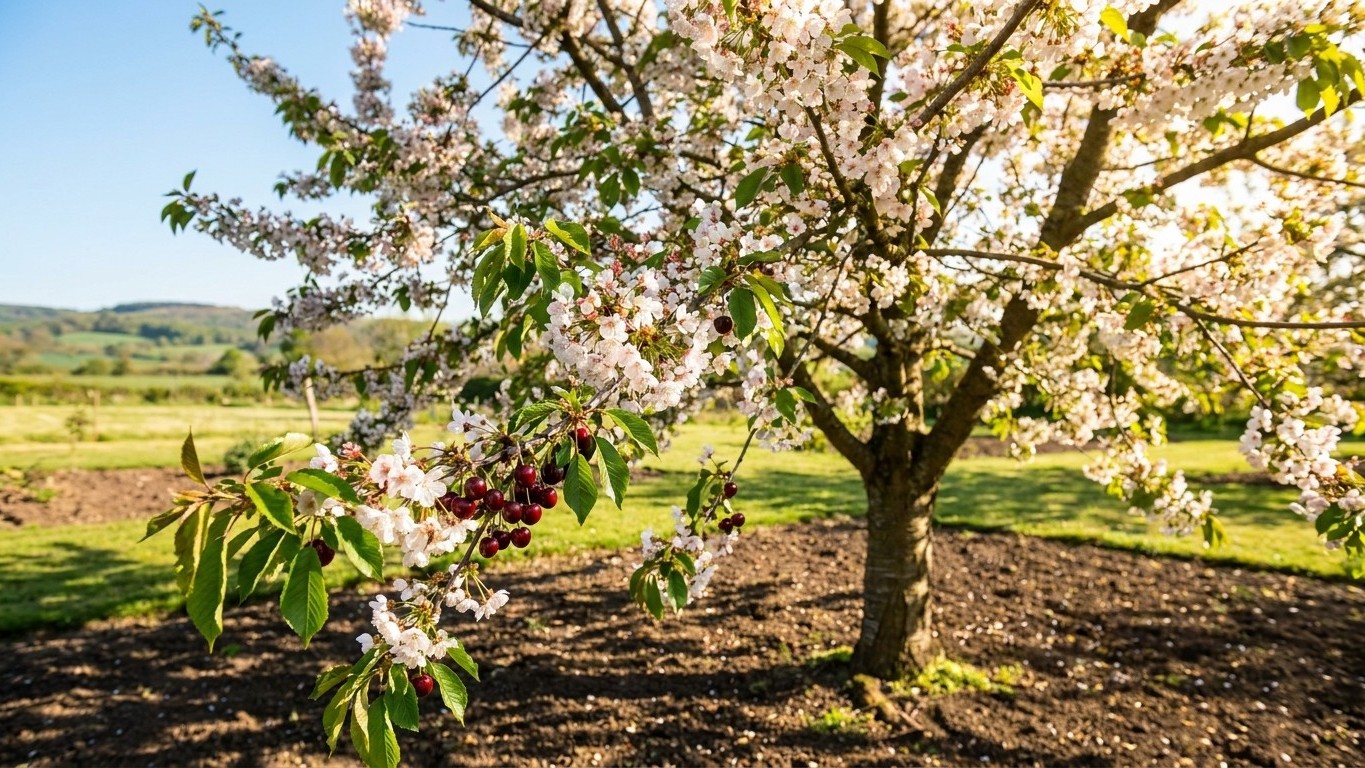

Prunus avium is the botanical name for the sweet cherry tree, hardy in USDA zones 3a to 8b, needing full sun and a lot of room to reach its mature shape. It crops in spring after flowering, but this data set does not say whether it needs a second tree nearby to set fruit, or how many years it takes to bear. Those are questions to settle before buying, not after.
Where it will and will not survive
The USDA hardiness range for Prunus avium runs from zone 3a to zone 8b. A range describes survival, not comfort. A tree rated to the coldest edge, 3a, is the one that will make it through a hard winter there, not necessarily thrive and crop reliably every year. The same caution applies at the warm end: 8b is where the tree can still take the heat, not where it necessarily performs best.
What matters more is what this range rules out. Below 3a, a sweet cherry is not expected to survive a typical winter. Above 8b, the tree is outside the range given for reliable survival. Neither is a judgment call the tree makes season by season; it is a threshold, and thresholds get crossed eventually.
Nobody actually knows their zone from memory as reliably as they think. Zone maps shift at county lines, and a property near the edge of one zone can behave more like the neighboring one depending on elevation, wind exposure, or proximity to large water. Look up the actual zone rather than assuming one from a general impression of the region. This site keeps a hardiness zone guide broken down by state and county for that purpose.
Survival is not the same question as a good crop
“Will this tree live here” and “will this tree crop well here” are different questions. The hardiness range answers the first, within its limits. The second depends on more: late frosts at bloom time, summer heat during fruit development, and site conditions all play a role, none of which are settled by a hardiness zone number alone. A tree can be solidly inside its hardiness range and still have an off year for fruit because of a frost that hit at the wrong week in spring.
What it is called, and why that matters here
The common name in use for this species is Sweet Cherry. No source treats a common name as official, though. The North Carolina Extension Gardener Plant Toolbox, which supplies the growing data on this page, lists common names as they are used, not ranked by correctness, which is why this page is titled by the botanical name, Prunus avium, rather than by “Sweet Cherry” alone. Searching for cherry trees broadly will turn up cousins in the same genus with their own names and hardiness numbers, easy to mix up at the nursery counter.
One thing worth flagging: the same source classifies this species under several labels at once, including both Edible and Poisonous. That is not a contradiction. Fruit trees in this genus commonly carry both labels because different parts of the plant behave differently, the fruit being edible while other tissue, such as bark, leaves, or the pit itself, is not. The source’s edibility note is specific: “Fruit edible raw or cooked.” That note is about the fruit only. The “Poisonous” label on the general classification is not explained further here, and this page will not guess which plant part it refers to. It is simply worth knowing both labels exist on the same entry.
The source also lists this as a Tree with Deciduous foliage, consistent with what most people already picture: not an evergreen, and losing its leaves each fall.
The site it needs to actually crop
The growing conditions in this data set are narrower than a full soil profile. There is a light requirement and a maintenance rating, but no soil texture, pH, or drainage figures are given here, and this page will not fill that gap with numbers the source does not provide.
| Condition | What the source states | Survival or yield |
|---|---|---|
| Light | Full sun (6 or more hours of direct sunlight a day) | Yield. A tree can often live through partial shade; a sweet cherry grown in too little light is far less likely to flower and set fruit well. |
| Maintenance | High | Ongoing care, not a one-time site decision. |
| Soil texture / pH / drainage | Not specified in this data set | Not settled here; confirm locally before planting. |
The distinction between survival and yield matters more for a fruiting tree than for one grown purely for shade or looks. A cherry planted in partial shade may live for years without producing much worth picking, since flowering and fruit set lean heavily on full sun. That is different from a condition that threatens the tree’s life outright. Where the facts do not draw that line clearly, this page says so rather than guessing.
Space at maturity: the mistake that costs the most
The source describes this tree’s habit as columnar, conical, pointing toward a narrower, more upright shape than a wide-spreading shade tree. That is useful shorthand, but not a substitute for an actual mature size figure, which this data set does not carry. Since underestimating a tree’s eventual footprint is often the costliest planting mistake, confirm the expected mature height and spread for the specific tree before planting, and give it room away from foundations, fences, overhead wires, and other trees it will compete with for light and root space.
When it crops, and whether it needs a partner
Bloom time for Prunus avium is listed as spring, a season, not a calendar date, since actual timing shifts with latitude and elevation. What a spring bloom predicts, regardless of exact timing, is exposure to late frost risk: earlier-flowering trees are more likely to be caught mid-bloom by a late cold snap, and a frost hitting open flowers can wipe out that year’s fruit set even when the tree itself is unharmed.
This data set carries no pollination information for Prunus avium, and no figure for how many years a young tree typically takes before bearing fruit. Both are real, practical questions with a real cost: many fruiting trees need a second, compatible tree nearby to produce a crop at all, and gardeners have planted a single tree, waited years, and never gotten fruit for lack of a pollinator. Others simply take several years to reach bearing age regardless.
Do not assume compatibility or self-fertility based on the genus alone; sweet cherries are not uniform on this point, even among named selections of the same species. Before buying, ask a supplier plainly: does this specific tree need a second, compatible tree nearby to produce fruit, and roughly how many years before it starts bearing. A reputable fruit-tree nursery should answer both without hesitation; if not, treat that as a red flag.
What the fruit is, and what it is for
The source describes the fruit in plain botanical terms: fleshy, yellow to red to purple-red, with a large pit (stone) and a long stem. That covers appearance and structure, not taste. It tells a reader what to look for as the fruit ripens through that color range, and confirms the shape most people already associate with a cherry: a single hard pit at the center, held on a distinctly long stem.
On use, the source is direct: fruit edible raw or cooked, covering both eating it straight off the tree and common cooked applications like baking and preserving. Sweet cherries as a category are known for juicy, sweet flesh that eats well fresh (pit removed before eating), and that same juiciness and sugar content suits baking, sauces, or drying. This data set does not carry cultivar-level flavor detail, since named selections differ from one another. No nutrition or health claim appears in the source’s edibility note, so none is added here.
What it resists, and what it does not
Resistance describes a tendency, not immunity: a resistant tree is less likely to be seriously affected by a given pressure, not guaranteed to sail through untouched. This data set does not carry a dedicated resistance list for Prunus avium naming specific pest or disease pressures. What it does carry is narrower.
| What the source reports | What it tells a reader | What it does not tell a reader |
|---|---|---|
| Maintenance: High | The tree needs ongoing, attentive care through its life, more than a low-maintenance species would. | Which specific pest or disease pressures drive that maintenance need. |
| Attracts: Butterflies, Pollinators | Flowers draw pollinating insect activity, which supports fruit set generally. | Nothing about resistance to pests, disease, or browsing. |
That is the honest extent of what this data set offers on the subject. It does not name a specific pest or disease this species tolerates or resists, so none is named here. It is also worth noting that even a full plant-level resistance list would typically speak to pressures on leaves, bark, and general vigor, not to pests and diseases that target the fruit itself, a separate concern this brief does not cover either. Both gaps are worth flagging rather than filling with a guess.
Common questions
Is Prunus avium the same as ornamental flowering cherry?
No. Prunus avium is the sweet cherry, grown primarily for its edible fruit, classified by the source as edible, poisonous (in reference to non-fruit plant parts), and a tree. Ornamental flowering cherries are typically different species within the same genus, grown for bloom display rather than fruit production.
Does a sweet cherry tree need another tree nearby to produce fruit?
This data set does not say. Many fruit trees, including many sweet cherries, require a second, compatible tree nearby to set fruit, but this is not universal across the species or its selections. Ask a supplier directly before buying.
How long before a newly planted sweet cherry tree bears fruit?
No figure for this is included here. Years to first bearing varies by tree and rootstock, and it is one of the two questions worth confirming with a nursery before purchase, alongside pollination needs.
How much space does a mature sweet cherry tree need?
This source describes the habit as columnar and conical but does not give an exact mature height or spread. Confirm the specific tree’s expected mature size before planting near structures, fences, or other trees.