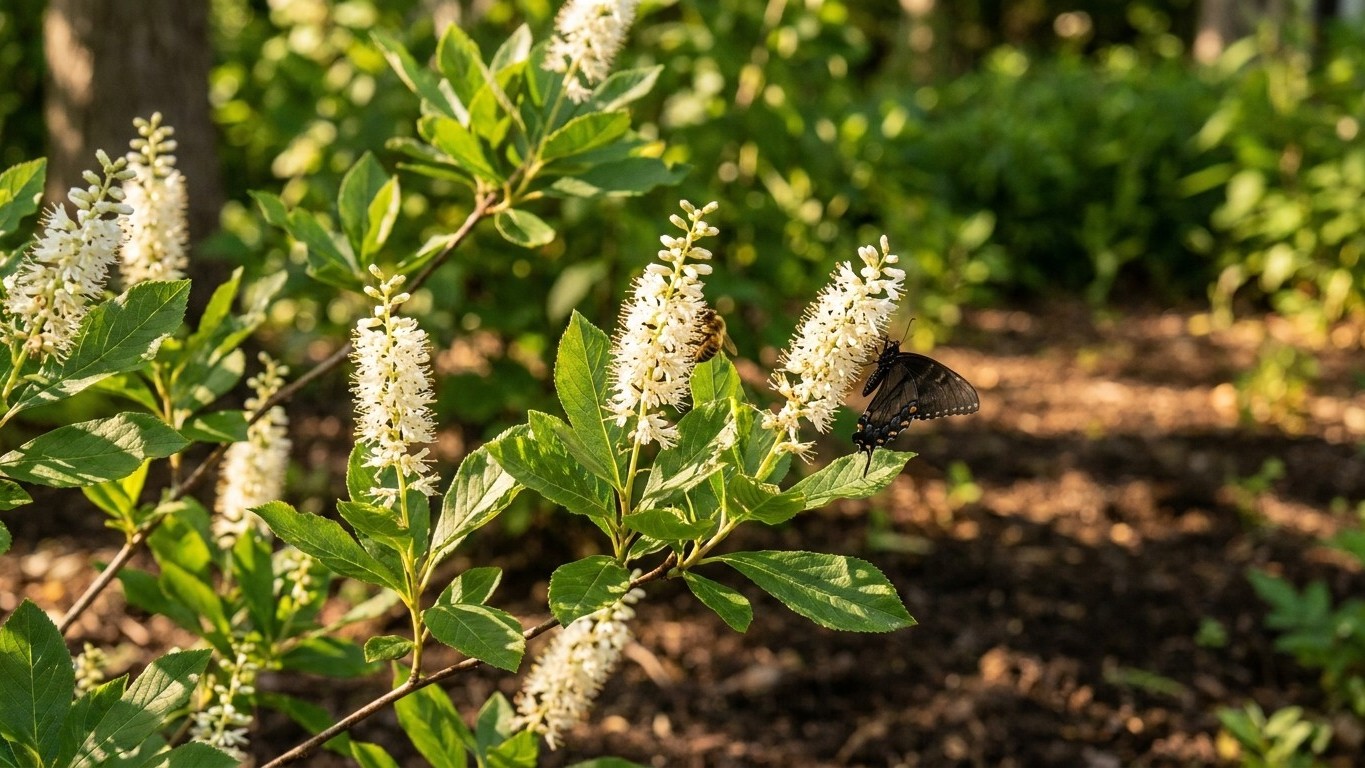

Clethra alnifolia, also sold as Alderleaf Clethra, Alderleaf Pepperbush, Coastal Sweet-pepperbush, or Sweet Pepperbush, is a deciduous native shrub hardy in USDA zones 3a-9b. It wants full sun or partial shade, soil that stays on the moist side, and it flowers in summer on wood the reader needs to watch for a season before pruning. Growth rate is medium, maintenance is low, and it draws bees, butterflies, hummingbirds and songbirds.
Where it will and will not survive

The USDA hardiness range for this shrub is 3a-9b. Below the bottom of this range, the wood won’t survive a normal winter low. Above the top of it, the plant is being asked to handle heat and winter mildness it isn’t built for, and it tends to decline rather than die outright.
A range like 3a-9b describes survival, not comfort. A shrub rated to the coldest edge of its range is not necessarily happy there, it’s surviving there. The same goes for the warm end: 9b is a place this plant can technically live, not a place it necessarily performs at its best.
Zone numbers on a national map are averages smoothed across huge areas, and they can be misleading at the county level, especially near coastlines, at elevation, or in urban heat pockets that run a full zone warmer than the surrounding countryside. Rather than assume a zone from memory or a regional stereotype, look up the actual hardiness zone for your county on this site’s hardiness zone guide before you plant. That page carries the zone data down to the county, which is the resolution that actually protects a $30 shrub from a $0 mistake.
One more caution on sourcing. The plant data comes from the North Carolina Extension Gardener Plant Toolbox. The USDA hardiness range, 3a-9b, is a national standard and applies everywhere. But that same source also publishes region-specific guidance for North Carolina’s Coastal, Piedmont, and Mountain zones, calibrated to North Carolina’s climate divisions, not to wherever the reader happens to garden. If you come across North Carolina-specific placement advice for this plant elsewhere, treat it as local color, not a national rule.
Light, soil and where it belongs
The source lists a set of conditions this shrub tolerates, not a single ideal setup it demands. Read the following table as a menu of what it can handle, not a recipe it needs followed to the letter.
| Condition | Tolerances reported |
|---|---|
| Light | Full sun (6+ hours direct) or Partial Shade (2-6 hours direct) |
| Soil texture | Clay, High Organic Matter, Loam (Silt), Sand |
| Soil pH | Acid (below 6.0), Neutral (6.0-8.0) |
| Drainage | Good Drainage, Moist, Occasionally Dry, Occasionally Wet |
That spread of tolerated soils, from sand to clay, acid to neutral, tells you this is a shrub that adapts rather than demands, but the drainage line is worth a second look: it accepts moist and even occasionally wet ground, making it a candidate for a low corner that stays soggy after rain, the kind of spot where a lot of other shrubs sulk or rot.
What it looks like from the window
The habit is described as dense, erect, mounding, multi-stemmed and oval. That combination reads as a shrub with real body to it, not an airy, see-through form. Planted along a fence line or foundation, it will read as a solid mass, which makes it a screening plant more than a specimen valued for winter branching. Because it’s multi-stemmed rather than single-trunked, it fills in from the base, so gaps at the bottom close up as it matures.
The source doesn’t give an exact spread figure for this shrub, so check the plant tag or a local nursery for the specific cultivar’s mature width before setting a hedge line. What the dense, mounding, multi-stemmed habit does tell you is the spacing logic: for a hedge or screen, plants are typically set closer than their eventual spread so the mounds merge into one continuous line; for a specimen meant to keep its individual oval shape, it needs open space on all sides. Measure the actual tag width for your cultivar, then decide which spacing goal you’re planting for.
When it flowers, and what that decides
This shrub blooms in summer. That’s given as a season rather than a calendar month, because bloom timing shifts with latitude and elevation: a summer bloom in a warmer, lower-elevation spot can arrive noticeably earlier than the same shrub’s bloom at a cooler, higher-elevation site even a few hundred miles away. Watch your own plant’s timing rather than a date printed on a tag grown somewhere else.
The bloom itself isn’t the part that costs a reader a season of flowers, the pruning timing is. Flowering shrubs fall into two camps. One flowers on wood that grew the previous year, meaning the flower buds are already set by the time winter arrives, and pruning that shrub in late winter or early spring cuts off the very buds that would have opened that summer, so it gets pruned right after it finishes flowering instead. The other flowers on new growth put on during the current season, so it can be pruned before growth starts in spring without sacrificing a single bloom.
The facts available for this shrub don’t settle which camp it falls into, so watch one full growing season before making a pruning decision. If new spring stems carry flower buds that open that same summer, treat it as a new-wood bloomer and prune before spring growth begins. If instead the flowers open on stems that already existed the previous fall, wait until right after flowering to prune. One season of observation costs nothing; one wrong late-winter cut can cost an entire summer’s flower display.
Planting and the first two years
Getting a woody shrub through its first two seasons matters more than almost anything done afterward. Follow this sequence at planting time:
- Plant in spring or fall, when temperatures are mild and the plant isn’t fighting summer heat or a frozen root zone while it’s trying to establish new roots.
- Dig the hole wider than it is deep, roughly two to three times the width of the root ball, since new roots spread outward through loosened soil far more easily than they push downward.
- Set the root flare, the point where the trunk widens into roots, right at or slightly above the surrounding grade. Buried too deep, the base stays wet and can rot over time.
- Tease out any roots that are circling the root ball. Left alone, they keep circling in the ground and can eventually girdle the trunk years later.
- Backfill with the native soil that came out of the hole, rather than swapping in amended potting mix, so roots don’t stay confined to a rich pocket and refuse to grow into the surrounding ground.
- Water deeply right after planting, soaking the entire root zone rather than a quick surface splash.
- Mulch two to three inches deep, but keep it pulled back from direct contact with the stems, since mulch piled against the base holds moisture against the bark and invites rot.
The tolerance for occasionally dry soil, and the general reputation shrubs like this one earn for handling drought, applies to an established plant with a developed root system, typically two years or more in the ground. A shrub planted this spring hasn’t earned that resilience yet. The first two summers are the ones that decide whether it survives, and they call for supplemental watering during dry spells regardless of what the mature plant’s tolerance list says.
Expect very little from year one. Most shrubs put their early energy into root growth underground rather than top growth anyone can see, so a plant that looks stalled the first season is often doing exactly what it should. Year two usually brings visible fill-in, and year three is when it starts to perform the way the plant tag promised.
What it resists, and what it does not
Resistance on a plant label means a tendency to shrug off a pressure most of the time, not a guarantee against it ever happening. A deer-resistant plant can still get nibbled by a hungry animal in a hard winter with nothing else to eat; a drought-resistant plant still needs water while it’s establishing. Read every item below with that qualifier attached.
| Challenge | What resistance means here | What you’d actually see |
|---|---|---|
| Deer | Not a preferred browse plant | Occasional nibbling possible, especially in a hard winter, but not the plant’s usual fate |
| Salt | Tolerates salt exposure better than average | Fewer leaf-edge burns near roads salted in winter or coastal salt spray |
| Wet soil | Handles occasionally saturated ground | No root rot in a low spot that stays soggy after storms |
| Heavy shade | Tolerates low light better than most flowering shrubs | Survives under a shade tree, though bloom may be lighter than in more light |
| Erosion | Root system helps hold soil in place | Useful on a slope or bank prone to washout |
| Fire | Some tolerance to fire exposure | Relevant mainly in landscapes near fire-prone vegetation |
| Insect pests | General resistance to common insect damage | Fewer chewed or skeletonized leaves than a susceptible neighbor |
| Diseases | General resistance to common disease pressure | Fewer spotted, wilted, or dropped leaves through the season |
Paired with a medium growth rate and a low maintenance rating, this is a shrub that fills its space steadily rather than explosively and doesn’t demand a regular pruning or spraying schedule to stay presentable. Low maintenance doesn’t mean no maintenance, though. It still needs the pruning-timing judgment call covered above, and it still needs the space its dense, mounding habit calls for so it isn’t fighting a fence, a wall, or a neighboring shrub for room by its third or fourth year.
Common questions
Is Clethra alnifolia the same plant as Summersweet?
Yes. Summersweet, Sweet Pepperbush, Coastal Sweet-pepperbush, Alderleaf Clethra, and Alderleaf Pepperbush are all common names used for the same botanical species, Clethra alnifolia. None of these common names is more official than another, which is exactly why the botanical name is used to identify the plant reliably.
Does “Native Plant” mean this shrub is native to my area?
Not necessarily. The source classifying it as a native plant is a North Carolina extension resource, and in that context “native” refers to native range in the southeastern United States. Whether it counts as native where you garden depends on your own region’s native plant list, not on this label alone.
Can I prune it in late winter to shape it before spring?
Only once you know which wood it flowers on, and the facts here don’t settle that. Watch one growing season first: if flowers open on brand-new spring growth, late-winter pruning is safe; if flowers open on stems that grew the previous year, late-winter pruning removes the buds and costs you that summer’s bloom.
What does the fruit look like, and is it edible?
The fruit is a small, brown, three-valved capsule, about 1/8 inch across, that ripens in fall and persists on the plant through winter, adding visual interest to the bare shrub. Nothing in the available information indicates whether it’s edible, and it shouldn’t be assumed to be.