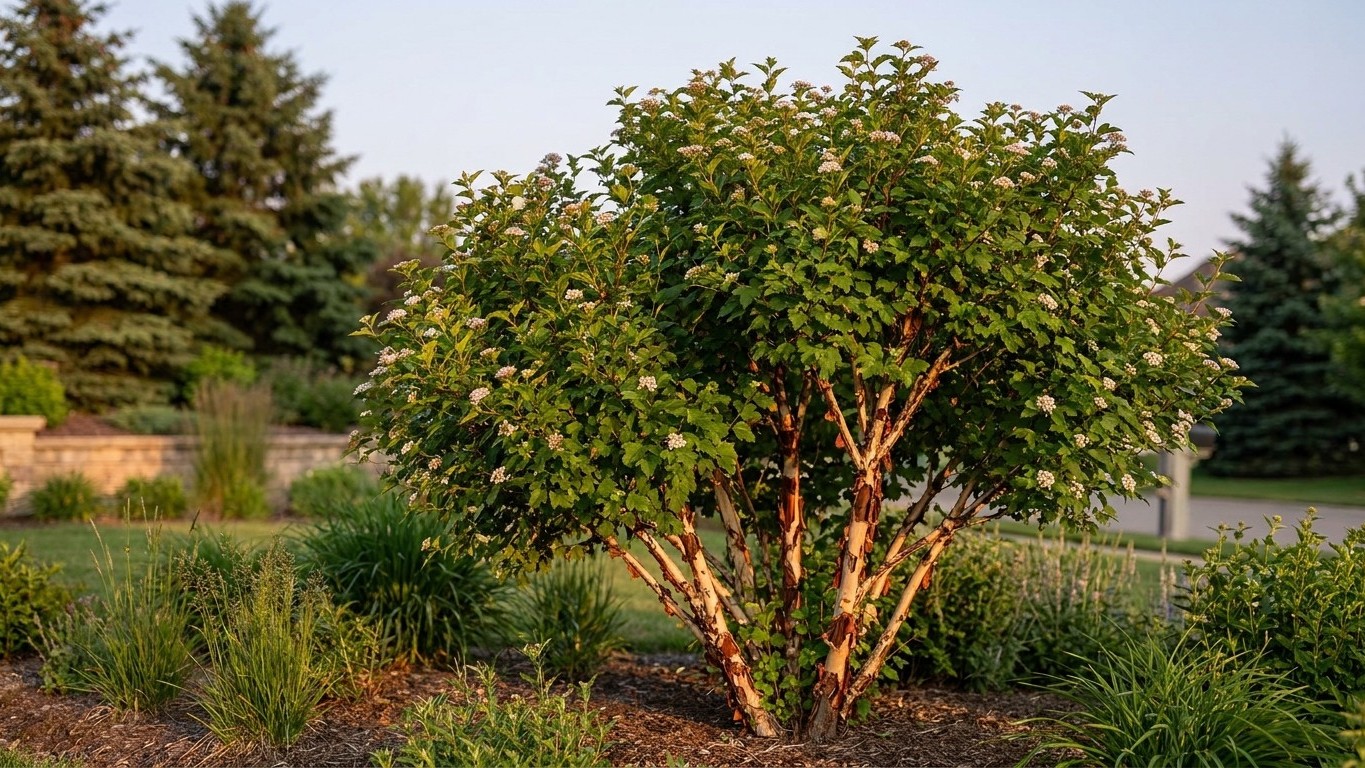

Physocarpus opulifolius, sold under names like Atlantic Ninebark, Common Ninebark, Eastern Ninebark, Ninebark, or simply Nine Bark, survives across USDA zones 2a through 8b. That’s an unusually wide range for a shrub, and it’s the reason this deciduous, multi-stemmed plant shows up in gardens from cold interior climates to warm coastal ones. What decides whether it thrives where you live isn’t just that range, though. It’s how close your site sits to either edge of it.
Where it will and will not survive

The USDA hardiness range for Physocarpus opulifolius runs 2a-8b. That’s a span, and a span like this exists to tell you where a plant survives winter cold and summer heat, not where it looks its best. Below the bottom of this range, winter lows go past what the shrub’s wood and roots can take, and it won’t come back reliably. Above the top of it, the plant may survive but the summer heat load works against it in ways a nursery tag never mentions.
A shrub rated to the warm end of its range, 8b in this case, is not automatically comfortable there. Survival and thriving are different claims. A ninebark planted at the edge of its tolerance can hang on for years while never quite filling out the way the same plant does in the middle of its range.
None of this tells you what zone you’re actually gardening in, and that’s the part worth getting right before anything else. Zone lines shift with elevation, with proximity to large bodies of water, and with local microclimates that a national map can’t capture. Rather than guess from a general USDA map, check your own county against the hardiness zone guide on this site, which carries that detail down to the county level.
The plant data behind this range comes from the North Carolina Extension Gardener Plant Toolbox. The USDA hardiness figure is a national standard, so citing it here is straightforward. What that same source says about coastal, piedmont, or mountain conditions inside North Carolina is regional advice built for North Carolina gardeners specifically, and it doesn’t transfer to a reader gardening somewhere else. Zone 2a to 8b is the number to carry with you; anything more specific has to come from a source built for your own region.
Light, soil and where it belongs
The growing conditions reported for this shrub aren’t a recipe for one ideal spot. They’re a list of what it tolerates, which is a different and more useful thing when you’re matching a plant to a yard that doesn’t offer perfect conditions anywhere.
| Factor | Tolerated range |
|---|---|
| Light | Full sun (6+ hours direct) or partial shade (2-6 hours) |
| Soil texture | Clay, loam/silt, or sand |
| Soil pH | Acid, alkaline, or neutral |
| Drainage | Good drainage, moist, or occasionally dry |
That spread covers most soils a homeowner would encounter without amending anything. It doesn’t mean the plant performs identically in all of them; a shrub in full sun with good drainage will generally build denser growth than one in partial shade on soil that stays wet, but it won’t necessarily fail in either case.
Its habit is described as arching, dense, erect, multi-stemmed, and spreading, all at once. In practice that means it doesn’t read as a single clean silhouette from a window the way a rounded, single-stemmed shrub does. Expect a looser, fountain-like mass of stems that fills in from the base outward, which makes it more useful as a screen you plant in front of a fence than as a specimen you expect to frame like a piece of topiary. Against a wall, give it room to arch outward without brushing siding or a walkway.
Space at maturity runs 6 feet to 12 feet, and that single figure implies two different spacing decisions depending on the job. Planted as a hedge meant to knit together into one screen, plants go in closer, toward the lower end of that spread or slightly under it, so the arching stems overlap. Planted as a standalone specimen, give it the full 12-foot allowance on every side, including from the house or fence line, since a shrub that reaches full size and finds itself six feet from siding was planted for the wrong role.
When it flowers, and what that decides
Physocarpus opulifolius blooms in spring and summer, a season range rather than a fixed month, since bloom timing shifts with latitude and elevation. A reader in a warmer zone will see flowers earlier in the calendar than a reader in a colder one, even on the same species.
The bloom season matters less for the display than for what it decides afterward: when you’re allowed to prune without cutting off next year’s flowers. The rule that governs every flowering shrub comes down to which wood carries the blooms. A shrub that flowers on last year’s growth, meaning the wood it grew the previous season, gets pruned right after it finishes blooming, because pruning any other time removes the buds that were already set. A shrub that flowers on the current season’s new growth can be pruned before growth starts in late winter or early spring, since the wood that will carry flowers hasn’t grown yet.
The available facts on this plant don’t settle which category it falls into. Rather than guess, the reliable way to find out is to watch one full growing season. Note whether flowers appear on stems that clearly grew the year before (thicker, slightly weathered wood) or on fresh green growth put out that same spring. Once you’ve seen it once, the pruning window becomes obvious and you won’t need to reason it out again.
Until you’ve made that observation, the safer move is to prune lightly and only to remove dead or damaged wood, saving any larger shaping cuts for after you’ve confirmed which wood is doing the flowering. A wrong guess here doesn’t kill the plant, but it can cost you a season’s worth of flowers.
Planting and the first two years
Getting a ninebark established follows the same sequence that works for most woody shrubs, and skipping steps here shows up two summers later as a plant that never filled in.
- Plant in spring or fall, when the ground is workable and Temperatures aren’t at their extreme.
- Dig the hole wider than it is deep, roughly two to three times the width of the root ball, so lateral roots have loosened soil to grow into.
- Set the plant so the root flare, the point where the trunk widens into roots, sits at or slightly above grade, never buried.
- Tease out any roots that are circling the root ball; left alone, they keep circling underground and can eventually girdle the plant.
- Backfill with the native soil dug from the hole, without heavy amendment, so roots don’t stay confined to a richer pocket and refuse to spread.
- Water deeply right after planting, soaking the root zone rather than sprinkling the surface.
- Apply mulch two to three inches deep, kept a few inches back from the stems so it doesn’t hold moisture against the bark.
The drought tolerance associated with this shrub applies to an established plant, one that’s had a season or two to build a root system reaching beyond the original planting hole. A shrub in its first summer hasn’t done that yet, and it needs regular, deep watering regardless of what the label says about drought resistance later on.
Many shrubs, this one included, follow a predictable pattern: they sulk the first year while roots establish, fill in visibly by the second, and hit their real stride in the third. A ninebark that looks thin or slow to leaf out in year one isn’t necessarily failing. Digging it up on the assumption that it’s dying is the most common way gardeners undo a plant that would have come around on its own.
What it resists, and what it does not
Resistance in a plant description means a tendency, not a guarantee. A shrub described as drought tolerant can still struggle in an unusually severe dry spell; it just handles ordinary dry stretches better than a species without that tendency. That distinction matters more than the label itself.
| Condition | What tolerance means here | What you’d see |
|---|---|---|
| Drought | Established plants handle dry spells better than average, once root systems are developed | Foliage holds up through short dry periods without wilting badly, in a plant past its first two seasons |
That’s the resistance trait the source data confirms clearly. It doesn’t carry a list of specific pests or diseases the plant resists, so none should be assumed here.
Growth rate is listed as rapid, and maintenance as medium. Together those two figures tell you what to expect once the shrub is past establishment: it will reach its mature spread faster than a slow-growing shrub would, which means the spacing decisions made at planting time matter sooner rather than later. Medium maintenance suggests it isn’t a plant you can ignore entirely, but it also isn’t one that demands constant shaping. Expect to prune on the schedule dictated by its bloom timing, thin out old or crowded stems periodically to keep air moving through the multi-stemmed base, and check that its arching habit hasn’t started to spread past the space you allotted it.
Common questions
Is Physocarpus opulifolius native to my region?
The source classifies it as a native plant, but that classification refers to the southeastern United States specifically, not to every region where the shrub is sold and planted. Whether it counts as native where you garden depends on your own location, not on the label alone.
Does the hardiness range mean it will look good in zone 8b, or just survive?
Survive. The 2a-8b range describes where the plant can live through winter cold and summer heat, not where it performs at its best. A shrub at the warm edge of its range can survive there for years without ever filling in as densely as it would closer to the middle of that range.
How do I know if my ninebark blooms on old or new wood?
Watch one growing season. If flowers appear on stems that clearly grew the previous year, it’s blooming on old wood and gets pruned right after flowering. If flowers show up on fresh green growth from that same spring, it’s blooming on new wood and can be pruned before growth starts.
How far should I plant it from my house or a fence?
Use the full mature spread, 6 feet to 12 feet, measured from every side, including structures. For a specimen planting, give it the full allowance; for a hedge, plants go closer together so the arching stems overlap and knit into a screen.