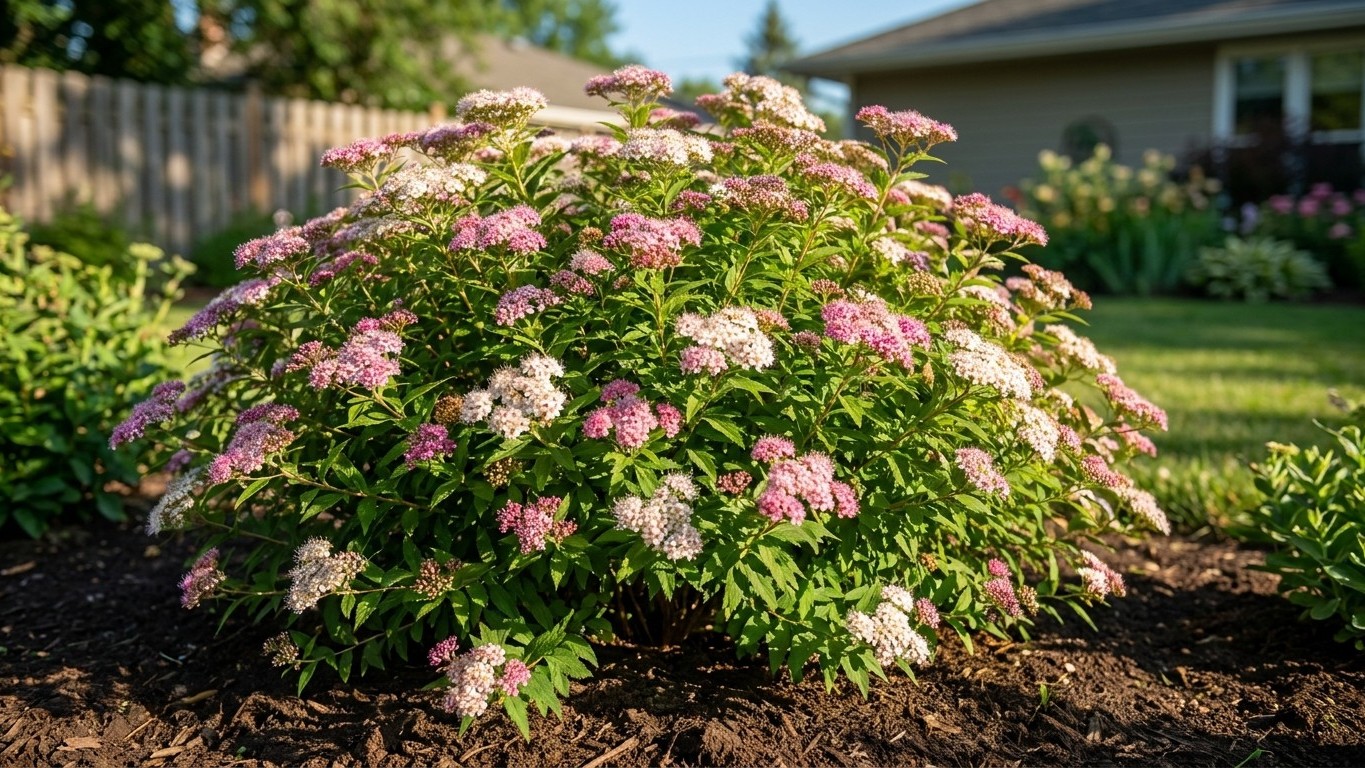

Spiraea japonica survives across USDA hardiness zones 3a through 8b, takes full sun or partial shade, and tolerates soil ranging from clay to loam as long as drainage is good. At maturity it stays compact, 3 to 6 feet wide, which makes spacing the detail most gardeners get wrong. Whether you prune it before growth starts or right after the flowers fade depends on which season’s wood carries the bloom, and that’s a detail worth confirming on your own plant rather than assuming from a tag.
Where it will and Will Not Survive
The USDA hardiness range for Spiraea japonica, as listed by the North Carolina Extension Gardener Plant Toolbox, is 3a-8b. That’s a wide band, but the useful reading of it isn’t where the shrub does well, it’s where it flatly won’t make it. Below the bottom of this range, winter cold kills the plant outright, roots and all. Above the top of it, the summers run too warm and too long for the shrub’s dormancy needs, and it declines rather than grows.
A hardiness range describes survival, not comfort. A shrub rated to the warm edge of its zone can limp along there, stressed every summer, never filling out the way it would a couple of zones cooler. The same goes for the cold edge: surviving zone 3a doesn’t mean thriving in it, just not dying from it. Treat the range as a boundary condition, not a recommendation.
Figuring out which side of that boundary you’re on takes knowing your own zone, not guessing at it from a general sense of your climate. Zone lines don’t follow state borders, and they shift with elevation and local microclimates in ways a national map glosses over. Check your county against this site’s hardiness zone guide before you plant, rather than relying on what a neighbor’s yard or a decades-old memory suggests.
The North Carolina Extension source that supplies this hardiness figure also publishes regional planting advice specific to that state’s coastal, piedmont, and mountain zones. None of that regional guidance applies outside North Carolina, and it isn’t repeated here for that reason. The 3a-8b range itself is a national USDA figure and travels fine; the local commentary attached to it in that source does not.
Light, soil and where it belongs
The extension data lists this shrub’s site tolerances as a set of conditions it accepts, not a single ideal setup. Here’s how they break down:
| Condition | Tolerance range |
|---|---|
| Light | Full sun (6+ hours direct) or partial shade (2-6 hours direct) |
| Soil texture | Clay, high organic matter, loam (silt), shallow rocky soil |
| Soil pH | Alkaline (above 8.0) |
| Drainage | Good drainage required |
Good drainage is the one non-negotiable item on that list. The shrub accepts clay, rocky ground, or rich loam, but standing water around the roots isn’t part of what it tolerates, regardless of how forgiving it is about texture and pH.
In the landscape, its habit is described as dense, erect, and rounded, which reads as a solid mound from a window rather than something you see through. That makes it useful for softening a foundation line or filling the gap between a walkway and a fence, but it won’t work as a low, open border where you want to see past it to something behind.
Space at maturity runs 3 feet to 6 feet, and that single figure implies two different spacings depending on the job. Planted as a hedge, set plants at roughly half their mature spread apart, around 18 to 30 inches on center, so the mounds knit together into a continuous line. Planted as a specimen, give it the full 3 to 6 feet of clearance on every side, including from a wall or fence, so the rounded shape fills out without getting pruned flat against a structure it was never meant to touch.
When it flowers, and what that decides
Bloom time is listed as spring and summer, a season-long window rather than a fixed month. That range shifts with latitude and elevation, so a plant blooming in late spring in one location may not open until early summer in a cooler or higher one. After the flowers fade, the shrub sets fruit described as a dry, brown follicle, a seed pod rather than anything edible, and those pods often persist into the later part of the growing season as a secondary bit of texture.
The bloom timing matters most for one practical decision: when to prune. Shrubs that flower on last year’s wood, called old wood, are pruned right after they finish blooming, because next year’s flower buds form soon after on that same season’s new growth. Shrubs that flower on this year’s new growth, new wood, get pruned before growth starts in late winter or early spring, since the wood that will carry flowers hasn’t grown yet.
The source data doesn’t settle which category this shrub falls into, so the honest answer is to watch one full season rather than guess. If you prune it back hard in late winter and it still flowers normally that same year, it’s blooming on new wood and late-winter pruning is safe going forward. If a hard late-winter cut noticeably reduces or delays that year’s bloom, it’s flowering on wood that formed the previous season, and pruning should wait until right after the flowers drop instead.
Planting and the first two years
Getting a new shrub established follows the same sequence regardless of species, and skipping steps here shows up two summers later as a struggling plant.
- Plant in spring or fall, when temperatures are mild and the plant isn’t fighting summer heat while trying to grow new roots.
- Dig the hole wider than it is deep, roughly twice the width of the root ball, so roots can spread into loosened soil rather than hitting a hard-sided pit.
- Set the root flare, the point where trunk meets roots, right at or slightly above grade. Buried too deep, it invites rot at the base.
- Tease out any roots that are circling the root ball before planting, so they grow outward instead of continuing to wrap around themselves.
- Backfill with the native soil dug from the hole, without amending it heavily, so roots don’t stay confined to a rich pocket and refuse to spread beyond it.
- Water deeply right after planting and regularly through the first two growing seasons, enough to soak the root zone rather than just wet the surface.
- Mulch two to three inches deep in a ring around the plant, keeping it pulled back from direct contact with the stems.
Drought resistance in the source data describes an established plant, one with roots that have had time to spread well beyond the original root ball. The first two summers are the ones that decide whether the shrub reaches that point at all, and it needs consistent water through both of them no matter what the tolerance label says about mature plants.
Expect a slow start. Many shrubs sulk through their first year, barely growing while roots establish underground, then fill out visibly in year two and hit their stride by year three. A quiet first season isn’t a sign of failure, and digging up a plant that’s simply settling in wastes the two years already invested in it.
What it resists, and what it does not
Resistance means a tendency to hold up under a particular stress, not immunity from it. A shrub resistant to drought can still decline in a severe or extended dry spell; the label just means it copes better than a plant without that tendency.
| Challenge | What resistance means here | What you’d see |
|---|---|---|
| Drought | Established roots draw on reserves during dry stretches | Less wilting during dry spells, once the plant is past its first two seasons |
| Erosion | Dense root mass helps hold soil in place | Fewer bare patches or washouts on a slope or bank planting |
The source data doesn’t specify a degree beyond listing these two tolerances, so treat both as general strengths rather than guarantees under extreme conditions.
Growth rate is listed as rapid, and maintenance as high, and those two figures explain each other. A shrub that fills its 3-to-6-foot space quickly also needs regular attention to keep it there, whether that’s the seasonal pruning discussed above or occasional shaping to keep a hedge line even. Give it the room its mature spread calls for from the start, and budget for yearly pruning rather than treating it as a plant you set and forget.
Common questions
Is Spiraea japonica the same plant as Bumald Spiraea?
The common names in use, Bumald Spiraea, Japanese Meadowsweet, and Japanese Spiraea, don’t line up neatly. Bumald Spiraea more often refers to a related hybrid group derived in part from this species, so the name overlap reflects that shared parentage rather than confirming they’re identical. If a tag says “Bumald,” confirm which plant you’re actually getting rather than assuming it matches this species exactly.
Is this shrub considered invasive?
The source classifies it under several labels at once, including Perennial, Shrub, and Weed. That weed designation is worth taking seriously alongside its rapid growth rate, and it’s a reason to keep an eye on self-seeding or spread beyond where it was planted, particularly near natural areas.
Does it need full sun to bloom well?
It tolerates both full sun and partial shade, so it doesn’t strictly require six-plus hours of direct light. More shade generally means a looser habit and lighter bloom, while full sun keeps the dense, rounded form the plant is known for.
How do butterflies factor into where I plant it?
The plant is listed as attracting butterflies, which makes it a reasonable fit near a patio or window where you’d actually see that activity, rather than tucked against a back fence where the benefit goes unnoticed.