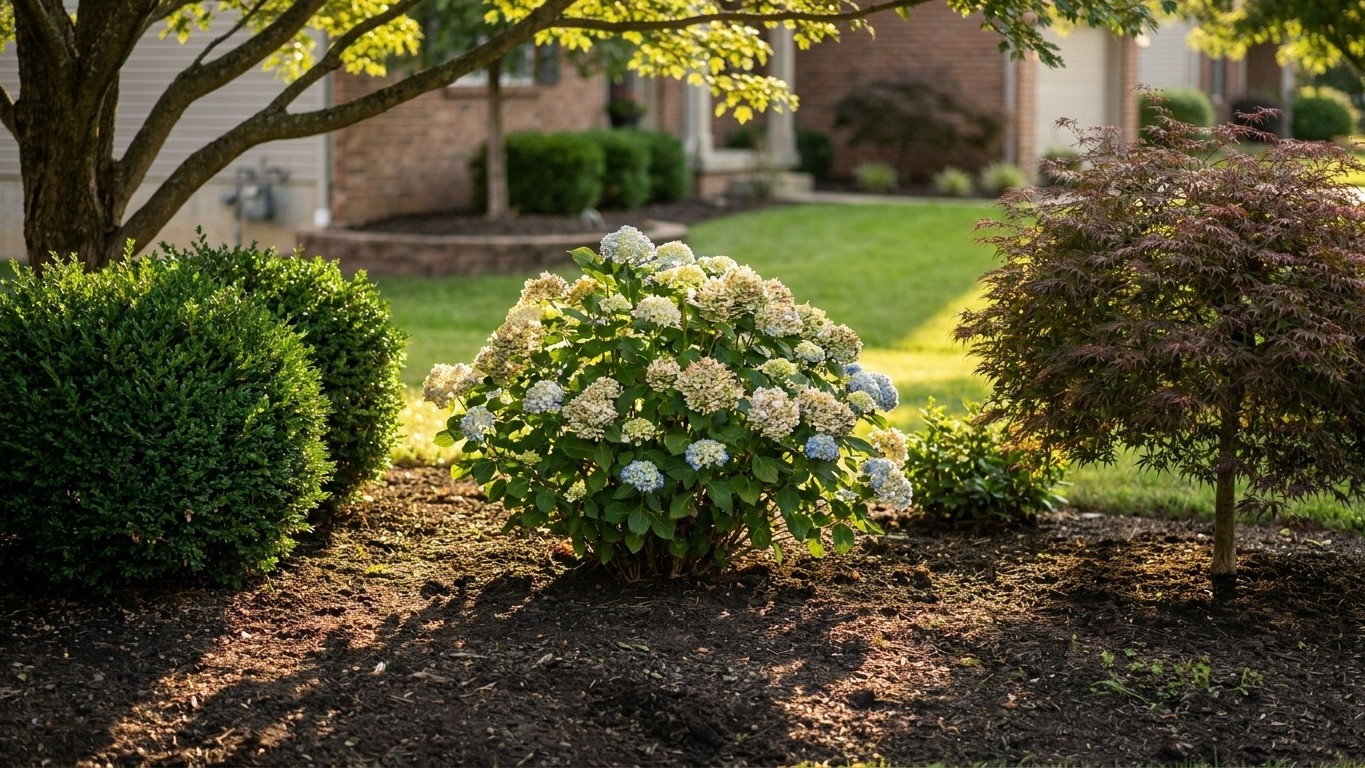

Pick a shrub for hardiness alone and you can still lose it to the wrong spot ten years later. Three things decide whether a woody plant thrives in a home landscape: the hardiness range that sets the outer limit of survival, the site conditions (light, drainage, and the space a plant will actually need once mature), and a pruning habit matched to how and when that species blooms. Get the order right and most of what follows is maintenance. Get it backwards and you’re digging out an overgrown shrub in a decade.
The limit that decides everything

A hardiness range is not a recommendation. It’s a boundary. The USDA Plant Hardiness Zone Map divides North America into zones based on the average annual minimum winter temperature, and each zone is split into an “a” half and a “b” half that differ by five degrees Fahrenheit. That half matters more than most gardeners assume: a shrub rated for zone 7a can sit at the edge of survival in a spot that regularly dips into 7a territory in a hard winter, while the same shrub planted two towns over in 7b coasts through with no damage at all.
The useful way to read a hardiness range is backwards. It doesn’t tell you where a plant will look good. It tells you where it will not survive. A shrub listed for zones 6 through 9 is a flat statement that anyone gardening in zone 5 or colder is wasting their money and their planting hole, no matter how good the soil or how sheltered the corner. That’s the whole function of the number: it’s a filter, not a promise.
Before choosing anything, find your own zone rather than assuming it from a neighboring state or a memory of what grew at a childhood home. Zones shift with elevation, with distance from large bodies of water, and with the built-up warmth of a city compared to open countryside a few miles out. Two addresses twenty minutes apart can land in different zones. The USDA hardiness zone lookup tools maintained by extension services and the map’s own publishers let you check by ZIP code in under a minute, and it’s worth doing that check for every new planting site, not just the first one.
One caution belongs here and only needs saying once: a hardiness range means survival, not comfort. A shrub rated to zone 6 will likely live through a zone 6 winter. It may still leaf out later, bloom less, or show tip dieback most years, because surviving the cold and thriving in the cold are not the same claim. The zone number answers one question only, and it’s the most important question, but it’s not the last one.
And the one people discover too late
Size at maturity is the mistake that costs the most, because it doesn’t show up on planting day. A shrub that’s perfectly hardy and perfectly happy in the soil can still be wrong for the spot, and the wrong-spot problem usually surfaces ten or fifteen years in, once a young three-gallon plant has grown into something that shades a window, blocks a walkway, or presses against a foundation. At that point the fix isn’t a spring pruning. It’s removal, and removal of an established shrub is a bigger job, and a bigger loss, than most people expect when they’re standing at a nursery cart picking out something that looks small and manageable.
The fix is to run through the site before digging, not after:
- Look up. Note any overhead utility wires and how far the planting spot sits from them.
- Check the foundation, the driveway, and any paved walk within reach of the mature footprint.
- Think about what’s underground: septic lines, water and gas service, buried irrigation.
- Ask what the plant’s eventual canopy width and height will actually be, not what it looks like in the container.
- Consider which direction it will cast shade once full-grown, and what that means for a garden bed, a patio, or a neighboring window.
No single distance rule covers every shrub, and giving one would be misleading. A dwarf selection and a full-size relative in the same genus can differ by several feet in every direction, so the individual plant’s own mature size, the number listed on its specific guide, is what should govern the planting distance, not a rule of thumb carried over from a different species. That’s the reason a site-first approach matters more than it sounds like it should: the shrub that’s right for the light and the soil still has to fit the actual footprint it will occupy in year twelve, not year one.
Choosing, in the order that works
Most planting mistakes trace back to choosing the plant before checking the site. The order that actually works runs the other direction:
- Start with light. Note how many hours of direct sun the spot gets, and whether that sun is morning (gentler) or afternoon (harsher).
- Check drainage. Dig a hole, fill it with water, and see how long it takes to empty. Standing water after an hour means a different set of plants than a spot that drains in minutes.
- Measure the space, in every direction, including up.
- Confirm the hardiness zone for that specific spot.
- Only then look at what’s available and matches all four.
That order is right because the first two conditions are close to fixed. Light exposure changes only if a mature tree comes down or a structure is added, and neither happens on a gardener’s schedule. Drainage can be improved with amendment or raised beds, but doing it well is expensive and doesn’t always take. Space is fixed outright. It’s the one variable with no workaround; a shrub either fits the mature footprint of the spot or it doesn’t, and no amount of pruning changes what its root system and structure want to become. Hardiness, by contrast, is the easiest of the four to check and the hardest to argue with once confirmed.
Choosing the plant first inverts all of that. A gardener who falls for a shrub at the nursery, then goes looking for somewhere to put it, ends up forcing that plant into whatever space, light, and drainage happen to be left over, even when none of them fit. The site-first method costs a little more patience upfront. It saves a decade of pruning against a plant’s nature, or worse, replacing it. Once light, drainage, space, and zone are pinned down, the individual plant guides on this site are built to be checked against exactly those four conditions, one shrub, tree, or perennial at a time.
What is on this site
This hub sits over three groups of individual guides, organized the way most home landscapes actually get planned: trees for structure and long-term shade, shrubs for the middle layer of screening, foundation planting, and seasonal bloom, and perennials for the beds that fill in around both. Each individual guide carries the specifics this hub deliberately leaves out: the exact hardiness range, the mature height and spread, the light and soil preference, and a pruning window matched to how that particular species sets its flower buds.
A word on where that plant-level data comes from matters here. The individual guides in this cocon draw their plant data from a university extension source based in North Carolina. The USDA hardiness range itself is a national standard and applies the same way no matter where the source is written or where the reader gardens. Regional advice from that same source, on the other hand, is calibrated to the Southeast: planting timing, local pest pressure, and any note calling a species a “native plant” is describing native range in the southeastern United States, not a claim that holds for a reader gardening in the Pacific Northwest or the upper Midwest. Reading the hardiness number as universal and the regional notes as local to that source is the right way to use these guides regardless of where the reader actually gardens.
Two more labels worth reading carefully wherever they appear on individual guides: “deer resistant” describes a plant deer tend to browse less often, not one deer will never touch in a hard winter when other food is scarce, and “drought tolerant” describes an established plant with a developed root system, not one still in its first season after planting, when even the toughest species needs regular water to get established.
Common questions
Does a shrub rated for my zone need any winter protection?
Not usually, if the zone match is accurate and the site isn’t an unusually exposed spot, like a windy corner or an open ridge that runs colder than the surrounding area. A shrub sitting at the edge of its rated range, in a zone that’s colder than what the label calls for by even half a zone, benefits from a sheltered planting spot and a layer of mulch over the root zone heading into the first winter or two.
Can I plant a shrub rated for a warmer zone than mine if I put it somewhere sheltered?
A sheltered microclimate, close to a south-facing wall or tucked out of prevailing wind, can shift the effective conditions by roughly half a zone in some cases, but it’s not a reliable way to push a plant a full zone or more outside its rated range. The hardiness number should still be treated as the limit, not a target to beat with placement.
What happens if I plant something that turns out too big for the space?
Repeated hard pruning to hold a shrub below its natural mature size usually stresses the plant, reduces flowering, and has to be repeated every year rather than solving the problem once. In most cases the more workable long-term fix is replacing an oversized shrub with a variety whose natural mature size already fits the spot.
Does “native plant” on these guides mean native to my region?
Not automatically. Since the plant data on this site comes from a North Carolina university extension source, a “native plant” label there refers to native range in the southeastern United States. A reader gardening outside that region should treat that label as a regional note from the source, not a claim about their own area.
Guides by state
- Aronia arbutifolia
- Buxus sempervirens
- Clethra alnifolia
- Fothergilla gardenii
- Hydrangea macrophylla
- Hydrangea paniculata
- Ilex glabra
- Ilex verticillata
- Itea virginica
- Kalmia latifolia
- Physocarpus opulifolius
- Spiraea japonica
- Syringa vulgaris
- Viburnum dentatum
- Weigela florida
- Aronia arbutifolia: Hardiness, Site and When to Prune
- Buxus sempervirens: Hardiness, Site and When to Prune
- Clethra alnifolia: Hardiness, Site and When to Prune
- Fothergilla gardenii: Hardiness, Site and When to Prune
- Hydrangea macrophylla: Hardiness, Site and When to Prune
- Hydrangea paniculata: Hardiness, Site and When to Prune
- Ilex glabra: Hardiness, Site and When to Prune
- Ilex verticillata: Hardiness, Site and When to Prune
- Itea virginica: Hardiness, Site and When to Prune
- Kalmia latifolia: Hardiness, Site and When to Prune
- Physocarpus opulifolius: Hardiness, Site and When to Prune
- Spiraea japonica: Hardiness, Site and When to Prune
- Syringa vulgaris: Hardiness, Site and When to Prune
- Viburnum dentatum: Hardiness, Site and When to Prune
- Weigela florida: Hardiness, Site and When to Prune