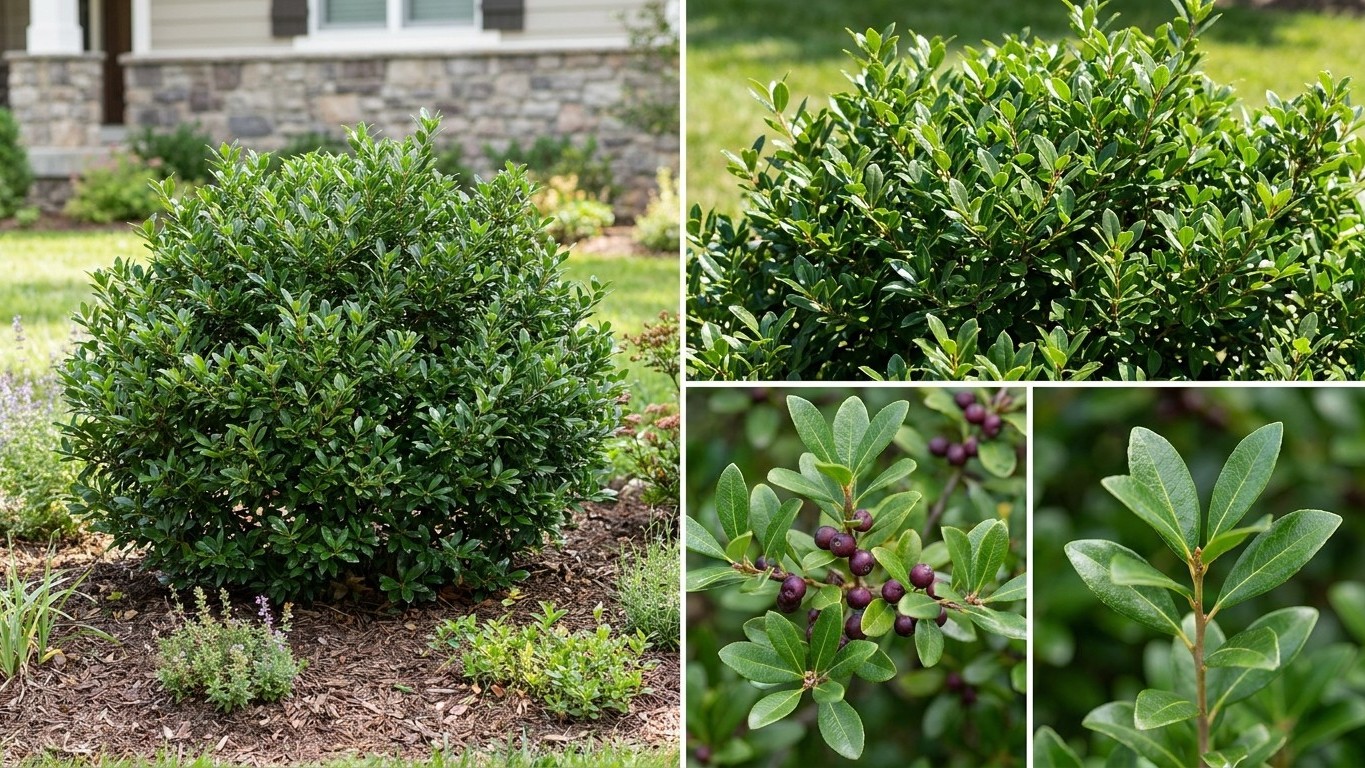

Ilex glabra is a broadleaf evergreen shrub, also sold as Appalachian Tea, Gallberry, or Inkberry, hardy in USDA zones 4a-9b. It tolerates wet or dry soil, sun or partial shade, and grows into a rounded, low-maintenance hedge or specimen. Left alone it thrives with almost no care, but two questions decide whether it settles into a landscape well: does your zone fall inside that range, and did you give it the room its mature spread actually needs.
Where it will and will not survive

The USDA hardiness range for Ilex glabra is 4a-9b. That is the number that matters before any conversation about soil or sun happens, because a shrub that cannot survive a winter never gets the chance to show off its summer tolerances. Below the bottom of this range, the plant is not expected to make it through a typical winter. Above the top of it, past 9b, heat and winter warmth outside its adapted range put it under stress it was not built to handle.
A range like this describes survival, not comfort. A shrub rated hardy to 9b will likely live at that warm edge, but living and thriving are different outcomes. Long, humid summers at the hot end of a hardiness range can push a technically hardy plant into a stressed, less vigorous version of itself. The same logic applies at the cold edge: a plant surviving in zone 4a is not necessarily putting on the growth or bloom it would show two or three zones warmer.
Hardiness zones are drawn county by county, not shrub by shrub. Rather than guessing from a general sense of where a state sits, look up your own zone on this site’s hardiness zone guide before deciding whether Ilex glabra belongs on your planting list.
The plant data behind this profile comes from the North Carolina Extension Gardener Plant Toolbox, and the USDA hardiness figure is universal, drawn from the same national system used everywhere. Regional planting advice tied to that source, split by coastal, piedmont, or mountain conditions, is specific to North Carolina and should not be treated as guidance for a garden anywhere else. The hardiness range travels; the regional notes stay home.
Light, soil and where it belongs
Ilex glabra tolerates a range of conditions rather than demanding one ideal setup. The Extension source lists several options for light, soil texture, pH, and drainage, and each represents a tolerance the plant can handle, not a single formula it needs to succeed.
| Condition | What the source lists |
|---|---|
| Light | Full sun (6+ hours direct) or Partial Shade (2-6 hours direct) |
| Soil texture | Clay or Sand |
| Soil pH | Acid (below 6.0) |
| Drainage | Good drainage, Moist, or Occasionally Wet |
That spread of tolerances explains why the shrub shows up so often along foundations, in low spots that stay damp after rain, and in beds that get sun for only part of the day. It adapts to clay or sand, wet spells or dry stretches, provided the pH leans acidic.
The habit is described as erect and rounded, a dense, self-contained form rather than an open, see-through shrub. Planted in a row, it builds an opaque screen once it fills in; planted alone, it holds its own shape without needing structure for support. Because the foliage is evergreen, that screening effect holds through winter, unlike a deciduous hedge that goes bare for several months.
Spacing for a hedge versus a specimen
The source gives a mature spread of 3 feet-6 feet for one figure and 6-feet-12 feet for another, which likely reflects the difference between compact and larger-growing forms, or between spread and the combined width of a mature planting. In a hedge, planting toward the tighter end, roughly 3 to 4 feet apart, lets individual plants merge into one line without gaps that take years to close. As a standalone specimen, the same shrub needs room to reach its full spread without crowding a walkway, foundation, or neighboring planting, which argues for spacing closer to the wider figures. Planting a hedge at specimen spacing leaves gaps for years; planting a specimen at hedge spacing means shearing it flat long before it would naturally fill that space.
When it flowers, and what that decides
Ilex glabra blooms in spring and summer, a season-length window rather than a fixed calendar date, since bloom timing shifts with latitude and elevation.
The detail that matters more than the flower display is what that timing decides about pruning. Woody shrubs generally fall into one of two groups: those that set flower buds on the previous year’s growth, and those that set buds on new growth made in the current season. The first group gets pruned right after it finishes blooming, so the plant has a full season to grow new wood before next year’s buds form on it. The second group can be pruned earlier, before growth starts in late winter or early spring, without cutting off any flowers.
The facts available for Ilex glabra do not specify which category it falls into for pruning purposes, and guessing would risk cutting off a season’s flowers. The safer approach is to observe one full growing season before making major cuts: watch where flowers appear relative to the wood that grew the year before versus the wood that grew that spring. If blooms consistently show up on last year’s stems, prune after flowering. If they show up on current-season growth instead, pruning before that growth begins is the lower-risk window.
Light shaping, removing a stray branch or thinning for air movement, carries little risk regardless of bloom timing. It is the harder cuts, meant to reduce size or reshape an overgrown plant, where getting the timing wrong costs an entire year’s flowers.
Planting and the first two years
Getting Ilex glabra established follows the same sequence that works for most container-grown shrubs, with a few details worth getting right from the start.
- Plant in spring or fall, when temperatures are mild and the plant isn’t fighting summer heat or winter cold while its roots are still settling in.
- Dig the hole wider than it is deep, at least twice the width of the root ball, so roots have loosened soil to spread into rather than hitting a hard wall.
- Set the plant so the root flare sits right at grade, neither buried under extra soil nor perched above the surrounding ground.
- Tease out any circling roots before backfilling; left alone, those roots keep circling below ground and can eventually choke the plant.
- Backfill with the native soil that came out of the hole rather than amending it heavily, so roots spread outward instead of staying confined to a small rich pocket.
- Water deeply right after planting, soaking the root zone rather than a light surface sprinkle.
- Mulch two to three inches deep in a wide ring, keeping the mulch pulled back from direct contact with the stems.
The maintenance and growing conditions listed for this shrub describe an established plant, and that distinction matters most in the first two summers. A note about tolerating occasionally wet soil or handling drought once mature says nothing about a plant whose roots haven’t spread past the original root ball yet. New plantings need consistent watering through their first one to two growing seasons regardless of what an established specimen can handle.
It also helps to expect very little in year one. Many shrubs put their early energy into rebuilding roots rather than visible top growth, so a plant that looks stalled through its first season is often just working underground. Growth becomes more visible in year two, and by year three a well-sited shrub is usually filling its space as promised. Reading a quiet first year as failure, and digging up a plant that was simply establishing, is one of the more avoidable mistakes in a new planting.
What it resists, and what it does not
Resistance, as used here, describes a tendency rather than a guarantee. A plant listed as resistant to a given stress is less likely to suffer serious damage from it than a plant with no such tolerance, but “less likely” still leaves room for exceptions under extreme or prolonged conditions.
| Challenge | What resistance means here | What a reader would see |
|---|---|---|
| Salt | Tolerance to salt exposure noted, without further detail specified | Fewer signs of leaf burn or dieback in exposed or coastal-adjacent sites compared with less tolerant shrubs |
| Erosion | Tolerance to erosion-prone conditions noted, without further detail specified | Root systems that help hold soil on slopes or banks rather than washing out |
| Rabbits | Tolerance to rabbit browsing noted, without further detail specified | Reduced browsing damage on lower stems and foliage, though not guaranteed immunity |
| Wet soil | Tolerance to occasionally wet or poorly drained soil noted, without further detail specified | Continued healthy growth in low spots that stay damp after rain |
| Pollution | Tolerance to pollution exposure noted, without further detail specified | Fewer visible stress symptoms in urban or roadside settings compared with less tolerant shrubs |
The growth rate is listed as slow, and the overall maintenance level as low. Together those two facts point toward a shrub that does not demand frequent pruning to control its size. That same slow pace means a young planting takes longer to reach the spacing discussed earlier, so patience during establishment matters more with this shrub than with a fast-growing alternative. Low maintenance also means fewer seasonal chores overall, but it is not a substitute for the attentive watering a newly planted specimen needs in its first two years.
On edibility, the source notes that human ingestion of the berries can cause a minor toxic reaction, and the berries themselves are described as pea-sized, jet black, berry-like drupes up to 3/8 inch in diameter, maturing in September and lasting through November. That combination, an evergreen shrub holding dark berries into late fall, is part of what draws bees, butterflies, pollinators, small mammals, and songbirds to it, even though the berries are not intended for a person’s table.
Common questions
Is Ilex glabra the same plant as Inkberry Holly?
Inkberry is one of the common names used for Ilex glabra, alongside Appalachian Tea and Gallberry. All three refer to the same species in the sourced classification, though common names can vary by region, so the botanical name is the more reliable reference point.
Can I eat the berries?
No. The source specifically warns that human ingestion of the berries can cause a minor toxic reaction, so they should not be treated as an edible fruit despite their resemblance to other dark berries.
Does Ilex glabra need full sun?
No. It tolerates full sun of six or more hours as well as partial shade with two to six hours of direct sunlight, giving flexibility for sites that don’t get all-day sun.
Why is my Ilex glabra still small after one year?
That is typical rather than a sign of trouble. Its growth rate is classed as slow, and newly planted shrubs generally spend their first year rebuilding roots rather than producing visible top growth, with more noticeable growth arriving in year two and beyond.