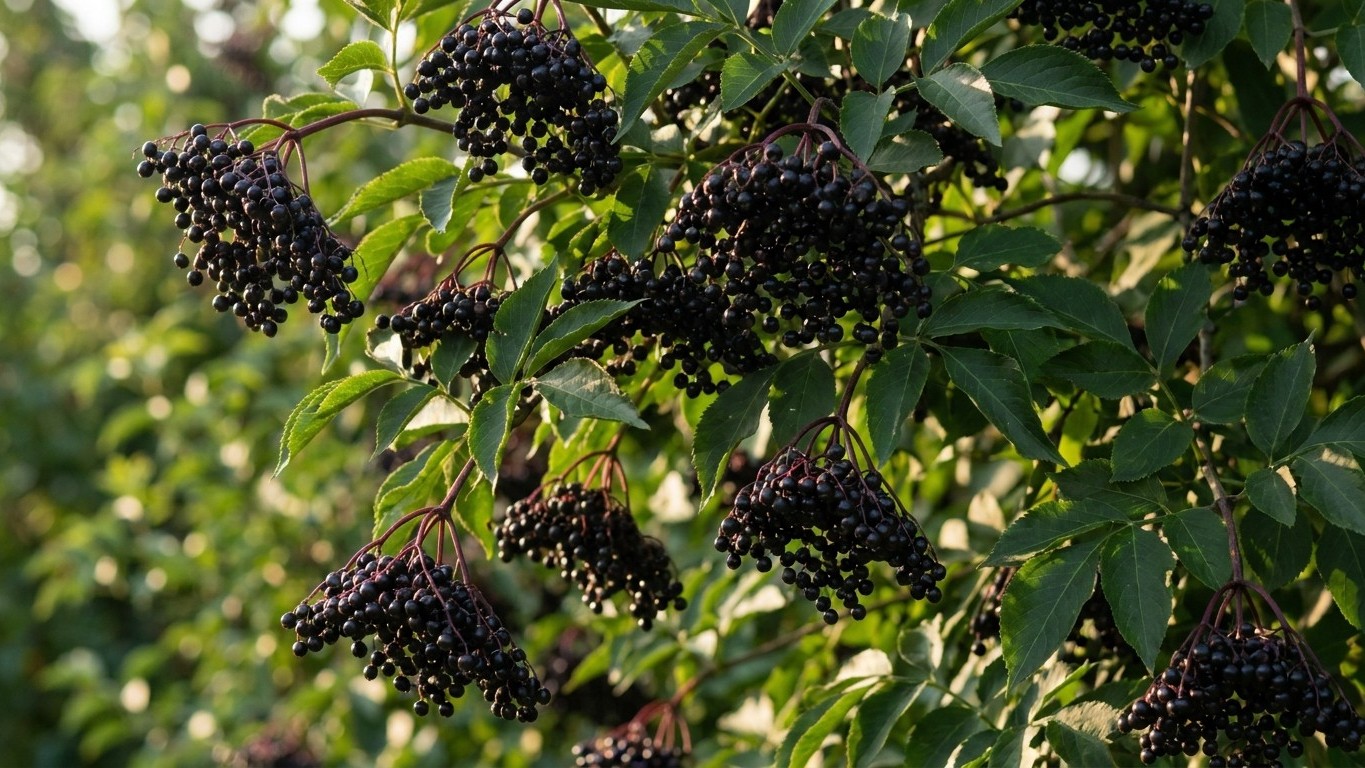

Sambucus canadensis, the American elderberry, survives across USDA zones 4a through 8b, tolerates wet soil and poor drainage that would kill most fruiting shrubs, and needs a full accounting of its mature spread before it goes in the ground. It crops in clusters of small purplish-black berries that are not eaten raw off the bush, they go into jelly, pie, and wine after cooking.
Where it will and will not survive
The USDA hardiness range for Sambucus canadensis is 4a-8b. Below the bottom of this range, a winter will kill the plant outright or cut it back so hard it never establishes as a real shrub. Above the top, the plant is pushed into heat and humidity it wasn’t built for, and while it may not die immediately, it won’t perform the way the same shrub does in the middle of its range.
A hardiness range describes survival, not comfort. A shrub rated to 8b can live there without thriving, just as one rated to 4a can survive a zone 4a winter without putting on the growth or fruit it would in a milder spot. Treat the edges of the range as tolerances, not endorsements.
Zone boundaries shift with elevation and local microclimate more than most people expect, and a property five miles from another can sit in a different zone entirely. Look up your specific hardiness zone on this site’s hardiness zone guide before deciding whether this plant is even a candidate.
The plant data behind this page comes from the North Carolina Extension Gardener Plant Toolbox. The USDA hardiness range itself is a national standard and applies wherever you garden, but that same extension service also publishes regional growing notes for North Carolina’s coastal plain, piedmont, and mountains specifically, and none of that regional guidance belongs on a page written for a national audience. If you’re gardening outside North Carolina, the zone number is the only piece of that source you should be borrowing.
What it is called, and why that matters here
The common names attached to this plant are American Elder, American Elderberry, Common Elderberry, and Elderberry, listed the way the source lists them, alphabetically, with none of the four as the official or primary name. “Elderberry” on its own is also the name attached to other Sambucus species grown in gardens across the country, which means a plant tag or a neighbor’s recommendation using just “elderberry” isn’t necessarily this species. That ambiguity is why this page is titled by the botanical name rather than any of the four common ones.
The source’s plant-type classification adds a second layer worth flagging. It lists this shrub as Edible, Native Plant, Perennial, Poisonous, Shrub, Tree, all at once. Edible and Poisonous sitting side by side looks like a contradiction, and the source doesn’t resolve it on this page. What is clear from the separate edibility note is that cooked berries are the edible part; beyond that, this page isn’t going to guess at which parts earn the Poisonous label.
The “Native Plant” label deserves its own caveat too. As this extension source uses the term, native means native to the southeastern United States, not native to wherever you happen to be reading this. Don’t read “Native Plant” on a nursery tag as a blanket claim about your own yard.
The Shrub and Tree labels appearing together are less contradictory than they look. This species is typically grown as a large, multi-stemmed shrub, and its arching, spreading growth habit is closer to a big bramble than a single-trunk tree, even though the source’s classification allows for both forms.
The site it needs to actually crop
The growing conditions the source lists are broad enough that this shrub survives in more places than it fruits well in. Full sun and partial shade are both marked as workable light levels, but light is where the survival-versus-yield distinction matters most: this plant can live for years in partial shade and never produce the dense fruit clusters it’s grown for. The source doesn’t spell out a minimum light threshold for cropping specifically, so full sun is the safer bet if fruit is the goal.
| Condition | What the source lists as tolerated |
|---|---|
| Light | Full sun (6+ hours direct) or partial shade (2-6 hours direct) |
| Soil texture | Clay, high organic matter, loam (silt), sand |
| Soil pH | Acid (below 6.0), neutral (6.0-8.0) |
| Drainage | Good drainage, moist, occasionally wet |
That drainage line is unusual for a fruiting shrub. Most fruit crops punish wet feet with root rot; this one tolerates occasionally wet soil, making it one of the few fruiting options for a low, damp corner of a yard that other trees and shrubs won’t touch. Soil texture is similarly forgiving, spanning clay through sand, and pH tolerance runs from acid through neutral. None of that flexibility guarantees heavy fruit, though, and the source doesn’t separate out which end of that range produces the best crop.
Space at maturity
The source lists mature spread at 6 feet to 12 feet, with a medium growth rate and medium maintenance. That’s a meaningful range to plan for, since a shrub finished at 6 feet fits against a fence line where a 12-foot spread would swallow a walkway. Given the multi-stemmed, arching, spreading habit the source also lists, give this plant room on both ends of that spread rather than assuming it will stay compact. The upside of the open habit is practical: fruit clusters hang on outer branches rather than deep inside a dense canopy, making harvest easier than on a tightly branched shrub of the same size.
When it crops, and whether it needs a partner
Bloom time is listed as spring and summer, a wide window compared to fruiting shrubs that flower in a tight two-week stretch. A shrub blooming into spring carries real frost exposure in a year where a late cold snap follows an early warm spell, since open flowers are far more vulnerable to a freeze than dormant buds. Because the exact bloom window shifts with latitude and elevation, don’t pin this to a calendar month; your own bloom timing will depend on where you garden.
Two questions this page can’t answer, and that matter more than bloom timing for whether you ever see fruit: does this shrub need a second, genetically different plant nearby to set fruit, and how many years after planting before it bears at all? This brief carries no pollination data and no age-to-bearing figure for Sambucus canadensis, and guessing at either would be irresponsible. Some plants in the same genus are self-fertile; others need a partner to cross-pollinate, and assuming one behavior because a relative works a certain way is exactly the kind of mistake that leaves someone with a shrub that flowers reliably and never fruits.
Ask any nursery or supplier both questions directly before buying: whether the specific plant or cultivar needs a second plant nearby, and roughly how long it takes from planting to a meaningful first crop. Get both answers in writing if you can, because they change the planting plan. A shrub that needs a partner means budgeting space and money for two plants from the start, not one plus a hopeful wait.
What the fruit is, and what it is for
The fruit is described as clusters of rounded, edible, purplish-black drupes, on display from August to September. Each berry runs about ¼ inch across and holds 3 to 5 small stones inside, carried in large, drooping clusters rather than singly. That cluster habit is part of why this fruit is picked by the head, not the berry: you cut whole clusters and process them, rather than harvesting one drupe at a time the way you would a cherry.
The source is specific that cooked berries are the edible part, used in pies, pancakes, and jellies, with the flowers and fruits together going into winemaking, marmalade, yogurt, and desserts. That “cooked” qualifier is worth holding onto rather than smoothing into a general “the berries are edible,” since the source draws that line deliberately.
Nobody eats these raw off the bush the way they would a blueberry, and the flavor explains why: raw, the berries run tart and faintly bitter, with none of the straightforward sweetness of a dessert fruit. Cooking with sugar, the standard path into jelly, pie filling, or wine, is what turns that sharp, earthy edge into something worth eating. If a nursery or recipe describes this berry as a sweet snacking fruit, that claim isn’t coming from this source.
What it resists, and what it does not
Resistance, as the source uses it, means a tendency to shrug off a particular stress, not immunity from it. A plant resistant to wet soil can still suffer in standing water for weeks on end; it just tolerates occasional saturation better than a plant without that trait.
| Challenge | What resistance means here | What you’d actually see |
|---|---|---|
| Erosion | The root system and habit help hold soil on slopes or banks | Less soil movement on a slope than with a shallow-rooted plant, not a guarantee against erosion in heavy runoff |
| Wet Soil | Tolerates soil that stays damp or occasionally floods | The shrub keeps growing through wet spells that would stress or kill less tolerant plants |
Both entries in the source are marked simply as resistant, without further detail on degree, which is why the table above describes the general mechanism rather than inventing a percentage or threshold the source doesn’t give. Nothing in this brief covers pests or diseases that attack the shrub itself, so this page isn’t going to name any, resisted or otherwise.
What this resistance list leaves out entirely is anything about the fruit. A shrub resistant to erosion and wet soil tells you nothing about what might affect the berries themselves between flowering and harvest. That’s a real gap in the available information, and it’s worth asking about directly if fruit quality and reliability matter to your planting decision.
Common questions
Will Sambucus canadensis survive in a colder zone than 4a?
Not reliably. The USDA range starts at 4a, and winters below that threshold typically kill the plant back hard or outright. Confirm your zone before planting.
Can this shrub grow in a spot that stays wet part of the year?
Yes. The source lists occasionally wet drainage as tolerated, along with moist and well-drained soil, which makes it more flexible on water than most fruiting shrubs.
How much space does it actually need?
Plan for 6 to 12 feet of mature spread, with an arching, spreading, multi-stemmed habit. Planting it tight against a fence or wall at the low end of that range risks crowding as it fills out.
Can I eat the berries straight off the plant?
The source specifies cooked berries as the edible part, used in pies, jellies, and wine. It does not describe raw berries as a food to eat out of hand.