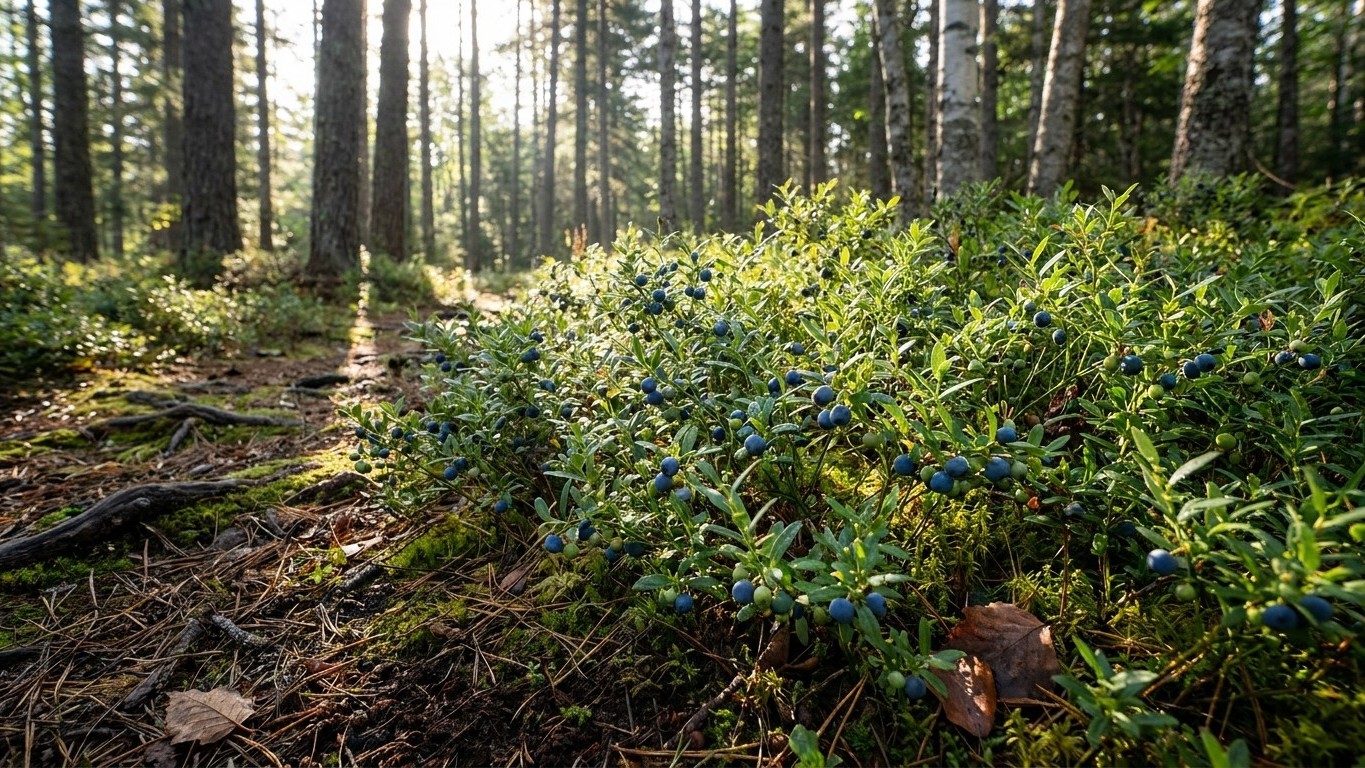

Vaccinium angustifolium, the lowbush blueberry, survives across a wide swath of USDA zones 2a through 8b, but surviving winter is only the first hurdle. This is an acid-loving, low-growing native shrub that spreads by underground stems rather than growing into a single trunk, and whether it actually produces berries depends on light, soil pH, and site conditions that go well beyond the hardiness rating alone.
Where it will and will not survive
The USDA hardiness range for Vaccinium angustifolium is 2a-8b, an unusually wide span stretching from some of the coldest winters recorded in the continental United States down into warm-temperate territory. But a range like this describes what the plant can endure, not where it will be comfortable. A shrub rated hardy to 8b is not necessarily happy at the warm edge of that number, and one rated to 2a is not necessarily thriving at the cold edge either. It is simply not dead.
The more useful way to read a rating like this is backward: where does it stop working? Below the bottom of this range, winter cold will kill the plant outright, no matter how good the site or how careful the mulching. Above the top of it, the plant may survive a mild winter or two, but it will not get the sustained cold dormancy it needs, and over time it weakens, flowers poorly, or fails to persist. Neither end of that scale is a place to plant this shrub and expect a reliable, long-term stand.
The plant’s own biology reinforces this: it is a small, cold-climate native adapted to short growing seasons and hard winters, which is part of why its range extends so far into the cold end of the scale, and why it does not carry the same tolerance for prolonged heat that some southern shrubs do.
Rather than guess at your own zone, check your specific USDA hardiness zone using a hardiness zone guide on this site, which breaks the rating down by state and county. Cross that number against 2a-8b before buying, not after.
What it is called, and why that matters here
Vaccinium angustifolium goes by several common names in everyday use: Late Lowbush Blueberry, Low Bush Blueberry, Lowbush Blueberry, and Low Sweet Blueberry. All four show up in nursery listings and extension bulletins, and none is treated as the single official name. The source that supplies this plant’s data lists its common names alphabetically, which is a reminder of how these lists work in general: alphabetical order is not an endorsement of one name over the others, and a common name can occasionally get attached to an entirely different species by mistake.
That is a real risk with common names generally. A gardener searching “lowbush blueberry” could, in principle, land on a listing for a different Vaccinium species or an unrelated plant with a similar folk name. In this case, the four names attached to Vaccinium angustifolium are at least consistent with each other, all describing the same low, spreading blueberry shrub with slightly different regional phrasing. That is not always true of common-name lists, which is why this page is titled by the botanical name rather than any one of the four.
Using “Vaccinium angustifolium” as the reference point removes the ambiguity entirely, since it is the one label that will not shift meaning depending on catalog, guide, or forum. When buying bare-root or potted stock, it is worth confirming the botanical name on the tag matches, since “lowbush blueberry” on a label alone does not guarantee which species is in the pot.
The site it needs to actually crop
Vaccinium angustifolium tolerates a genuinely broad range of light, from deep shade with less than two hours of direct sun, through dappled sunlight, to partial shade of two to six hours. That tolerance is about staying alive, not about fruiting well. A plant tucked into deep shade can persist for years as ground cover without producing much of a crop. The available data does not specify an exact light threshold for maximum yield, but more open light generally favors fruiting in this genus, even though the shrub does not need it to live.
Soil and drainage requirements
Soil chemistry is far less flexible than light. Vaccinium angustifolium requires acid soil, below pH 6.0, and this is not a minor preference; a soil that tests neutral or alkaline will hold this shrub back regardless of sun or water. Texture is more forgiving: it tolerates clay, sandy soil, and soil high in organic matter, with drainage needs ranging from good drainage and consistently moist to occasionally dry. That combination points to a plant built for the naturally acidic, humus-rich soils of open woodland edges and barrens rather than heavy, waterlogged clay or bone-dry sand extremes.
| Condition | Tolerance range | Mainly affects |
|---|---|---|
| Light | Deep shade to partial shade | Survival broadly fine; fruiting favored by more light |
| Soil texture | Clay, sand, high organic matter | Survival |
| Soil pH | Acid, below 6.0 | Survival and nutrient uptake, both |
| Drainage | Good drainage, moist, occasionally dry | Survival |
Space at maturity
This shrub stays small: 12 inches to 3 feet at maturity, with a medium growth rate and low to medium maintenance once established. That modest footprint suits a fruiting plant, since low, spreading growth keeps berries within easy reach for hand-picking rather than requiring a ladder. It also means this shrub does not need a wide buffer from a walkway, fence, or foundation, though crowding several too tightly in a mass planting can still limit the airflow and light that fruiting depends on.
When it crops, and whether it needs a partner
Vaccinium angustifolium blooms in spring, which carries a practical warning: early-blooming shrubs are the ones most exposed to late frost. A cold snap after flowering begins can damage or kill the blossoms, and since fruit only forms from flowers that survive to be pollinated, a late frost can mean a much lighter crop, or none, even on an otherwise healthy plant. Anyone planting this shrub where late spring frosts are common should favor a spot that avoids the coldest low-lying pockets where frost settles.
What this page cannot tell a reader is whether a single plant will set fruit on its own, or whether it needs a second, genetically different plant nearby for cross-pollination. Many fruiting shrubs require a compatible partner planted close enough for pollinators to move between them, and some do not; within a single genus, both self-fertile and partner-dependent types are common, so guessing based on the plant category alone is unreliable. The same gap applies to timing: nothing here indicates how many years a newly planted specimen takes before it begins bearing fruit.
Both questions are worth settling before buying. Ask directly whether the variety needs a second plant for pollination, and how many years to expect before a meaningful first harvest. A supplier who cannot answer either is one to press further, since planting a single shrub and waiting years for fruit that never arrives is entirely avoidable.
What the fruit is, and what it is for
The source describes the fruit plainly: juicy and edible berries appearing in summer. The accompanying edibility statement adds the practical detail: highly edible berries are enjoyed fresh, cooked, or frozen. That covers the three main ways lowbush blueberries typically get used, without needing embellishment beyond what the source states.
As for taste, this is ordinary, well-established knowledge about a familiar fruit rather than a claim tied to a named variety. Lowbush blueberries are small, dark blue-purple berries with a sweet, slightly tart flavor and a soft, juicy texture, closer in character to a wild berry than to the larger, milder cultivated highbush blueberries sold fresh in most grocery produce sections. That smaller size often comes with a more concentrated flavor, part of why lowbush blueberries are prized for baking and preserving even where larger cultivated berries are also available.
Nothing here supports any nutritional or health claim beyond what the source states, which is limited to describing the berries as highly edible and naming those three uses.
What it resists, and what it does not
Resistance, in a plant listing, means a tendency, not a guarantee. A shrub described as resistant to a pest or condition tends to shrug off that pressure better than a comparable plant without the trait, not that it is immune under every circumstance. The facts available for Vaccinium angustifolium do not include a resistance list for pests, diseases, deer, or drought, so this page cannot responsibly assign it any of those traits. Naming a resistance the source does not carry would be guessing, and guessing here is exactly the kind of error that costs a reader a damaged planting later.
What can be said is that this is a native, low-maintenance shrub rated low to medium on the maintenance scale, suggesting it does not demand intensive pest or disease management to stay healthy as a landscape plant. That is a different statement from a documented resistance rating, and the two should not be confused.
| Category | What resistance means | What is documented here |
|---|---|---|
| Pests and disease (foliage/stem) | Tendency to shrug off common pressures, not immunity | Not stated in available data |
| Deer | Reduced browsing preference, not deer-proof | Not stated in available data |
| Drought | Applies to an established plant, not a new transplant | Not stated in available data |
There is also a separate gap worth flagging for anyone growing this shrub for its berries: a resistance list typically covers threats to leaves, stems, and general health, not the pests and diseases that go after the fruit itself, such as fruit-feeding insects or ripening rot. That category is not covered anywhere in the facts available for this page, and it is a genuinely separate concern from whether the shrub itself stays healthy.
Common questions
Does Vaccinium angustifolium need full sun to produce berries?
It tolerates conditions from deep shade to partial shade and will survive across that whole range, but the available data does not specify an exact light level for maximum fruiting. More open light generally favors better fruit set in this genus, even though the plant does not require it simply to live.
Will one lowbush blueberry plant produce fruit on its own?
That depends on pollination requirements not covered in this data. Ask a supplier directly whether the specific plant needs a second, compatible plant nearby to set fruit before buying just one.
How long before a newly planted lowbush blueberry bears fruit?
There is no age-to-bearing figure available for this species in this data set, and it varies widely across woody plants. Ask a supplier for a realistic timeline for the specific stock being sold.
Is Vaccinium angustifolium the same as the blueberries sold in grocery stores?
No. Grocery store blueberries are typically the larger highbush type. Vaccinium angustifolium is the lowbush blueberry, a smaller, spreading native shrub with smaller, more intensely flavored berries, commonly used fresh, cooked, or frozen.