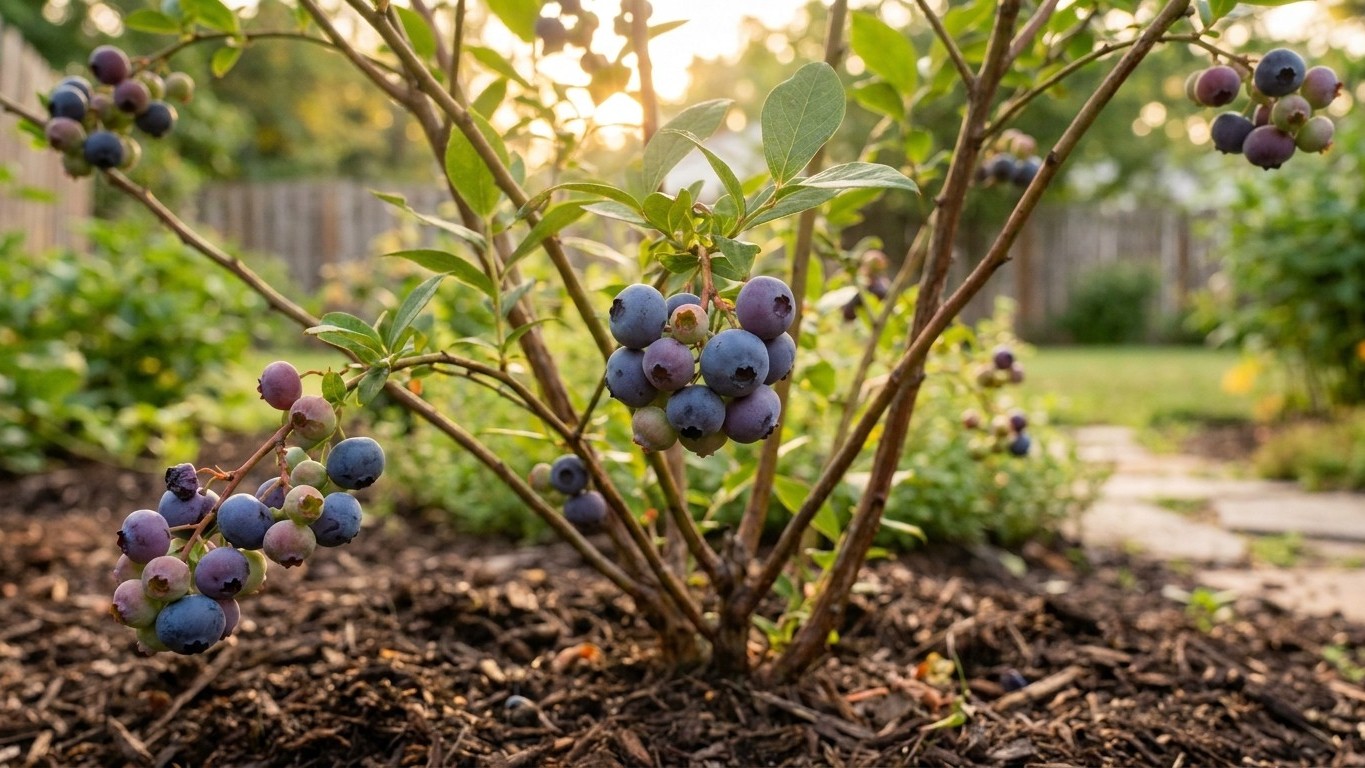

Vaccinium corymbosum is the botanical name for highbush blueberry, a deciduous, multi-stemmed shrub hardy across USDA zones 3a through 8b. It wants acidic, evenly moist soil, full sun to partial shade, and room to spread 6 to 12 feet wide at maturity. It’s native to the southeastern United States, blooms in spring, and produces small blue-to-purple fruit by August. Those are the basics. What actually decides whether this shrub survives on a given property, and whether it ever fruits there, takes more unpacking than a zone number can give.
Where it will and will not survive
The USDA hardiness range for Vaccinium corymbosum is 3a through 8b. That range is the useful boundary, and the boundary matters more than the middle. Below the bottom of this range, winter cold goes past what the shrub’s wood and buds can take, and the plant is likely to die back hard or fail outright. Above the top of it, the shrub may survive, but survival and comfort aren’t the same claim.
A hardiness rating only answers one question: will the plant live through an average winter low in that zone. It says nothing about whether it thrives, fruits well, or fights disease pressure once summers turn hot and humid, or how it handles a winter that never gets cold enough to satisfy its chilling needs. A shrub rated to the warm edge of its range is tolerated there, not necessarily happy there.
None of this works without knowing your own zone, and zone maps vary enough county to county that guessing is a bad habit. Rather than naming regions here, check your own zip code or county against a hardiness zone guide on this site before deciding whether this shrub belongs on your property at all.
One more caution on the source itself: the growing details in this profile come from the North Carolina Extension Gardener Plant Toolbox. The USDA hardiness range is a national standard and applies wherever you garden. Any regional planting advice tied specifically to North Carolina’s coastal, piedmont, or mountain regions does not transfer to a different state, and this page doesn’t repeat it.
What it is called, and why that matters here
The source lists four common names for this species: Highbush Blueberry, Rabbit-eye Blueberry, Rabbiteye Blueberry, Smooth Highbush Blueberry. They’re given alphabetically, not by popularity or accuracy, and none of them is flagged as the official name. That’s exactly why this page is titled by the botanical name instead of picking one common name and running with it.
Worth flagging directly: this list groups “Highbush” and “Rabbit-eye” or “Rabbiteye” together under one species entry, and those two terms are commonly used in the nursery trade to describe different blueberry growth types with different regional performance. Whether that distinction applies cleanly here, or whether the source is simply cataloguing name variants people use loosely, isn’t something this page can settle from the data at hand. That ambiguity is real, and it’s the reader’s problem as much as the source’s.
The practical fix is not to argue over which name is “correct.” It’s to confirm with whoever sells you the plant exactly which type and growth habit you’re getting, since a tag reading “blueberry” can cover shrubs that behave quite differently in the ground. Buying by the botanical name, and asking the supplier to confirm it against the tag, avoids the guesswork these overlapping common names invite.
The site it needs to actually crop
The growing conditions below come straight from the source’s data fields. Some of them govern whether the shrub lives at all; others govern whether it bears fruit worth picking, which is a separate and more demanding standard.
| Condition | What the source lists | Survival or yield |
|---|---|---|
| Light | Full sun (6+ hours) or partial shade (2-6 hours) | Both are tolerated for survival; the source doesn’t specify how fruit set differs between the two, so that split isn’t settled here |
| Soil texture | Clay, loam, sand | Survival, the shrub tolerates a range of textures |
| Soil pH | Acid, below 6.0 | Both, acidic soil is close to a hard requirement for this genus, affecting root function and overall vigor |
| Drainage | Good drainage, moist, occasionally dry | Survival, poor drainage or prolonged drought stress works against the plant regardless of light |
Full sun is generally the safer bet if fruit is the goal, since shade cuts flowering and ripening in most fruiting shrubs, but the source’s data doesn’t break out a specific yield penalty for partial shade here, so treat that as an open question rather than a settled one.
Space at maturity is 6 to 12 feet, and this is the number that costs readers the most when it’s ignored. A shrub planted 3 feet from a fence or another plant will eventually crowd both, choke off air circulation, and make picking fruit off the far side nearly impossible. Plan the mature spread before digging the hole, not after.
When it crops, and whether it needs a partner
Bloom time is listed simply as spring, and that’s given as a season rather than a calendar date on purpose, since bloom timing shifts with latitude and elevation. A shrub blooming in early spring in a warmer zone may bloom weeks later at higher elevation or further north, and that timing matters most for one reason: a plant that flowers early is the one a late frost catches, killing the flush of blossoms before they ever set fruit.
Two questions this page cannot answer, and that matter enormously before buying: does this shrub need a second, compatible plant nearby to set fruit, and how many years after planting before it bears anything worth picking. Neither figure is part of the data behind this profile. Some plants in a genus are self-fertile on their own; others in the very same genus need a partner variety within a set distance, and guessing wrong means planting a single shrub and waiting years for fruit that structurally can’t happen without a second plant nearby.
Ask a nursery or supplier both questions directly before buying: pollination requirements, and expected years to first meaningful crop. Don’t infer either from the plant type or from general knowledge of the genus, since self-fertility and bearing age vary by variety within the same species, not just between species.
What the fruit is, and what it is for
The source describes the fruit as blue to purple, small, and round, appearing in August and ripening in stages from green to pink to full ripeness. It also notes that females cannot produce fruit on their own, a detail worth flagging to a supplier alongside the pollination question above rather than treating as fully resolved here. The fruit is stated plainly as edible.
On use, the source states the berries have been used raw, sun-dried, smoke-dried, and baked. That’s a fairly wide range of handling, spanning fresh eating straight off the bush to drying for storage to baking into other dishes. The source also notes the berries have high iron content, a claim that belongs to the source and isn’t expanded on here.
Beyond that formal description, blueberries as a fruit are widely known for a sweet, mildly tart flavor and a soft, juicy bite when fully ripe, the kind of fruit eaten by the handful fresh or folded into baked goods without much fuss. That general character applies to the fruit type broadly; how any one cultivar of this species tastes can vary, and this page doesn’t claim to know the specifics of a particular variety’s flavor beyond what’s true of the fruit in general.
What it resists, and what it does not
Resistance in a plant profile means a tendency to hold up under a given stress, not immunity from it. A shrub listed as resisting wet soil can still struggle in standing water for weeks on end; it just tolerates occasional saturation better than a shrub with no such tolerance at all.
| Challenge | What resistance means here | What the source specifies |
|---|---|---|
| Fire | Tendency to recover after fire exposure rather than being killed outright | Listed as a tracked trait, degree unspecified |
| Wet soil | Tolerance of periodic saturation without root failure | Listed as a tracked trait, degree unspecified |
| Compaction | Tolerance of dense, poorly aerated soil | Listed as a tracked trait, degree unspecified |
The source flags all three as relevant categories for this species without assigning a specific rating to any of them, which is a real gap rather than something to fill in with a guess. Treat these as traits worth asking about, not settled advantages.
One more gap worth naming directly: this resistance list covers the shrub itself, its wood, roots, and foliage. It says nothing about the pests and diseases that attack the fruit specifically, and this profile carries no data on that front at all. Anyone growing this for fruit, not foliage, should treat fruit-specific pest and disease pressure as a separate question to research before planting, not something this page settles.
Common questions
Does Vaccinium corymbosum need a second plant to fruit? This profile doesn’t carry pollination data. Ask a supplier directly whether this shrub is self-fertile or needs a compatible partner nearby before buying.
How long after planting will it bear fruit? No years-to-bearing figure is available here. This is a question to settle with the nursery or supplier at purchase, since it varies by variety.
Will it survive in zone 9? The listed hardiness range tops out at 8b. Above that range, survival isn’t part of the rating, so check your specific zone before planting.
How much space does it actually need? The source lists 6 to 12 feet at maturity. Plant it that far from structures, fences, and other shrubs to avoid crowding later.