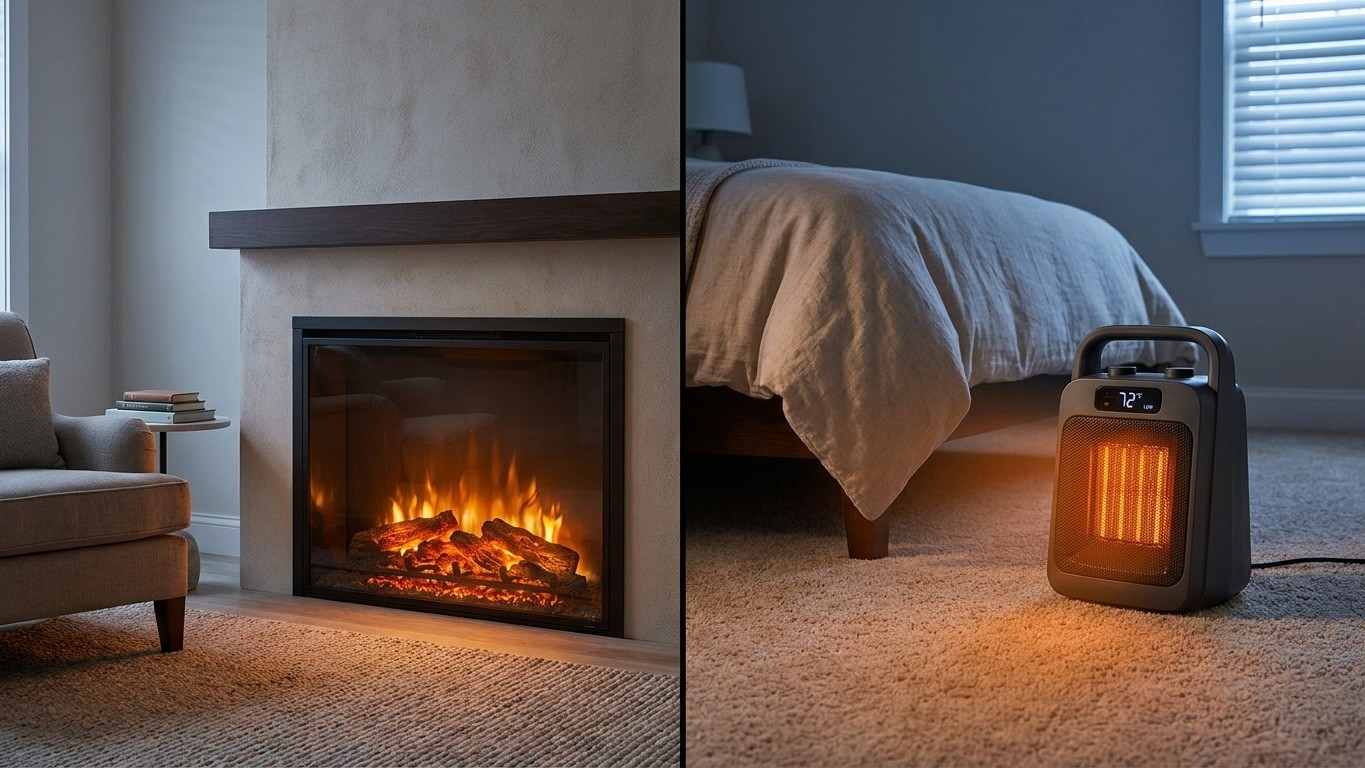

If you’re choosing purely for warmth, the answer is simple: an electric fireplace and a space heater set to the same wattage will heat a room identically, because they’re built from the same components. The real decision isn’t about heat output at all. It’s about whether you want a piece of furniture that stays put and doubles as a focal point, or a portable tool you can carry from the bedroom to the garage on a cold morning.
The same heater in different clothes

Here’s the part nobody selling electric fireplaces wants to advertise loudly: at 1,500 watts, an electric fireplace and a basic space heater produce the exact same amount of heat. Both rely on a resistive heating element, the same technology that’s been warming toasters and hair dryers for decades. Run electricity through a coil, it gets hot, a fan pushes that heat into the room. There’s no secret fireplace physics involved.
A plug-in electric fireplace on a standard 120-volt circuit is built at or below about 1,500 watts, roughly 5,000 Btu per hour. That’s enough for one room, not a house, and it’s the same ceiling that limits most portable space heaters sold for home use. Anyone telling you a fireplace insert “heats better” than a space heater at the same wattage is either mistaken or trying to justify a higher price tag.
What actually differs is the box around that heating element. A space heater is a small, movable appliance, usually plastic or metal, designed to be picked up and relocated. An electric fireplace is built to look like furniture: a mantel, a media console, a wall-mounted unit with a glass front. You’re not paying extra for warmth, you’re paying for cabinetry and a visual effect.
No combustion, no flame heat
One point that genuinely sets electric units apart from wood or gas fireplaces, not from space heaters, is that an electric fireplace burns nothing. No flue, no carbon monoxide, no combustion air pulled from the room, no water vapor released into your walls. That’s a real, honest advantage over an open-flame appliance, and it applies whether the electric unit looks like a fireplace or like a plain box heater.
The flickering flame effect you see in an electric fireplace is light, not heat. It comes from LEDs and a slowly rotating or oscillating reflector creating the illusion of flames and embers. The actual warmth comes from a separate resistive element and a fan, running independently of the light show. You can typically turn on the flame effect with the heater switched off, which proves the two systems have nothing to do with each other. Don’t let the glow fool you into thinking it’s doing any of the heating work.
Side by side
Laid out next to each other, the practical differences between the two categories become clearer than the marketing copy suggests. Heat output is the one place they tie exactly, assuming comparable wattage. Everything else, placement, portability, upfront cost, appearance, and how forgiving each one is around kids and pets, tends to favor one format over the other.
| Factor | Electric Fireplace | Space Heater |
|---|---|---|
| Heat output | Up to ~1,500 watts / 5,000 Btu/hr | Up to ~1,500 watts / 5,000 Btu/hr |
| Placement | Fixed or semi-fixed, often against a wall | Anywhere with an outlet, moved room to room |
| Portability | Low, some models are freestanding but bulky | High, designed to be carried and stored |
| Upfront price | Higher, pays for cabinetry and flame effect | Lower, simpler construction |
| Appearance | Furniture-style, matches decor | Utilitarian, visible cord and housing |
| Safety around kids/pets | Cool-touch glass on many models, stable base | Can tip if bumped, cord is a trip hazard |
The portability line is worth sitting with for a second. A space heater’s whole job is to be temporary, moved to wherever the cold spot is that day. That flexibility is also its biggest risk factor: it gets dragged onto rugs, tucked under desks, and plugged into whatever outlet or extension cord is closest. If you’re weighing models for a specific room, our guides on choosing a space heater and on space heater safety go deeper into wattage, thermostats, and shutoff features than this comparison can.
Price is the other place people get surprised. A basic space heater can cost a fraction of a furniture-style electric fireplace, since you’re not paying for a mantel, a media shelf, or a realistic flame display. If your only goal is heat, that price gap buys you nothing extra in Btu.
Where the fireplace has an edge
Set aside the heating element for a moment, because the one place an electric fireplace genuinely outperforms a space heater has nothing to do with watts. It’s about what a fixed, furniture-style appliance simply cannot do compared to a portable one.
A wall-mounted or console-style electric fireplace isn’t sitting loose on the floor. It can’t be knocked over by a running toddler, a curious dog, or someone stepping over it in the dark. It isn’t the kind of thing that ends up shoved onto a rug or a stack of blankets because it needed to be “closer to the couch tonight.” And it isn’t the appliance that gets unplugged from the wall, carried to another room, and plugged back in through a coiled extension cord, one of the most common ways portable heaters overheat and start fires.
None of that makes a fireplace unit heat-proof or eliminate the need for clearance. The U.S. Fire Administration’s guidance applies to both formats equally: “Keep anything that can burn at least 3 feet from all heat sources including fireplaces, wood stoves, radiators, space heaters or candles.” A media console loaded with paperbacks a foot from the heat vent is exactly the same fire risk whether the appliance is called a “fireplace” or a “heater.”
The habit that matters more than the label
The USFA is just as direct about a second point that trips people up with portable units specifically: “Turn space heaters off when leaving the room or going to bed.” A fixed electric fireplace tends to get this right almost by accident, since it’s usually near a main living area where someone’s around to notice it and switch it off. A space heater in a bedroom or home office is far more likely to get left running because it’s easy to forget something that small and quiet is still drawing power.
If you’re prone to walking out of a room and leaving the heater on, or if there are pets and small children moving through the house, the fixed appliance format removes a few of the everyday risk factors that come with something you can pick up and move. It won’t heat the room any better. It just won’t end up somewhere it shouldn’t be.
Common questions
Does an electric fireplace use more electricity than a space heater?
No, not at the same wattage. Both draw power based on their wattage setting, not their appearance. A 1,500-watt fireplace and a 1,500-watt space heater cost the same to run per hour. Check your own utility bill for the rate per kilowatt-hour to estimate actual cost, since rates vary by region and provider.
Can an electric fireplace heat a whole house?
No. At roughly 5,000 Btu per hour, a standard plug-in unit is sized for one room, not a whole home. Treat it as supplemental or zone heating, the same way you would a portable space heater.
Is the flame effect on an electric fireplace producing any heat?
No. The flame is an LED and reflector light display, entirely separate from the heating element and fan that produce warmth. You can run the flame effect with the heat turned off, which is proof the two functions don’t overlap.
Which is safer around kids and pets, a fireplace or a space heater?
A fixed, furniture-style electric fireplace tends to be more forgiving because it can’t be knocked over or dragged onto flammable material the way a portable unit can. Both still need the same clearance from anything that can burn, and both still need to be switched off when nobody’s in the room.