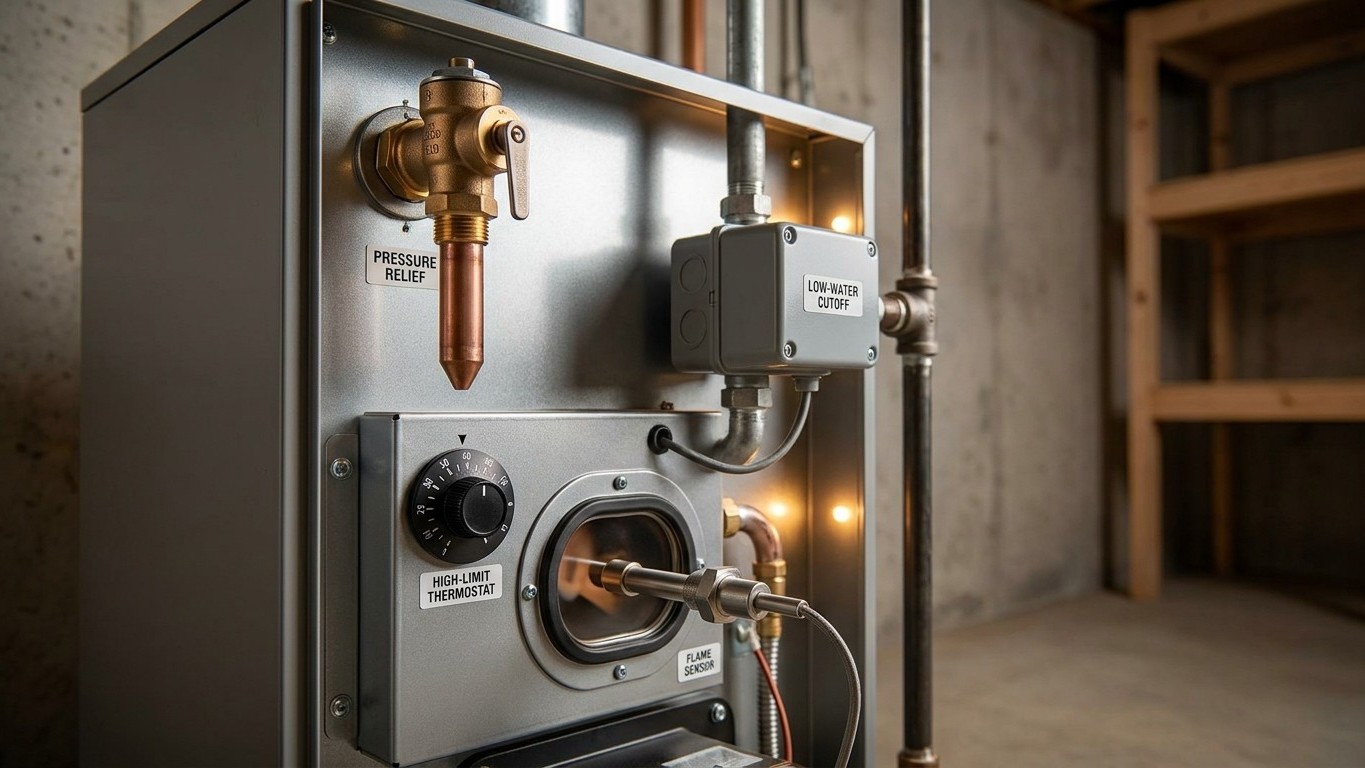

Four devices, four different jobs. A boiler’s pressure relief valve stops overpressure from splitting a tank or a pipe. Its high-limit thermostat stops water from overheating past what the system was built to handle. On a steam boiler, a low-water cutoff stops the unit from firing when there isn’t enough water in it. And a flame-proving device stops unburned fuel from continuing to flow into the combustion chamber when there’s no flame to burn it. Each one answers a separate question about what can go wrong.
Several devices, several different failures
Homeowners tend to lump every shutdown into one category: “something’s wrong with the boiler.” But a boiler that trips offline is almost never failing randomly. It’s usually one specific safety device doing exactly the job it was built for, and figuring out which one narrows the problem fast.
The pressure relief valve is the last line of defense against overpressure. If the system’s expansion tank fails, or if a backflow condition lets pressure climb unchecked, the relief valve is designed to open and discharge water before something ruptures. It’s a mechanical fail-safe, not a diagnostic tool. When it opens, it’s telling you pressure exceeded a threshold. It isn’t telling you why.
The high-limit thermostat guards against overheat. Boilers are built to heat water to a controlled range, and if the primary control fails or a circulator pump stops moving water through the system, temperatures can climb past what the heat exchanger and piping were designed to tolerate. The high-limit switch cuts power to the burner before that happens. It’s a separate device from the operating thermostat that cycles the burner on and off for normal heating, and it’s set to trip only when something else has already gone wrong upstream.
On steam boilers specifically, a low-water cutoff prevents dry firing. Steam systems lose small amounts of water to the system over time, and if the water level drops below the point where the burner can safely operate, dry firing can crack a heat exchanger in the time it takes to notice something smells wrong. The low-water cutoff senses that drop and cuts the burner before the boiler runs without adequate water contact.
The flame-proving device, sometimes called a flame sensor or flame rod depending on the fuel type, stops a completely different failure: unburned fuel entering the space. If the burner fails to ignite, or if the flame goes out mid-cycle, this device detects the absence of flame and shuts the fuel valve. Without it, a boiler could keep feeding gas or oil into a chamber with nothing burning it off.
None of these four devices does another’s job. A tripped high-limit switch doesn’t mean the pressure relief valve is compromised, and a low-water cutoff has nothing to do with flame sensing. Each is a narrow, single-purpose safeguard, and that’s exactly what makes a shutdown useful information instead of just an inconvenience.
The valve that must never be capped
Of the four, the pressure relief valve is the one people are most tempted to interfere with, and it’s worth saying plainly: don’t. A relief valve that weeps or drips periodically is annoying. It stains the floor, it makes a small puddle near the boiler, and it’s an obvious itch to fix with a wrench and a plug. But a weeping relief valve isn’t malfunctioning. It’s reporting something.
When a relief valve discharges, even in small amounts, it’s because pressure inside the system reached the point where the valve is designed to open. That’s not a valve defect most of the time. It’s a symptom of something upstream, whether that’s a waterlogged expansion tank, a fill valve stuck open, or thermal expansion with nowhere to go. The valve is doing its job by releasing pressure before a weld seam, a fitting, or the boiler shell itself takes the strain instead.
Capping the valve, plugging its discharge line, or tying it down removes that outlet entirely. Once that’s done, the system has no controlled way to relieve excess pressure. The pressure doesn’t go away just because the valve stops discharging. It keeps building until it finds the weakest point in the system, and that failure is uncontrolled, sudden, and far more dangerous than a drip on the floor. This is one of the few places in home mechanical systems where the “fix” people reach for first is genuinely more hazardous than the symptom they’re trying to eliminate.
The right response to a weeping or leaking relief valve is to find out why pressure is rising, not to silence the valve itself. That means checking the expansion tank, the fill valve, and the system’s static and operating pressure, topics covered in more detail on this site’s boiler pressure page, since the actual psi figures and what’s normal for a given system depend on the appliance’s own label and the installer’s setup, not a single number that applies everywhere.
If a relief valve is discharging constantly rather than occasionally, or if it won’t reseat after opening, that’s a signal to call a licensed technician rather than reach for pliers. A relief valve that’s replaced when it’s actually worn out is a normal maintenance item. A relief valve that’s disabled while the underlying pressure problem continues is a very different situation, and it’s the single clearest example on this list of a small annoyance masking a real risk.
Carbon monoxide is not one of them
Here’s the gap that catches a lot of people off guard: none of the four devices covered above detects carbon monoxide. The pressure relief valve responds to pressure. The high-limit thermostat responds to temperature. The low-water cutoff responds to water level. The flame-proving device responds to the presence or absence of flame. Not one of them is built to sense a gas byproduct of incomplete combustion.
A gas or oil-fired boiler is a fuel-burning appliance, and that means it carries the same carbon monoxide considerations as any other fuel-burning appliance in the home. Carbon monoxide is colorless and odorless, which means there’s no smell, no visible sign, and no physical symptom you can rely on to catch it early. A carbon monoxide alarm, installed and maintained separately from the boiler’s own safety devices, is the only way to know it’s present. The boiler’s built-in safeties protect the appliance and the system. They were never designed to protect the air in the room.
This distinction matters most in exactly the moment when it’s easy to overlook: after a flame-proving device or high-limit thermostat has already tripped and shut the boiler down. A homeowner troubleshooting a shutdown is focused on the appliance, not the air. But if a boiler has been running with a combustion problem before that shutdown occurred, whether from a partially blocked flue or a failing heat exchanger, carbon monoxide could have already been produced during that period. The boiler stopping itself doesn’t retroactively clear the air of anything it already put into it.
An electric boiler sidesteps this issue entirely. Since there’s no combustion involved, an electric boiler produces no carbon monoxide, and it doesn’t need a flame-proving device for that reason either, since there’s no flame to prove. That’s a meaningful difference between electric and fuel-burning systems that’s easy to miss when comparing boiler types on cost or efficiency alone.
Annual professional inspection remains the backbone of catching combustion problems before they become carbon monoxide problems. The U.S. Fire Administration puts it directly: “Maintain heating equipment and chimneys by having them cleaned and inspected each year by a professional.” That inspection covers the flue, the burner, and the combustion chamber in ways a homeowner generally can’t check without training or equipment, and it’s the step most likely to catch a developing issue before any of the four safety devices ever needs to trip.
Common questions
Can a boiler run safely with a faulty safety device?
No. Each device covers a distinct failure mode, and a faulty one leaves that specific risk unguarded even if everything else about the boiler seems fine. A technician should test and, if needed, replace any device that isn’t functioning rather than running the boiler without it.
Why does my boiler shut off and restart on its own sometimes?
That’s often the operating thermostat cycling the burner normally, which is different from a safety device tripping. If the boiler stays off and needs a manual reset to restart, that’s more likely a high-limit thermostat, low-water cutoff, or flame-proving device responding to an actual fault rather than routine cycling.
Do electric boilers need the same safety devices as gas boilers?
Electric boilers still need pressure and temperature safeguards, but they don’t need a flame-proving device since there’s no flame, and they produce no carbon monoxide since there’s no combustion involved.
What’s the AFUE rating and does it relate to safety?
AFUE measures efficiency, not safety. It’s the ratio of a boiler’s annual heat output to the total fuel energy it consumes, so an AFUE of 90% means 90% of the fuel’s energy becomes heat in the home and 10% leaves up the flue. It has no bearing on which safety devices a boiler needs or how they function.