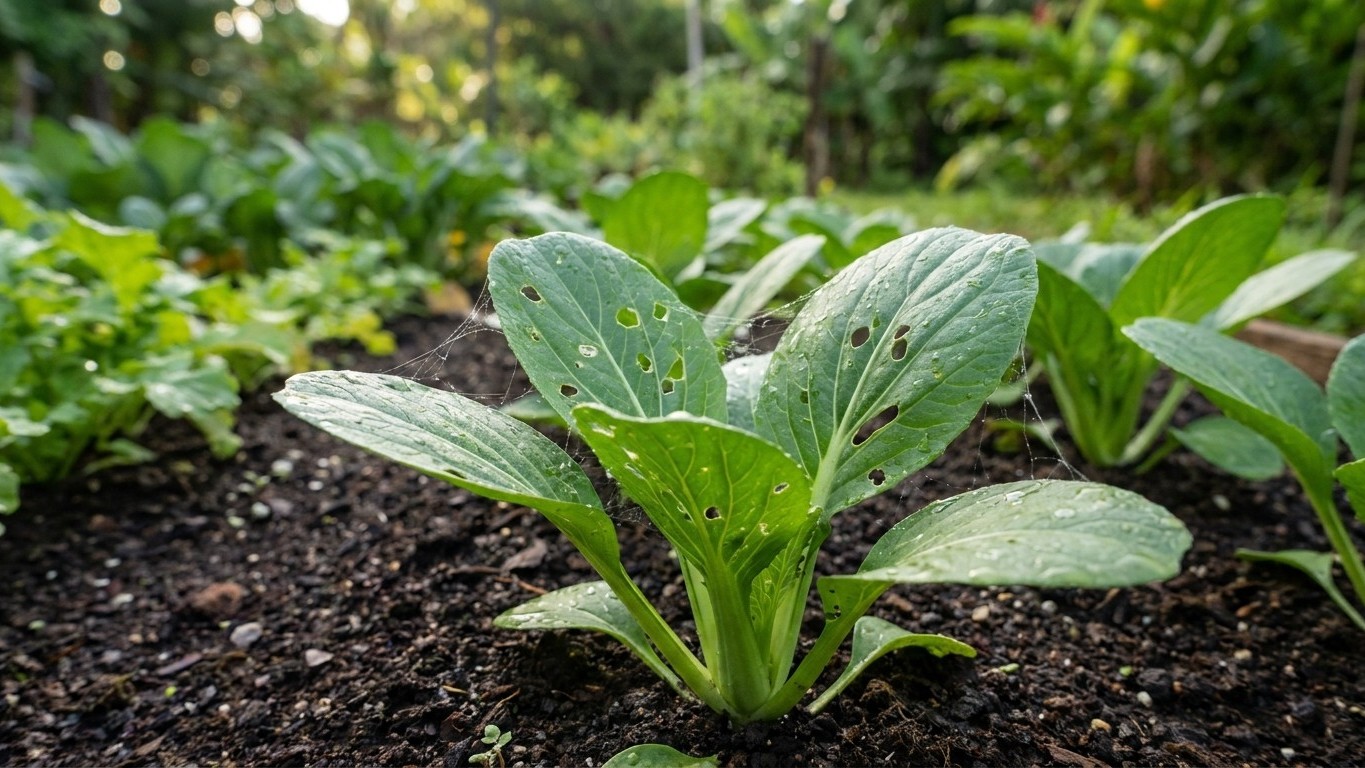

Cabbage webworm (Hellula undalis) turns up wherever crucifer crops are growing in Hawaii, essentially all year, because the islands never get cold enough to force it into dormancy. There’s no single “season” for this pest here the way there is on the mainland. Instead, its numbers track rainfall, humidity and how continuously home gardeners keep cabbage-family plants in the ground.
The weeks to watch

Hawaii’s cooperative extension publications don’t print a specific flight-window calendar for cabbage webworm the way some mainland states do for cabbage looper or diamondback moth. What they do confirm is the general pattern for tropical Lepidoptera pests of crucifers: because temperatures in lowland Hawaii rarely drop below the threshold that stops larval development, Hellula undalis can complete a generation in roughly three to four weeks and keeps breeding continuously as long as host plants are available.
No true off-season
That continuous cycle means a garden bed of cabbage, mustard or bok choy left standing for six months can host several overlapping generations, adults, eggs, larvae and pupae all present at once. The practical upshot: watch for damage starting the week seedlings put out true leaves, not at some fixed calendar date.
Wet-season pressure
Anecdotally and in general pest literature for the tropics, populations tend to build fastest during the warmer, more humid months, since moisture supports the moth’s egg survival and larval feeding. Drier windward-to-leeward transitions can slow things down slightly, but they don’t stop the cycle the way a frost would on the mainland.
Reading the calendar from your last frost

This is the one calculation that doesn’t apply in Hawaii, and it’s worth saying plainly: NOAA’s 1991-2020 climate normals for the islands show zero days per year at or below 32°F in inhabited areas, and every freeze-date percentile for the reporting station comes back not-computable. Frost only happens on the summits of Mauna Kea, Mauna Loa and Haleakala, thousands of feet above any vegetable patch. So a frost-based planting calendar simply doesn’t exist here.
What replaces it is elevation, rainfall pattern and windward-versus-leeward exposure. Crucifer growing seasons on Oahu’s windward side, for instance, run on a different rhythm than on the dry Kona side of the Big Island, because soil moisture and humidity, not soil temperature crossing a frost threshold, set the pace of both plant growth and pest activity.
- Identify your local planting window based on elevation and rainfall rather than a frost date, lowland leeward areas can plant crucifers nearly year-round, while higher, cooler elevations may see slower, more seasonal cycles.
- Once transplants go in, expect the first webbing or leaf damage from cabbage webworm within about two to three weeks, roughly matching the time it takes eggs laid on young leaves to hatch and larvae to begin feeding.
That two-to-three-week window is the number to plan around, not a date on the calendar. Cover seedlings before that point if you’re going to use row covers at all.
What it attacks, and what the damage looks like

Most gardeners notice cabbage webworm damage before they ever see the insect itself. New growth looks tattered and skeletonized, with fine silk webbing binding leaves together near the growing tip. On young plants, the central growing point can turn brown and collapse, and the plant responds by pushing out several weak side shoots instead of one strong head, a distorted, bushy look sometimes called a witches’-broom effect. On older plants, look for ragged holes in leaves clustered near where the webbing sits.
The damage is done almost entirely by the larval stage. Young larvae feed on the leaf surface inside their silk shelter, then bore into the stem, growing point or, on root crops, the root itself as they mature. That matters for control, because once larvae have tunneled inside plant tissue, anything applied to the leaf surface no longer reaches them.
Crops at risk include:
- Cabbage
- Cauliflower
- Broccoli
- Chinese cabbage and bok choy
- Mustard greens
- Radish and other root crucifers
- Kale
How Hawaii sits in this pest’s range

Cabbage webworm is a pest of tropical and subtropical crucifer-growing regions worldwide, found across parts of Asia, Africa, Australia and the Pacific Islands, with Hawaii sitting well within that broader range rather than at some outer edge. In a range this wide, the meaningful difference between locations isn’t whether the pest shows up, it’s how continuously it breeds. Places with a true cold season see the population reset each winter; Hawaii doesn’t get that reset, so pressure can stay elevated across more of the year than it would in a temperate garden growing the same crops.
No published source ties Hawaii’s cabbage webworm guidance to data borrowed from a neighboring state, and nothing in the available extension literature ranks Hawaii’s severity against other Pacific locations. What can be said with confidence is narrower: this is a warm-climate pest, and Hawaii’s climate keeps it active on a near-continuous basis rather than in short seasonal bursts.
What actually works against it

- Cover seedlings with floating row cover or fine mesh at transplant. This blocks adult moths from laying eggs on young leaves in the first place. It stops working the moment you lift the cover to weed or harvest, or once larvae are already present underneath it, so put it on early and check the crop before removing it for flowering or harvest.
- Hand-pick webbed leaf tips and crush the larvae inside. Because larvae feed inside visible silk webbing before boring inward, this window is your best chance to physically remove them. It’s cheap, requires no materials, and works as long as you catch the damage before the growing point collapses.
- Rotate crucifer beds with non-host crops. Continuous cabbage-family plantings in the same soil let the pest’s overlapping generations feed uninterrupted. Rotating breaks that chain for future plantings, though it does nothing for larvae already on this season’s crop.
- Clear and destroy crop debris right after harvest. Larvae pupate in soil and in leftover plant material, so removing debris promptly cuts down the number of adults emerging to attack your next planting.
- Accept that once larvae have bored into the stem or growing point, physical controls no longer reach them. At that stage the growing tip is usually already damaged, and the most practical step is removing and destroying the affected plant to stop it from serving as a breeding site for the next generation.
Common questions
Does cabbage webworm ever stop being a problem in Hawaii?
Not in the way it does where winters freeze. Because the islands don’t experience the killing cold that interrupts insect life cycles elsewhere, the pest can keep breeding continuously wherever crucifer crops are growing, with pressure shifting somewhat by season and rainfall rather than disappearing entirely.
Can I still grow cabbage-family crops if I’ve had webworm before?
Yes. Combining early row covers, prompt hand-picking of webbed tips, and clearing debris after each harvest keeps most home gardens producing, even in areas where the pest is established.
Is the damage ever confused with another pest?
The silk webbing near the growing point and the collapsed, bushy regrowth it causes are fairly distinctive, but ragged leaf holes alone can resemble damage from other caterpillars or slugs. Checking for the webbing itself is the clearest way to confirm cabbage webworm specifically.