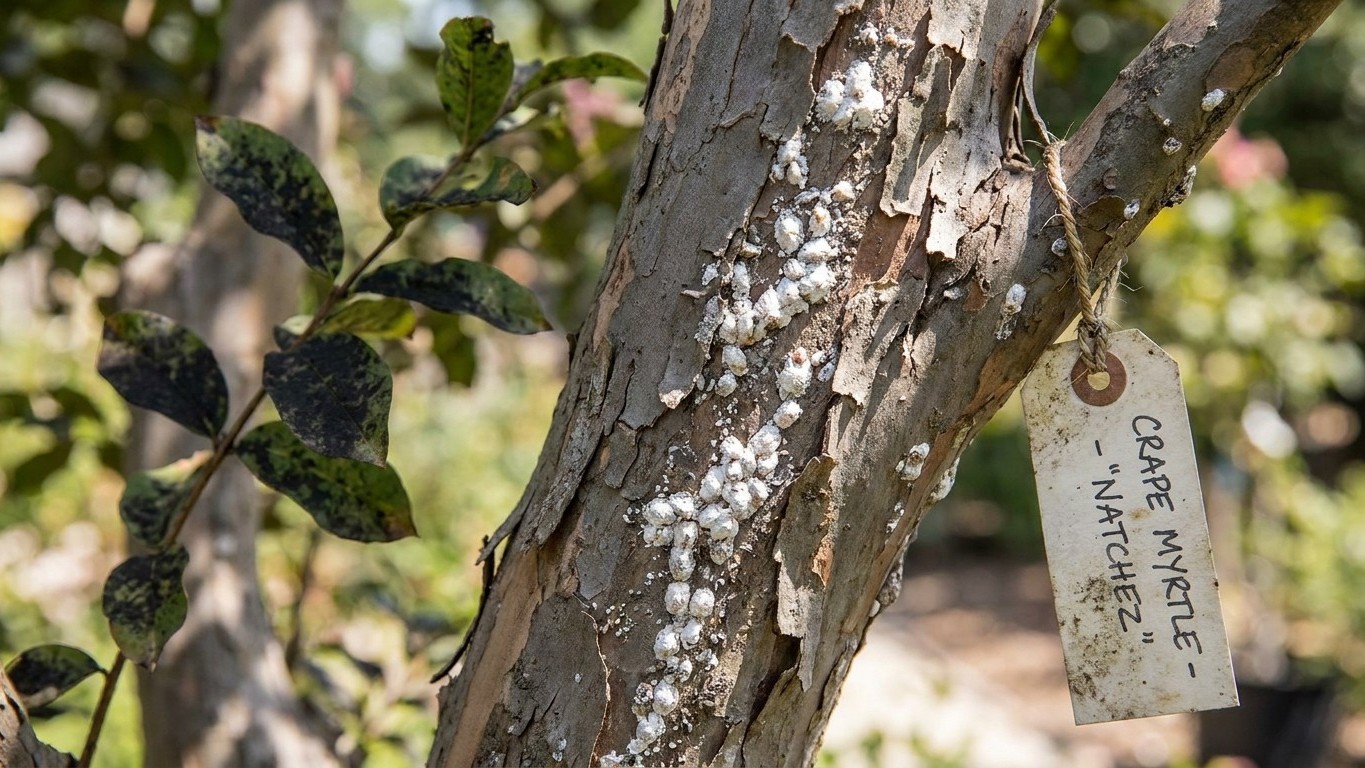

Crape myrtle bark scale shows up in Louisiana wherever crape myrtles grow, and thanks to the state’s long, mild growing season it never fully disappears. The sap-sucking insect coats bark in white, waxy patches and coats leaves in black sooty mold, weakening trees over several seasons rather than killing them outright. Scrubbing bark, encouraging predatory beetles, and catching infestations early are what actually reduce numbers; sprays aimed at leaves rarely finish the job once the waxy covering is in place.
The weeks to watch

LSU AgCenter’s general insect management guides for Louisiana gardens don’t set aside a specific calendar window for crape myrtle bark scale the way they do for pickleworm or leaf-footed bugs on vegetables. What the agency does say, in its broader notes on the state’s growing conditions, is that Louisiana’s long season lets insect populations reproduce and thrive essentially year round, and that pattern is the closest thing to a published timeline for this particular pest. There’s no single “watch this week” answer here. Instead, activity tracks temperature.
Warm months bring visible crawler activity
From spring through fall, as sap flow increases in crape myrtle bark, tiny pink crawlers hatch from egg masses and disperse to new feeding sites along stems and branches. This stretch is when populations expand fastest, and when a light infestation on a single trunk can spread across the whole canopy.
Winter doesn’t reset the population
Unlike pests that die back with the first freeze, crape myrtle bark scale overwinters as mated adult females tucked into bark crevices and pruning wounds, protected by their waxy shell. Because south Louisiana’s freeze events are inconsistent, even a cold snap rarely wipes out an established colony. Gardeners who wait for “the season” to end before checking their trees are checking a tree that’s likely been hosting scale the whole time.
Reading the calendar from your last frost

The one date most Louisiana gardeners actually track is the last spring frost, and for this NOAA station that falls somewhere between January 18 and February 8. Crape myrtle bark scale doesn’t answer to that date directly, since it isn’t waiting for warm soil to sprout, but the frost window still marks roughly when bark and sap temperatures start climbing enough for crawlers to move again.
The bigger wrinkle for Louisiana specifically: a 32-degree freeze only shows up in about 86.8 percent of years at this station. Roughly one winter in seven passes without a hard freeze at all, and the whole first-frost-to-last-frost window can blur into the New Year rather than sitting neatly on a calendar page. In a no-freeze year, dormancy barely happens, and crawler activity can pick up earlier than expected.
- Start from the local last-frost range: January 18 to February 8.
- Expect bark temperatures, and crawler movement, to climb through the weeks that follow, faster in years with no hard freeze, slower after a real cold snap.
There’s no published week-count that turns this into an exact date for crape myrtle bark scale, and treating the frost range as a single day would be misreading the data. It’s a normal to plan around, not a guarantee for any given spring.
What it attacks, and what the damage looks like

A crape myrtle coated in what looks like gray or white paint along its trunk and branches, with black sooty mold spreading across leaves and the pavement below, is the classic sign of crape myrtle bark scale. The waxy white encrustations are clusters of the insects themselves, and the black mold grows on the sticky honeydew they excrete while feeding. Bloom counts often drop and new growth can look stunted before a gardener ever spots the insect responsible.
The damage comes from adult females and the crawler stage, both of which use piercing-sucking mouthparts to draw sap directly from the bark. Because the insects feed through the bark itself rather than the leaf surface, treatments aimed at foliage alone tend to miss the source of the problem. Adult females, protected by their waxy shell, are the hardest stage to reach; crawlers, before they settle and build that covering, are the more exposed target.
This scale is closely tied to one plant group, but that group covers a lot of ground in Louisiana landscaping:
- Common crape myrtle (Lagerstroemia indica)
- Japanese crape myrtle and its hybrids (Lagerstroemia fauriei crosses)
- Dwarf and miniature crape myrtle cultivars grown in containers and foundation beds
- Older, established crape myrtles with heavy pruning wounds, where colonies tend to settle first
Any of these can carry the infestation to a neighboring tree once crawlers disperse, which is why one heavily infested crape myrtle in a yard often isn’t the only one by the following season.
How Louisiana sits in this pest’s range

On this site, crape myrtle bark scale is currently documented in one territory: Louisiana. That’s not a statement about how bad the infestation is here compared with anywhere else; it simply reflects what’s been compiled so far. With only one territory on record, there’s no neighboring state’s data to lean on and no ranking to draw between Louisiana and any other place this pest shows up.
What that does mean locally is straightforward. The conditions that let crape myrtle bark scale settle in are the same conditions that make Louisiana such a productive place to garden in general. Mild winters that rarely freeze hard, a long warm season, and crape myrtles planted in nearly every yard, median, and parking lot from Shreveport to New Orleans add up to a landscape where the insect has plenty of hosts and few hard stops to its life cycle. LSU AgCenter’s broader point about Louisiana’s growing conditions favoring insect reproduction year round applies just as directly to this scale as it does to vegetable garden pests.
For a homeowner, the practical takeaway isn’t comparing Louisiana to Texas or Georgia. It’s that a crape myrtle here rarely gets a real winter break, so whatever control measures go on need to work across most of the calendar, not just during a defined “season.”
What actually works against it

- Inspect before you buy or plant. Checking trunks and branches of nursery stock for gray-white crust before bringing a new crape myrtle home costs nothing and stops an infestation before it starts.
- Scrub established colonies off the bark. A soft brush with a mild soap-and-water solution, worked directly over the waxy patches, physically removes adult females and egg masses. Many gardeners report this knocks back populations they can reach, though results depend on how thoroughly the bark gets scrubbed.
- Prune out the worst branches. Cutting and disposing of heavily encrusted limbs removes a concentrated source of crawlers before they disperse to the rest of the canopy or to nearby trees.
- Encourage twice-stabbed lady beetles and other predators. These small black-and-red beetles feed on crape myrtle bark scale at both larval and adult stages, and yards that avoid broad-spectrum insecticide use tend to build up bigger predator populations over a season or two.
- Rinse honeydew and sooty mold off leaves and bark. A strong hose spray won’t kill the scale, but it removes the sticky residue that mold grows on and makes new colonies easier to spot early.
- Avoid heavy nitrogen fertilizer. Excess nitrogen pushes soft new growth that scale crawlers settle on more easily, so a lighter feeding schedule gives them less prime real estate.
Once adult females are established under their waxy covering, scrubbing and pruning are what still work; surface treatments aimed at leaves alone generally aren’t reaching the insect at all, since it feeds through bark. Some gardeners try copper tape or ultrasonic repellents borrowed from other pest problems; there’s no scale-specific trial showing either does anything here, and the trunk-feeding habit of this insect doesn’t match how those methods are meant to work in the first place.
Common questions
Does crape myrtle bark scale kill crape myrtles?
Rarely outright. Established trees usually survive, but the infestation weakens them over several years, reducing bloom size and vigor rather than killing the tree in one season.
How is crape myrtle bark scale different from ordinary bark discoloration?
The scale’s waxy covering builds up in raised, felt-like patches that don’t wipe away easily and are usually paired with black sooty mold on the leaves and bark below. Plain dirt or lichen doesn’t produce that sticky honeydew residue.
Does the sooty mold spread to other plants nearby?
The mold itself grows only on the honeydew the scale excretes, so it doesn’t infect unrelated plants as a disease would. It can appear on anything honeydew drips onto, including grass or patio furniture beneath an infested tree, and washes off with soap and water.