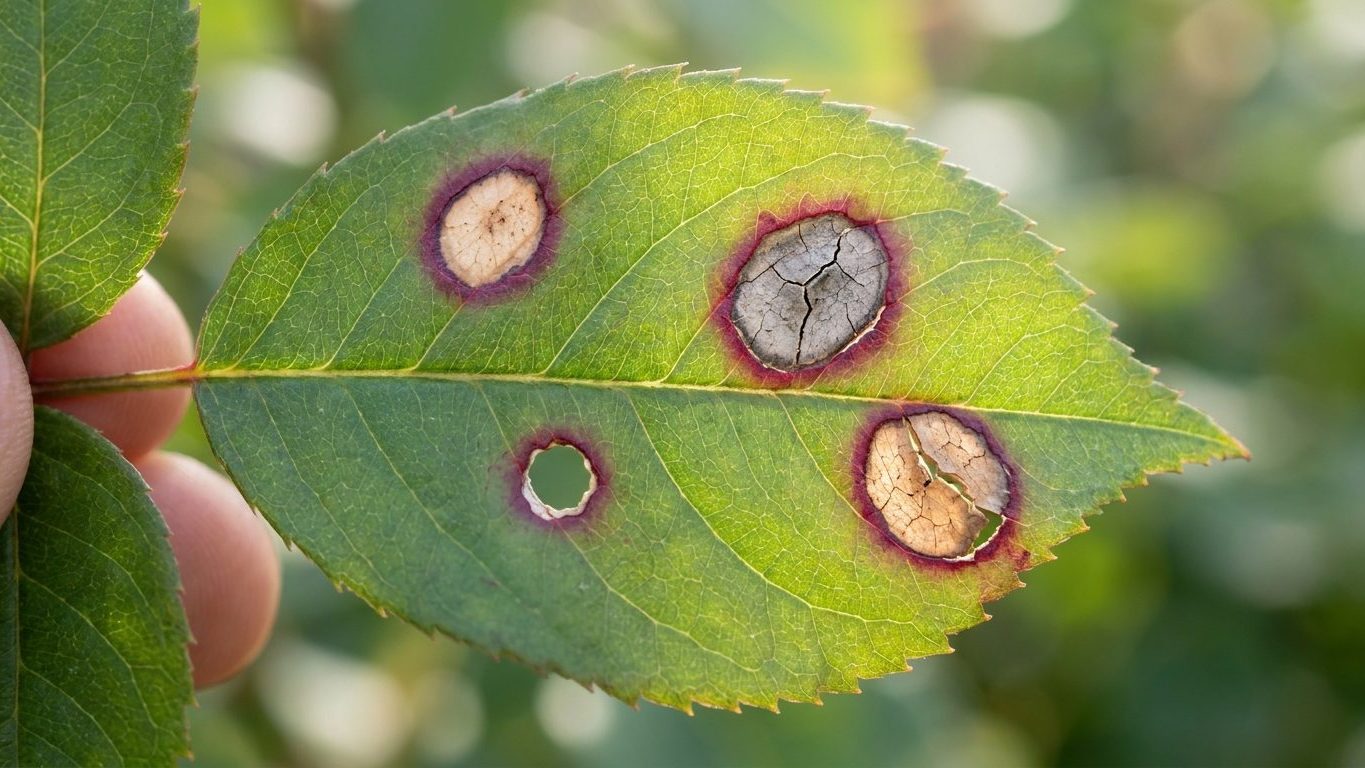

Small, round leaf spots with a grayish or tan center that dries, cracks, and drops out, leaving what looks like a shotgun blast through the leaf: that’s rose anthracnose. It’s one of the milder rose diseases, rarely fatal to an Established bush, but repeated flare-ups thin out foliage and weaken the plant over a season. It spreads at a moderate pace and gets mistaken for black spot more often than any other rose problem.
What you are looking at
This disease starts on the youngest, most exposed leaves, usually low on the bush or wherever water tends to sit longest after rain or irrigation. It is not an emergency. A bush can carry a moderate case for weeks without real damage, though a heavy infection over a full growing season will thin the canopy and stress the plant heading into dormancy.
Early leaf spots
The first sign is a scatter of tiny circular spots, often no bigger than a pinhead to about a quarter inch across, on the upper surface of the leaflet. Each spot has a reddish-purple to almost black border ringing a center that starts out pale tan or gray. At this stage the spot is flat and dry-looking, nothing like the greasy or fuzzy texture seen in some other leaf diseases.
The shot-hole stage
Given a few more days, the center of each spot dries out completely, becomes brittle, and often cracks free from the surrounding leaf tissue. It can fall away entirely, leaving a small round hole rimmed by that same dark purple border. A leaf with several of these side by side looks like it has been peppered with fine buckshot, which is the single most reliable visual signature of this disease.
Cane and stem lesions
On new green canes and stems, the disease shows up as small sunken lesions with a purplish-red to dark border, sometimes elongating into a shallow, cracked canker along the stem’s length. These rarely girdle a healthy cane, but on stressed plants they can weaken new growth at the point of infection.
Leaf yellowing and drop
Individual leaflets often yellow around a heavy cluster of lesions before dropping. Spread across the plant, infection tends to move upward from the lowest, oldest foliage toward younger growth as spores splash upward with rain or irrigation, rather than moving downward from the tips.
What it is not
Rose anthracnose gets confused with two or three other spotting diseases constantly, and the mistake matters because the wrong diagnosis leads to the wrong fix, or to unnecessary alarm about a plant that is actually fine.
Black spot
Black spot is the disease anthracnose is confused with most, and for good reason: both start as dark circular spots on rose foliage. The difference is in the edges and the middle. Black spot lesions are larger, often a half inch or more, with a fringed or feathery margin rather than a clean ring, and they are almost always surrounded by a distinct yellow halo. Crucially, a black spot lesion stays solid. The center does not dry out and fall away to leave a hole. If you can poke a finger through the middle of the spot once it’s dry, you are looking at anthracnose, not black spot. Treating a black spot outbreak like anthracnose usually just means under-reacting, since black spot spreads faster and causes more total defoliation over a season.
Downy mildew
Downy mildew is the one worth taking seriously, because it moves fast and can defoliate a rose in days under the right weather. Its lesions are irregular and angular rather than round, often purple to dark brown, and they tend to follow the leaf veins instead of forming clean circles. The tell is on the underside of the leaf early in the morning: a fine grayish or purplish fuzzy growth that anthracnose never produces. Downy mildew also causes rapid, whole-plant yellowing and leaf drop rather than the slow, spot-by-spot progression of anthracnose. Mistaking downy mildew for anthracnose costs time you don’t have, since downy mildew calls for prompt removal of affected tissue and a real change in watering habits, not a wait-and-see approach.
Cercospora leaf spot
Cercospora produces small, fairly uniform spots with a purplish-red border and a tan or grayish center, which on first glance can look a lot like early anthracnose. The difference shows up over time: a Cercospora spot’s center stays intact and slightly sunken, but it does not dry out, crack, and drop free the way an anthracnose center does. No shot-holing means no anthracnose. The two diseases are managed almost identically, so the practical cost of confusing them is low, but knowing which one you have keeps you from missing a shot-hole pattern that would otherwise be an easy, confident diagnosis.
Where it comes from and when it strikes
Rose anthracnose is caused by a fungus in the genus Sphaceloma (its sexual stage is classified as Elsinoë). It survives the off-season in infected canes still attached to the plant and in fallen leaf litter left on the ground beneath the bush. Come spring, spores form on that old tissue and are splashed onto new leaves by rain or by overhead watering, which is the main way the disease moves from plant to plant within a garden.
Wind can carry spores short distances during storms, but splashing water, whether from a hose, sprinkler, or heavy rain hitting bare soil, is by far the more common delivery method. That is why the lowest leaves on a bush, closest to the splash zone, are almost always the first to show spots.
The fungus favors warm, humid conditions paired with extended periods of leaf wetness. A leaf that dries quickly after rain or watering gives the spores little opportunity to germinate and infect; a leaf that stays wet for many hours in a row, especially in a garden with poor air movement, is exactly the setup this disease needs. It does not require the cool, wet spells that favor downy mildew, and it tends to build gradually across a season rather than exploding overnight the way downy mildew can.
What to do about it now
The single most useful thing you can do today is remove and destroy the worst-affected leaves and any cankered cane sections, rather than leaving them to drop and sit as a spore source under the bush. Bag them or burn them where local rules allow; don’t add infected material to a home compost pile that won’t get hot enough to kill the fungus.
After that, stop overhead watering if you’re doing it. Switching to drip irrigation or a soaker hose at the base of the plant, and watering in the morning if you must use a sprinkler, cuts down the hours each leaf stays wet. Pruning out crowded interior growth to open the canopy to air and light matters almost as much, since faster-drying foliage is foliage the fungus struggles to infect. A two- to three-inch layer of mulch under the plant helps too, by keeping splash from lifted soil off the lowest leaves.
A copper-based fungicide or another product labeled for rose leaf spot diseases can protect new, uninfected growth if applied before the next wet spell, but nothing will reverse damage already done to existing spots. Be honest with yourself about that: spraying spotted leaves back to health is not on the table, only preventing the next round of infection. Roses aren’t grown for eating, so there’s no harvest-safety question here, and cut flowers from an affected bush are perfectly fine to bring inside, since the fungus stays on the foliage and canes, not the bloom itself.
Keeping it out next season
Sanitation carries most of the weight going into next year. Rake up and dispose of all fallen leaves at the end of the season, and prune out any cane lesions during dormant pruning, cutting well below the visible damage. Clean your pruning shears between plants, and don’t reuse stakes or cages from an infected bed without scrubbing them down first, since old spore material can cling to wood and metal alike.
Spacing and airflow do double duty here: give bushes enough room that foliage from neighboring plants doesn’t stay pressed together and damp, and keep the center of each bush opened up with routine pruning. Mulch renewed each spring continues to act as a splash barrier between soil-borne spores and the lowest leaves.
When shopping for new roses, look for cultivars marketed specifically for disease resistance rather than assuming all modern roses are equal on this front. In parts of Europe, roses carrying an ADR rating (from Germany’s Allgemeine Deutsche Rosenneuheitenprüfung testing program) have been evaluated across multiple sites for resistance to common fungal diseases, and that designation is a useful shorthand where it’s available. There is no equivalent standardized letter-code system for rose disease resistance printed on tags the way vegetable seed packets carry codes like V or F; treat any specific resistance claim on a plant tag as the seller’s own testing rather than an independent standard. Buying bare-root or potted roses from a reputable nursery, and inspecting canes and foliage for spots before you bring a plant home, is the most reliable way to keep this fungus out of a clean bed.
Common questions
Does rose anthracnose kill the plant?
Rarely on its own. A healthy, established bush usually tolerates even a moderate infection for a full season with just some cosmetic leaf damage. Repeated heavy infections over consecutive years, especially combined with other stresses, can weaken a rose enough to make it more vulnerable to winter injury or other diseases.
Can I still use fungicide once the shot-holes have already formed?
Spraying won’t repair leaf tissue that has already died and dropped out of a lesion. A fungicide applied at that point still has value, though, because it protects the new growth coming in behind the damaged leaves from picking up fresh infection.
Is it safe to compost the fallen leaves?
Only if your compost pile reliably reaches a sustained hot temperature during its active phase; most backyard piles don’t get there consistently. When in doubt, bag infected leaves and canes for disposal with household trash rather than risking spreading the fungus back into the garden through unfinished compost.
Will this spread to my other plants, like tomatoes or shrubs?
The Sphaceloma species behind rose anthracnose is specific to roses. It does not cross over to unrelated garden plants, so there’s no need to isolate roses from vegetables or other ornamentals over this particular disease.