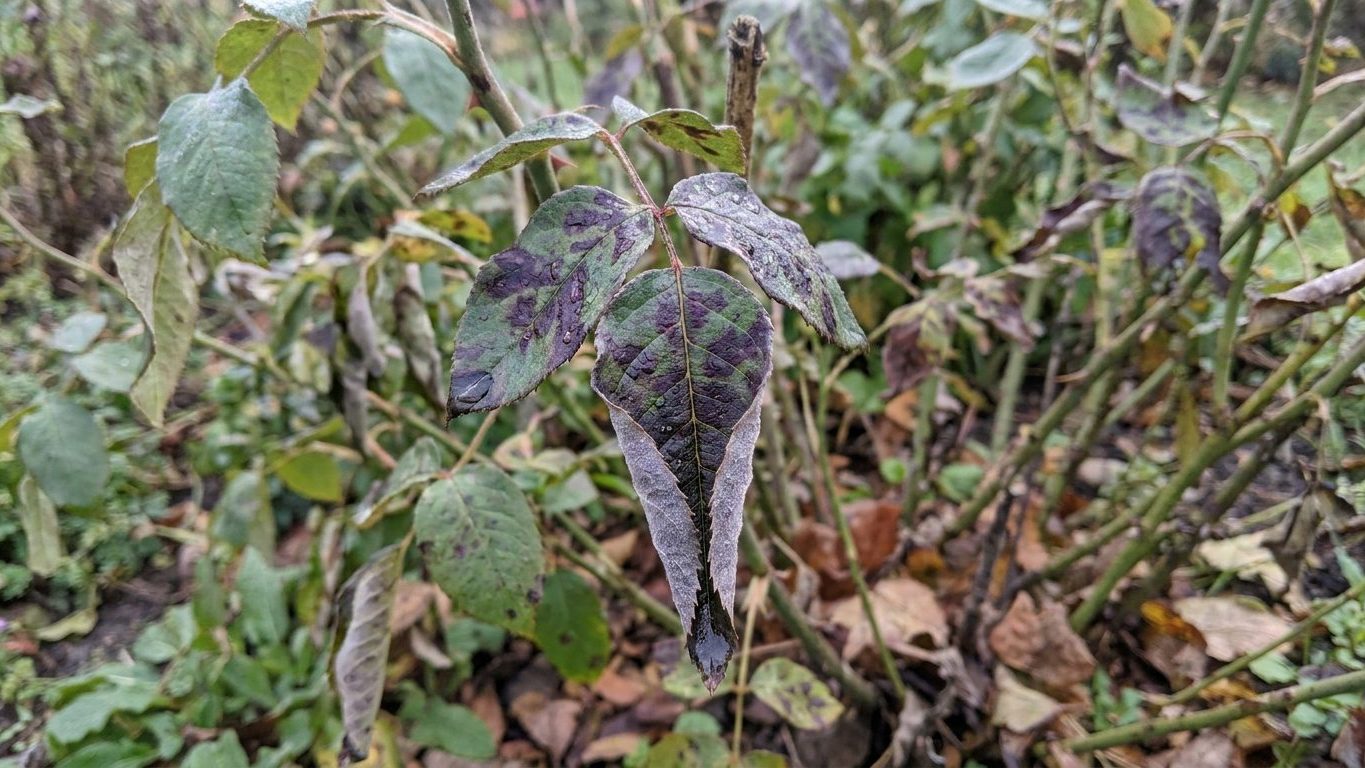

Yes, this one is serious, and it moves fast. Downy mildew on roses can turn a healthy bush into a bare, sticklike frame in under a week once conditions turn against you. The tell is purple-to-black blotches on the upper leaf surface with edges that follow the veins, not round spots with rings. Check the underside of a fresh lesion on a cool, humid morning for a faint gray fuzz. If leaves are already dropping in sheets, you are past the early window.
What you are looking at
Downy mildew starts on the newest growth, usually the upper leaves and the tender shoot tips, and works its way down the cane rather than climbing up from older foliage the way some rose diseases do. That direction matters: a plant losing its top growth first, while lower leaves stay green a little longer, points toward downy mildew rather than the reverse pattern you’d see with a soil-borne problem.
Purple to red-black blotches on upper leaf surfaces
The lesions are irregular and angular, not circular. Because the pathogen spreads through the leaf tissue between the veins, the blotch stops abruptly at a vein line instead of fading into a smooth, feathered edge. Color ranges from dark purple to reddish-brown to nearly black, and several blotches often merge into one large dead patch within a couple of days.
Grayish sporulation on the leaf underside
Flip a fresh lesion over in the early morning, before the dew burns off, and you may see a thin, grayish-violet fuzz tracing the same angular pattern as the blotch above it. This is the pathogen’s spore-producing structure, and it disappears within an hour or two once the air dries out, which is why so many gardeners miss it entirely.
Purple lesions and dieback on canes
On stems, look for sunken, purple-to-black streaks, sometimes several inches long, usually near a node or a pruning wound. Advanced cane lesions can girdle the stem, killing everything above the injury even if the roots are perfectly healthy.
Sudden, heavy leaf drop
This is the symptom that gives the disease its reputation. Leaves with blotches barely a day old can yellow, curl, and drop within 48 to 72 hours, sometimes leaving a rose bush almost bare while the mulch underneath fills with fallen foliage. No other common rose leaf disease strips a plant this quickly.
What it is not
Three conditions get mistaken for downy mildew often enough that the mix-up changes what a gardener does next, and not always for the better.
Black spot
Black spot lesions are round, with a distinctly feathered or fringed black margin and a yellow halo surrounding the spot, and they sit almost exclusively on the upper leaf surface without the angular, vein-bound shape of downy mildew. Black spot also progresses over weeks, with individual leaves yellowing and dropping one at a time rather than the whole canopy collapsing in days. Treating a black spot outbreak like downy mildew wastes time and product, since the two respond to different management timing, though many of the same sanitation steps help both. The real cost of confusing them is patience: black spot is a long-season nuisance you manage all summer, while downy mildew demands an immediate response or you lose the plant’s foliage entirely.
Botrytis blight (gray mold)
Botrytis shows up as fuzzy, grayish-brown mold directly on the lesion surface, usually on flower buds, spent blooms, and soft, damaged tissue rather than on healthy young leaves. The mold is visible in daylight and doesn’t disappear as the air dries, unlike the fleeting sporulation of downy mildew. Botrytis also favors dead or dying tissue as its entry point, so it often follows frost damage or bruising rather than attacking vigorous new growth outright. Mistaking the two matters because botrytis calls for removing spent blooms and improving air circulation around flowers, not the more aggressive cane and leaf sanitation downy mildew requires.
Herbicide drift
Phenoxy herbicide drift, from a lawn treatment applied nearby on a windy day, can cause reddish-purple discoloration and puckering on rose leaves that superficially resembles downy mildew at a glance. The giveaway is the pattern: herbicide damage tends to affect leaves uniformly across the whole plant and often shows twisted, cupped, or strap-like new growth rather than discrete angular blotches. There’s no sporulation, no cane lesions, and no rapid leaf drop pattern radiating from lesion sites. Treating herbicide injury with a fungicide does nothing, and treating true downy mildew as drift damage means losing the response window while you wait for symptoms to “grow out.”
Where it comes from and when it strikes
The organism responsible, Peronospora sparsa, is an oomycete, a water mold rather than a true fungus, which is part of why it behaves so differently from black spot or powdery mildew. It survives between seasons inside infected canes and dormant buds, and in leaf litter left on the ground under the bush, giving it a head start the moment conditions turn favorable again.
Spores travel two main ways. Rain splash and irrigation water carry them from infected debris up onto new leaves, while wind can move spores over considerable distance during outbreaks, which is one reason the disease sometimes appears seemingly out of nowhere in a garden that had no visible problem the week before. Infected nursery stock is another common entry point, since the pathogen can lodge in canes without obvious symptoms until conditions shift.
What it needs to take hold is cool, humid weather with extended periods of leaf wetness, the kind of stretch where dew sits on foliage well into the morning or a run of overcast, damp days keeps the plant’s surface moist for many hours at a stretch. Poor air movement around a densely planted or overgrown bush extends that wetness even further, which is why crowded plantings tend to suffer worse and faster outbreaks than well-spaced ones.
What to do about it now
Once cane lesions and canopy-wide defoliation have set in, that damage is done, and no treatment reverses it. Being honest about that upfront saves a lot of wasted effort spraying a plant that has already lost the fight for this season’s foliage.
What still helps: remove infected leaves and cut out cane lesions well below the visible discoloration, bagging or burning the debris rather than composting it, since home compost piles rarely get hot enough to kill oomycete spores. Stop overhead watering immediately and switch to watering at the base of the plant, since wet foliage is exactly what the pathogen needs to keep spreading. Prune out crowded interior growth to open the canopy to air movement, and refresh the mulch layer underneath the bush to bury spore-laden debris and cut down on splash-back during rain.
Fungicide treatments labeled for downy mildew, applied preventively or at the very first sign of blotching, can slow an active outbreak, but they won’t restore leaves already lost and work best as part of a broader sanitation effort rather than a stand-alone fix. If the rose in question is a hip-producing type grown partly for its fruit, the hips themselves remain safe to harvest and eat even on a plant showing heavy foliar downy mildew, since the disease affects leaves and canes, not the fruit’s edibility. A severely defoliated bush will bloom less and store fewer reserves for winter, which is the bigger long-term cost.
Keeping it out next season
Sanitation carries most of the weight here. Clean up and destroy fallen leaves and pruned canes at the end of the season rather than leaving them at the base of the plant, since that debris is exactly where the pathogen overwinters and re-infects the following spring’s new growth.
Unlike vegetable seed packets, rose nursery tags don’t carry a standardized letter-code system for downy mildew resistance, so there’s no simple “DM” marking to look for at the garden center the way a tomato or cucumber grower might check. What does help is choosing species roses and their close hybrids, Rosa rugosa types in particular, which have a long-standing reputation among growers for tougher foliage and better field resistance to downy mildew than many modern hybrid teas and floribundas bred primarily for bloom form.
Buy new plants from reputable growers who can speak to the disease history of their stock, and inspect any new rose closely before planting it near existing bushes, since infected nursery material is a documented way the disease enters gardens that had no prior history of it. Space plants for real air movement between mature canopies rather than the tight spacing that looks good the first year, disinfect pruning tools and any stakes or cages between uses, and keep mulch refreshed as a physical barrier between soil-borne debris and the Lowest Leaves. None of these steps guarantees an outbreak-free season, but together they remove most of the conditions the pathogen depends on to get established in the first place.
Common questions
Can a rose bush recover after losing most of its leaves to downy mildew?
Yes, if the canes themselves are still alive and the roots weren’t compromised. The plant will push new growth once conditions dry out and cooler, wetter weather passes, though bloom production for that season is usually reduced.
Does downy mildew spread to other plants in the garden besides roses?
Peronospora sparsa is specific to roses and does not infect unrelated garden plants, though other downy mildew species do attack other crops. A rose downy mildew outbreak won’t jump to your tomatoes or lettuce.
Is it safe to compost rose leaves with downy mildew lesions?
It’s not recommended for a typical backyard pile. Home compost setups usually don’t sustain the heat needed to kill oomycete spores reliably, so bagging and disposing of infected material in household trash is the safer route.
How quickly should I act once I spot the first purple blotches?
Within a day or two, ideally. Given how fast this disease moves from first lesion to significant leaf drop, prompt removal of affected foliage and an immediate change in watering habits make a real difference to how much of the plant you keep.