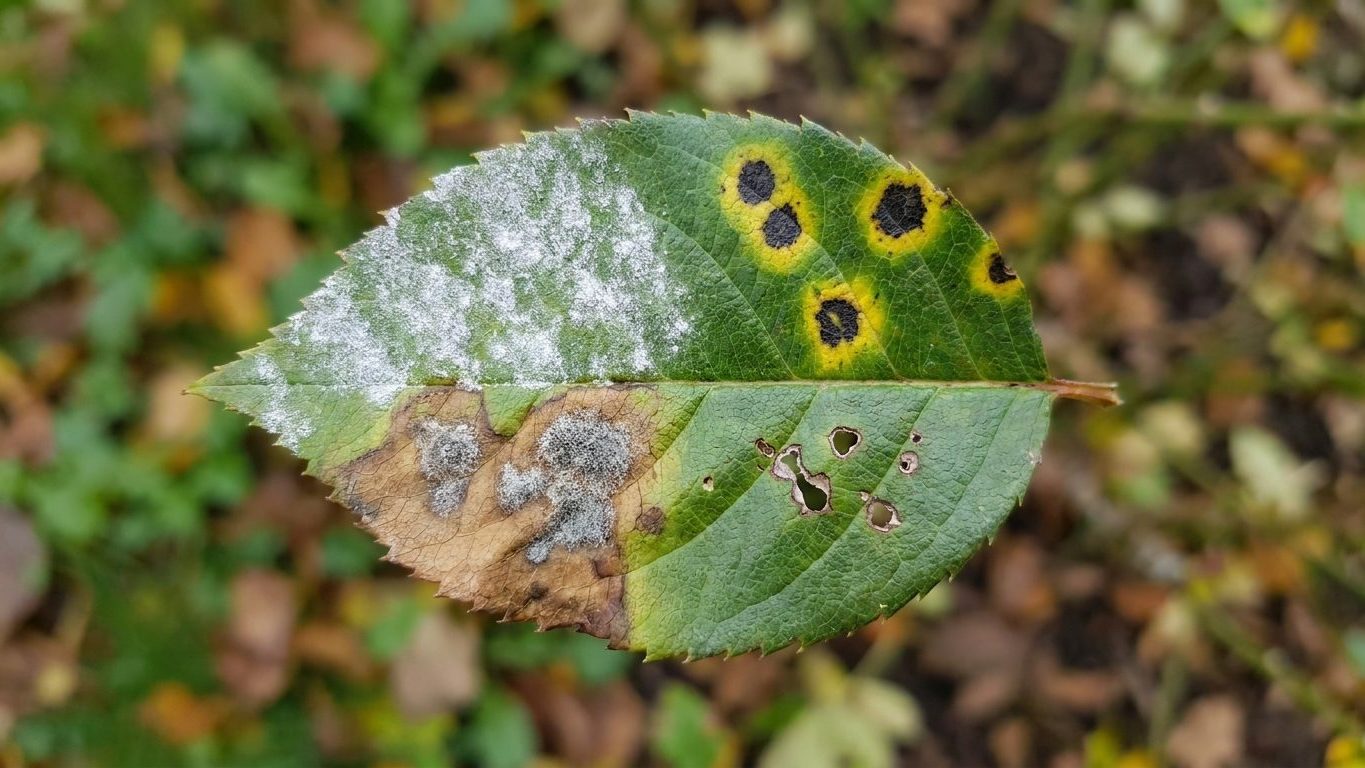

Rose diseases mostly announce themselves on the leaf before they ever touch a stem or a bloom, and four clues sort them out fast: where the mark sits on the leaf, its shape and edge, whether it comes with a powdery coating or a fuzzy gray fringe, and the weather that came right before it showed up. Powdery mildew dusts the top of young leaves white; black spot rings itself in yellow; botrytis fuzzes gray on wilted tissue; anthracnose punches small sunken holes.
Why this matters
Roses are already listed as HIGH maintenance by NC State Extension, and a wrong call on a leaf symptom adds weeks to that workload instead of cutting it down. Treat powdery mildew with the wrong product, or worse, treat a nutrient issue as if it were a fungal one, and the actual disease keeps spreading through the bed while the plant sits there being sprayed for nothing. Leaf spots and blights move fast once they’re established, and the delay caused by a bad guess is often the difference between pulling a few leaves and stripping half the bush.
The other cost is quieter. A misdiagnosed rose gets the wrong care routine attached to it long after the season ends, because whoever tends it now believes the plant has a chronic mildew problem when it actually had one wet week of black spot. That mistaken label shapes watering habits, pruning choices, and spray schedules for years. Getting the leaf reading right the first time is what keeps the rest of the plant’s care grounded in what’s actually happening, not in a guess made in a hurry.
When to do it
Check leaves at every flush of new growth, not on a fixed date. The first flush after the yearly late-winter pruning that most roses need is the moment fungal spores waiting on old wood get their first shot at tender tissue, so that’s the highest-value window to look closely. A second check belongs right after any stretch of extended wet or humid weather, since that’s exactly the condition that lets black spot and botrytis establish on foliage that looked clean a few days earlier.
Watch the plant itself rather than the calendar: new leaflets unfurling, a bud swelling toward bloom, or foliage staying wet past midday are all better signals than a date on a chart, because exact timing shifts with the reader’s own hardiness zone and local rainfall pattern. That zone-specific timing is covered on the state-level pages in this guide, not here, since a spray or pruning date that works in one region can be weeks off in another.
How to do it
Start with the leaf surface, not the whole plant. Turn a suspect leaf over and look at both sides in decent light, ideally outdoors rather than under a porch bulb, since the color cast changes how a faint white coating or a pale ring reads.
Read the mark itself
Note four things in order: location on the leaf, shape of the mark, its edge, and any texture riding on top of it. A circular black mark with a feathered, irregular yellow-fringed edge on the upper leaf surface points to black spot. A white or gray powdery film covering young leaves and stem tips, with no defined edge at all, points to powdery mildew. Small sunken, dark lesions with a defined rim, sometimes on leaves and sometimes on canes, point to anthracnose. Gray, fuzzy growth on wilted or damaged tissue, especially on flower parts that flopped over after rain, points to botrytis. General blights show up as larger, water-soaked patches that spread quickly across a leaf rather than staying as a discrete spot.
Compare against the plant’s recent weather
Cross-check the mark against what the plant just went through. Powdery mildew favors dry days with humid nights and poor air movement. Black spot and botrytis both need actual leaf wetness, from rain, overhead watering, or heavy dew, to get started. Anthracnose tends to show after mechanical damage or splashing rain moved spores from soil onto lower leaves first.
| Disease | Where it shows | What it looks like | Weather that favors it |
|---|---|---|---|
| Black spot (a leaf spot) | Upper leaf surface, lower canopy first | Round black spot, fringed yellow edge | Wet leaves, warm humid stretches |
| Powdery mildew | New leaves, buds, stem tips | White to gray powdery film, no sharp edge | Dry days, humid nights, poor airflow |
| Botrytis | Petals, wilted or damaged leaves | Fuzzy gray growth on soft tissue | Cool, damp, still air |
| Anthracnose | Leaves and sometimes canes | Small sunken lesion, defined rim | Splashing rain, prior wounding |
| General blights | Leaves, flower clusters | Larger water-soaked patches, fast spread | Extended wet weather |
Once the mark is identified, pull the specific affected leaflets rather than shearing the whole cane, and dispose of them away from the bed instead of composting them onsite. Diseased leaves stripped for diagnosis should never go back near the base of the plant.
What goes wrong
The most common error is treating any leaf mark as one single disease, usually the one the gardener has already dealt with before, and spraying accordingly without checking the edge and texture first. A ring with a defined yellow fringe is not the same problem as a powdery film with no edge at all, and the product that handles one does nothing for the other.
The mistake that looks like extra care but isn’t: stripping every leaf that shows the faintest mark, including healthy foliage nearby, in an attempt to be thorough. That removes the plant’s ability to photosynthesize right when it needs energy to push new, cleaner growth, and it does not stop black spot, which overwinters both in fallen leaves and in lesions left on the canes themselves. Raking the litter alone, without addressing the canes, leaves the source of next season’s outbreak sitting on the plant.
Another frequent slip is confusing overhead watering damage or fertilizer burn with fungal spotting. Burn marks tend to sit at leaf tips and margins with a dry, papery texture rather than a defined ringed spot, and they show up on leaves across the whole plant at once rather than starting low and working up. Reading that as disease leads to unnecessary spraying while the actual watering habit causing the burn goes unchanged.
Doing it differently
Growing method changes what to expect on the leaf, not the diagnostic steps themselves. Roses in containers or raised beds usually get better air circulation around the base than in-ground plantings crowded into a border, which cuts down on the still, humid air that favors powdery mildew, so a mildew reading there is a stronger signal of a real airflow problem worth fixing at the spacing level. Greenhouse-grown roses run the opposite risk: high humidity with little airflow makes botrytis far more likely on any damaged or wilted tissue, so that diagnosis deserves extra weight indoors.
Variety matters more than group. Disease resistance is set cultivar by cultivar, not by whether a rose is a hybrid tea, shrub, or rambler; some classic rambling roses are mildew-prone while a landscape shrub rose bred specifically for resistance can go a whole wet season with clean foliage. That means a leaf reading on a known susceptible cultivar carries less surprise than the same mark turning up on a rose sold as disease-resistant, which is worth a second, closer look before assuming the label was wrong.
Common questions
Are rose thorns dangerous?
They are prickles, not true thorns. They grow from the outer skin of the stem, which is why they snap off sideways instead of breaking like a woody point, and they carry no toxin, just the risk of a scratch getting dirty.
Does raking up fallen leaves stop black spot for good?
No. Black spot overwinters both in fallen leaves and in lesions on the canes themselves, so clearing the litter without addressing infected wood leaves the disease a way back onto the plant next season.
Do rose hips forming mean the plant is heading into dormancy?
No. Dormancy follows day length and cold, not the presence of hips. What is true is the reverse: every deadheading cut pushes a new shoot, so stopping cuts late in the season is what avoids soft growth that won’t ripen before frost.
What’s the real difference between powdery mildew and botrytis on a leaf?
Powdery mildew is a dry, dusty white to gray film with no defined edge, usually on young growth. Botrytis is a fuzzy gray growth that needs damp, soft or wilted tissue to take hold, and it shows up on damaged leaves and spent petals rather than fresh new leaves.