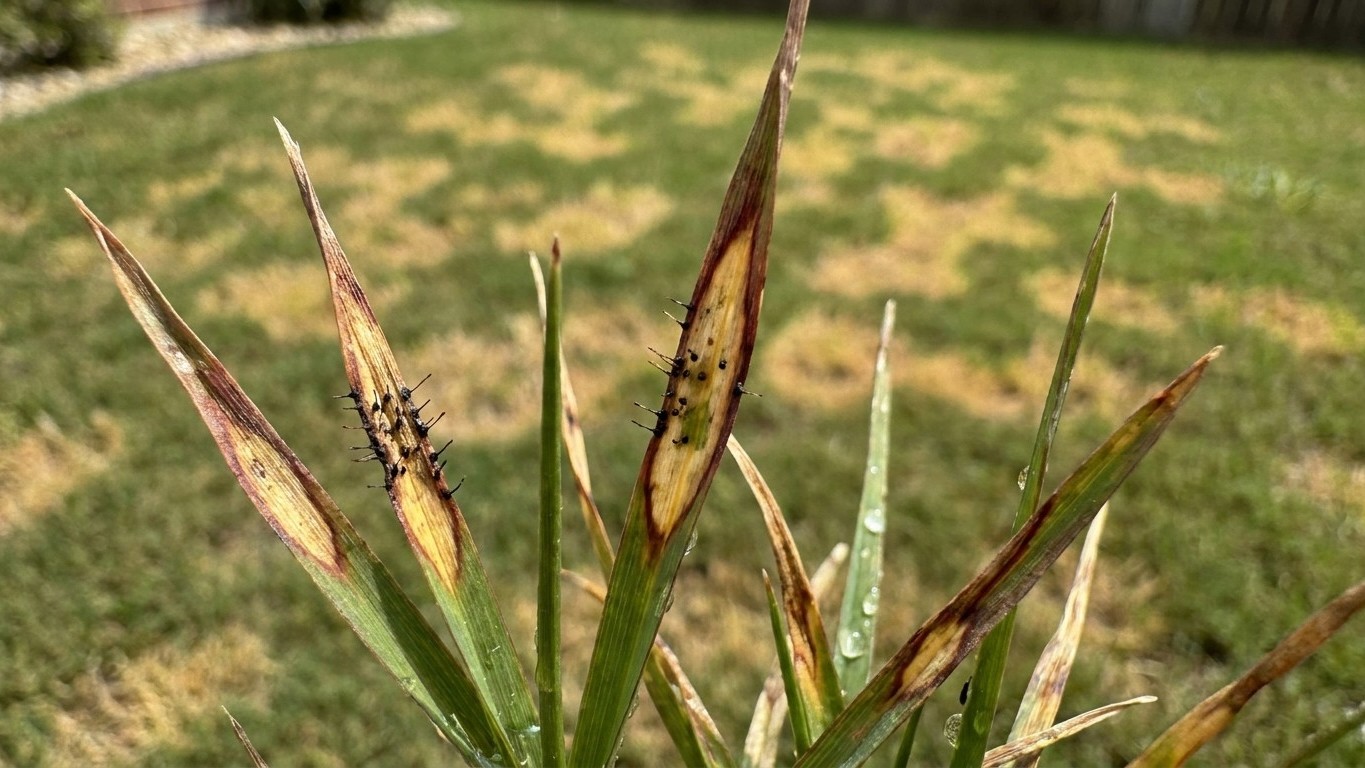

Anthracnose almost never strikes a healthy lawn. It shows up on turf that’s already running on empty, worn down by heat, drought, compacted soil, or a mowing habit that’s scalped the grass too short for weeks. The fungus is less a cause and more a symptom of stress that was already building before you noticed the first brown patch.
What you are looking at
From a distance, anthracnose looks like irregular, yellowish to reddish-brown patches scattered across the lawn rather than one uniform dead zone. The patches are ragged-edged, not the neat circles you’d get from a dog spot or a sprinkler head that quit working. They tend to merge as the disease spreads, giving the lawn a thinning, moth-eaten look instead of a clean kill line.
The confirmation isn’t the patch, though. It’s the individual blade. Pull a few affected leaves and look closely, ideally with a hand lens. You’ll find small lesions, oval or irregular in shape, tan to yellow in the center with a darker reddish-brown to black border. On close inspection, especially on older lesions, tiny black dots appear scattered across the dead tissue. Those are the fungal fruiting bodies, called acervuli, and they often carry stiff dark bristles poking out from the surface. That bristled black speck is the single most reliable field mark for anthracnose. No other common lawn disease produces quite that combination.
The basal rot phase
There’s a second, uglier form of the disease worth knowing. When anthracnose hits during the hottest, most stressful part of summer, it can attack the base of the plant instead of just the leaf blade. The crown and lower stem turn black and mushy, and the grass pulls out of the ground with almost no resistance, roots and all. This basal rot phase is the one most likely to actually kill turf rather than just discolor it, and it tends to show up on lawns that were already thin from drought or compaction before the fungus arrived.
What it is not
Most brown patches reported as “disease” turn out to be something simpler. Start with the pattern. If the discoloration follows a straight edge, like the arc of a sprinkler head or the exact boundary of a slope that drains faster than the rest of the yard, that’s a watering problem, not a pathogen. Anthracnose patches are irregular and don’t respect property lines drawn by your irrigation system.
Scalped tips are another common mix-up. If the grass blades are brown only at the very tip, in a straight line across the top, that’s mower damage from cutting too much off at once or mowing with a dull blade that shreds rather than slices. Anthracnose lesions appear anywhere along the blade and come with that telltale black, bristled dot, not a clean brown line at the top.
Dog urine spots are small, circular, and often ringed with a halo of extra-green grass around a dead center, the nitrogen burn effect. Grub damage feels different underfoot: the turf lifts like loose carpet because the roots have been eaten away, and you can often peel back a section by hand. Brown patch, a different fungal disease entirely, tends to form larger, smoky-edged rings, especially in humid weather, without the individual blade lesions anthracnose leaves behind.
If you’re checking a struggling lawn and you don’t find those black bristled specks on the blades, the honest answer is that you’re probably dealing with a watering or mowing habit, not a disease. That’s the case more often than not.
The conditions that bring it on
Anthracnose is fundamentally a stress disease, and the grass species involved changes both the timing and the risk. On cool-season lawns (species like annual bluegrass and creeping bentgrass, common on golf courses and some northern home lawns), the disease shows up in two very different windows. A foliar blight phase can appear during cool, wet stretches in spring or fall when leaves stay damp for extended periods. The more damaging basal rot phase tends to hit during the hottest, most humid part of summer, exactly when the grass is already struggling with heat and, often, drought.
Warm-season lawns aren’t immune, but they’re affected less often. Bermudagrass can develop anthracnose, typically when it’s been stressed by low mowing, heavy traffic, or a nitrogen deficiency going into a hot, humid stretch. Zoysia and St. Augustine cases are reported but less common.
The through-line across every case is prolonged leaf wetness combined with a plant that’s already running a deficit, whether that deficit comes from drought, compacted soil, low mowing height, or simply not enough nitrogen to keep growth ahead of stress. A precise number of wet hours or a specific temperature threshold isn’t something reliably published for home lawn conditions, so treat “warm and humid with leaves that stay damp for extended periods” as the practical warning sign rather than a hard cutoff.
| Grass type | Season of risk | Typical trigger |
|---|---|---|
| Annual bluegrass, bentgrass (cool-season) | Spring/fall (foliar) and summer (basal rot) | Cool wet weather, then heat and drought stress |
| Bermudagrass (warm-season) | Summer | Low mowing, heavy traffic, nitrogen deficiency |
| Zoysia, St. Augustine (warm-season) | Summer, less common | Prolonged stress, less frequently reported |
What to do now
Here’s the part that surprises a lot of homeowners: most lawn diseases, anthracnose included, run their course. Once the weather shifts (cooler nights, a break in the humidity, rain that lets the soil dry between waterings), the turf that hasn’t been badly thinned by basal rot typically fills back in on its own over the following weeks. Brown is not dead. A lawn under drought or heat stress often looks far worse than it actually is, and recovery is the normal outcome once conditions ease.
That said, the underlying stress needs addressing, not just waiting out. Cut back on foot traffic across the weakened area, switch to deep, infrequent watering rather than light daily sprinkles, and check whether the lawn is due for a nitrogen application, since a hungry lawn recovers slower and gets hit harder next time.
A fungicide is a reasonable option only in narrow situations, typically high-value turf, like a lawn you’re not willing to risk losing entirely, where basal rot is actively spreading and the weather pattern that triggered it isn’t letting up. Products labeled for anthracnose control are available at garden centers and home improvement stores for homeowner use, but they won’t fix compacted soil, a mowing height set too low, or a lawn that’s simply thirsty. Spraying a fungicide onto a stress problem is money spent on weather you can’t control. Fix the underlying stress first; the fungicide, if it’s needed at all, is a supporting move, not the main one.
Preventing it next season
Prevention here is almost entirely habit, not product. Watering in the early morning, rather than in the evening, gives grass blades time to dry out during the day instead of sitting wet all night, which is exactly the condition anthracnose favors. Evening watering is one of the most common unforced errors homeowners make.
Mowing height matters more than most people expect. Cool-season lawns prone to anthracnose, especially those with a lot of annual bluegrass or bentgrass, do noticeably better when kept a bit taller rather than scalped short, since taller grass handles heat and drought stress with more reserve. Keep mower blades sharp; a clean cut heals faster than a torn one and gives the fungus less of an opening.
Nitrogen timing is a balancing act. A lawn running low on nitrogen going into a hot, humid stretch is far more vulnerable, but pushing too much nitrogen right before or during high heat can add its own stress. A steady, moderate feeding program beats a single heavy dose applied at the wrong time.
Airflow and soil compaction round out the picture. Aerating compacted soil, especially on high-traffic areas, and reducing thatch buildup both help water drain properly and let grass blades dry faster after rain or irrigation. None of this is complicated or expensive; it’s mostly about timing the basics right rather than reaching for a new product.
Common questions
Can anthracnose spread to other parts of the yard on its own?
The fungus can move via water splash, mowing equipment, and foot traffic carrying spores from an infected patch to healthy turf, particularly when leaves stay wet. Cleaning mower decks and avoiding mowing wet grass reduces the spread.
Will my lawn recover without any treatment at all?
In many cases, yes, once the triggering stress (heat, drought, compaction) eases and normal growing conditions return. The exception is turf that’s suffered severe basal rot, where the crown itself has died; those areas may need overseeding or patching rather than simple recovery.
Is anthracnose contagious to other plants in the yard, like shrubs or trees?
The strains affecting turfgrass are generally specific to grass species and aren’t the same pathogens that cause anthracnose on ornamental trees or shrubs, so it’s not something to worry about spreading to your landscaping beds.
How long does it take for a lawn to bounce back after an anthracnose outbreak?
There’s no universally published timeline, since recovery depends heavily on how much of the crown survived, the weather that follows, and how well watering and mowing habits are corrected. A lawn with intact roots often shows visible improvement within a few weeks of cooler, drier conditions and consistent care.