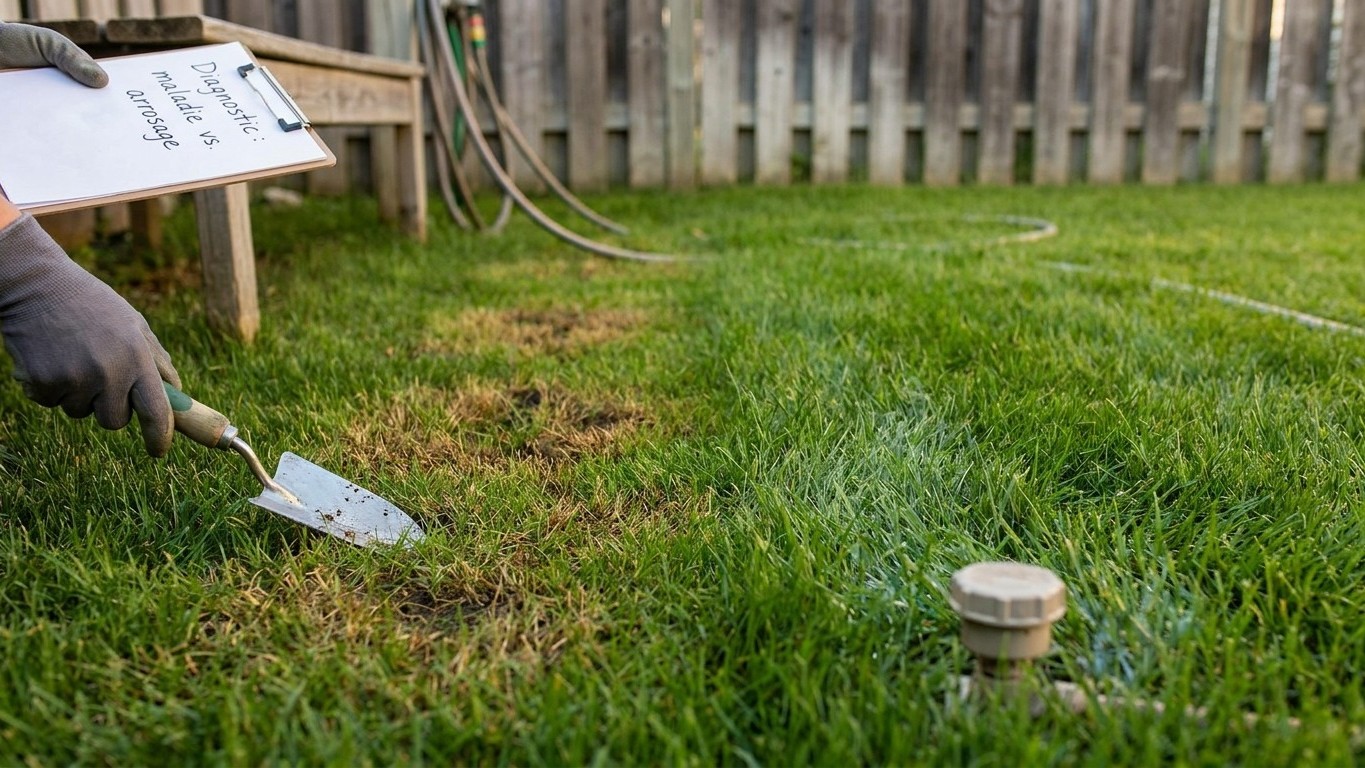

A lawn disease and a watering mistake can look identical from the porch: a patch of brown or yellow grass that won’t green back up. The real tell is pattern and edge. Drought or overwatering stress spreads in broad zones that follow slopes, sun exposure or sprinkler coverage, while disease shows up in rings, streaks or scattered spots with a sharp border, often appearing almost overnight during humid weather. Walk the yard and check whether the discolored areas line up with your irrigation heads before you buy anything to spray on it.
Why this matters
Grass doesn’t announce a mistake the day it happens. Water too little or too much this week and you won’t see the damage until two to three weeks later, by which point you’ve likely repeated the same error several more times. Misread that damage as disease and you’ll reach for a fungicide that does nothing for a watering problem, while the actual cause keeps working on the lawn underneath.
The reverse mistake costs more. If a fungal outbreak gets diagnosed as drought stress, the standard fix is more water, and extra moisture on the leaf surface is exactly what most turf fungi need to spread. A Dollar Spot lawn, Red Thread lawn, Lawn Rust lawn, Brown Patch lawn or Fairy Ring lawn outbreak that would have stalled out in a week of dry weather can instead cover the whole yard by the time you notice the pattern doesn’t match a hose or a sprinkler zone.
Mowing height plays into both problems. Clemson Cooperative Extension’s HGIC 1205 Mowing Lawns notes that cutting shorter than a species tolerates stresses the grass and makes it more vulnerable to both drought injury and fungal infection, so a scalped lawn will show symptoms of either faster and more severely than one mowed correctly for its species.
When to do it
Cool-season grasses such as Kentucky bluegrass, perennial ryegrass and the fescues do their growing in spring and fall, per Penn State Extension’s Lawn Establishment guidance, and go semi-dormant in summer heat. Warm-season grasses such as bermudagrass, zoysiagrass, centipedegrass and St. Augustinegrass, covered by Clemson Cooperative Extension’s HGIC 1214 Selecting a Lawn Grass, grow through summer and go dormant and brown over winter. That means the same brown lawn in July can be a warm-season grass having its best month, or a cool-season grass under real stress, and you have to know which type you’re standing on before the color tells you anything.
Check symptoms against the grass’s active growing season, not the calendar month. A cool-season lawn that browns in January is very likely just dormant, not diseased, though matted, grayish patches that appear as snow melts in late winter point instead to Snow Mold lawn. The same lawn browning in ring patterns during a humid stretch in May or September, its active growth window, is worth a closer look. For warm-season species, summer disease pressure builds during the same weeks the grass is putting out its heaviest growth, so scattered irregular patches showing up in July deserve more suspicion than a uniform winter brown-out.
Species-specific timing for mowing, feeding and disease watch windows is laid out in the individual maintenance calendars: HGIC 1215 for centipedegrass, HGIC 1216 for bermudagrass, HGIC 1217 for zoysiagrass, HGIC 1218 for St. Augustinegrass and HGIC 1219 for tall fescue. If you haven’t settled on species-specific practices yet, start with the basics covered in Lawn Care before troubleshooting individual symptoms, since half of what looks like disease traces back to a mowing or watering routine that was never matched to the grass in the first place.
How to do it

Read the mowing height first
Before treating anything, confirm the lawn is being cut within the range its species tolerates. Cutting a bermudagrass lawn at 3 inches when it wants 0.75 to 1.5 inches per Clemson’s HGIC 1214, or cutting a fine fescue lawn down to 1 inch when it wants 2.5 to 3.5 inches per Penn State Extension, produces stress symptoms that mimic both drought and disease. The table below lays out mowing height alongside shade, drought and wear tolerance for common species, since a lawn struggling with the wrong grass for its site will show chronic thinning that looks like recurring disease.
| Grass | Season | Mowing height | Shade tolerance | Drought tolerance | Wear tolerance |
|---|---|---|---|---|---|
| Fine Fescues | Cool | 2.5-3.5 in | Excellent | Good | Poor |
| Kentucky Bluegrass | Cool | 2-3 in | Fair | Fair | Good |
| Perennial Ryegrass | Cool | 2-3 in | Fair | Fair | Good |
| Rough Bluegrass | Cool | 2-3 in | Excellent | Poor | Poor |
| Tall Fescue | Cool | 2.5-3.5 in | Good | Fair | Fair |
| Bahiagrass | Warm | 3-4 in | Poor | Excellent | Good |
| Bermudagrass | Warm | 0.75-1.5 in | Very poor | Excellent | Excellent |
| Carpetgrass | Warm | 1-2 in | Fair | Very poor | Poor |
| Centipedegrass | Warm | 1.5-2 in | Fair | Fair | Poor |
| Seashore Paspalum | Warm | 1-1.5 in | Poor to fair | Fair to good | Good |
| St. Augustinegrass | Warm | 2.5-4 in | Excellent | Good | Fair |
| Zoysiagrass | Warm | 0.75-2 in | Excellent | Good | Very good |
Cool-season figures: Penn State Extension, Lawn Establishment. Warm-season and Tall Fescue figures: Clemson Cooperative Extension, HGIC 1214.
Water for the root zone, not the leaf
Water deeply and less often rather than lightly every day. A quick daily sprinkle wets the blade surface without pushing moisture down to the roots, and a wet leaf surface for hours at a stretch is what most turf fungi need to establish. If disease has already shown up, cutting back to fewer, deeper watering sessions and watering in the morning so the grass dries by afternoon does more to stop the spread than anything in a bottle.
Nitrogen feeding also swings disease risk in both directions. Underfed turf recovers slowly from any stress, while heavily overfed turf grows soft, disease-prone tissue. Check Clemson’s HGIC 1201 Fertilizing Lawns for the nitrogen rate per 1000 square feet appropriate to your species before applying anything, since the right amount differs by grass type and by season.
What goes wrong
Scalping mistaken for disease
Mowing below the tolerated height, especially after letting the lawn get too tall between cuts, strips away enough leaf tissue that the grass browns in patches within days. It reads like a disease outbreak but the pattern usually follows mower paths, not fungal rings, and it grows out within one to two mowing cycles once the height is corrected.
Overwatering that looks like a fungal outbreak, because it becomes one
Standing water or daily light watering keeps the crown of the grass wet long enough for fungal disease to actually take hold, so what starts as a watering mistake becomes a real infection within one to two weeks of humid weather. The tell at that stage is a defined ring or patch edge, distinct from the diffuse yellowing of simple overwatering.
Underwatering that recovers on its own
Grass under drought stress turns a dull gray-blue before it browns, and footprints stay visible in the lawn longer than usual because the blades have lost enough turgor that they don’t spring back. This shows up first on slopes, high spots and areas near pavement, and it greens back up within one to two soaks once watering resumes, unlike a disease patch that stays dead until it’s overseeded.
Grubs and insects mimicking both
Not every brown patch is watering or fungus. Grub damage and other insect feeding can produce patches that pull up loose like carpet, a symptom neither drought nor disease causes, and it’s worth ruling out before you treat for either. The differences between insect damage and disease symptoms are laid out in Lawn Pests: The Damage Each One Leaves Behind.
How this changes across the country
A cool-season grower working with Kentucky bluegrass or perennial ryegrass, the species Penn State Extension covers in its Lawn Establishment guidance, watches for disease pressure during the humid stretches of spring and fall when the grass is actively growing, and largely stops worrying about it once the lawn goes semi-dormant in summer heat. A warm-season grower in a state like South Carolina, where Clemson Cooperative Extension’s HGIC 1214 covers species from bermudagrass to St. Augustinegrass, watches through the humid summer growing season instead and expects winter browning to be dormancy, not disease.
The transition zone, where summers are too hot for reliable cool-season turf but winters are too cold for most warm-season species to survive without dieback, is where tall fescue gets used precisely because it splits the difference. Clemson’s HGIC 1214 rates tall fescue’s shade tolerance as good and its drought tolerance as fair, a middle-of-the-table profile compared to a shade specialist like fine fescue or a drought specialist like bermudagrass, which is exactly why it holds on in regions that don’t cleanly fit either camp.
What doesn’t change by region is the diagnostic method. Pattern, edge sharpness and timing against the grass’s own growing season tell the same story whether you’re reading a bermudagrass lawn in the Southeast or a Kentucky bluegrass lawn in the Northeast. If you’re reseeding a problem area, matching the replacement seed to the site’s shade and drought conditions rather than to whatever bag was on sale cuts down on repeat trouble, a point covered in Buying Grass Seed: What the Label Actually Tells You.
Common questions
Why does my lawn have brown rings that keep getting bigger?
An expanding ring with a defined edge is a classic sign of fungal disease rather than a watering problem, since drought and overwatering stress tend to spread in broad, diffuse zones rather than clean circles. Note whether the center of the ring is still green or has died along with the rest, since that detail helps narrow down which disease is involved when you take a sample to your local extension office.
Can I just water more if I’m not sure which one it is?
No, and this is the single most common way a small problem turns into a large one. Extra water on a fungal patch keeps the leaf surface wet and speeds the infection along, while extra water on a genuine drought patch is the right fix, so guessing wrong in this direction costs you the whole lawn instead of one section.
How long does it take a lawn to recover once I fix the actual problem?
A watering correction usually shows improvement within one to two soak cycles, since the grass simply rehydrates. A disease-damaged patch takes longer because the dead tissue has to be replaced by new growth or reseeding, and how long that takes depends on which species is filling in and whether it’s currently in its active growing season.
Does dormant grass need to be treated for disease?
Brown dormant grass, cool-season turf in winter or warm-season turf in the same season, is not sick. Treating a dormant lawn for disease wastes product and doesn’t address anything, since the grass is simply following its normal seasonal cycle and will resume growth on its own schedule.