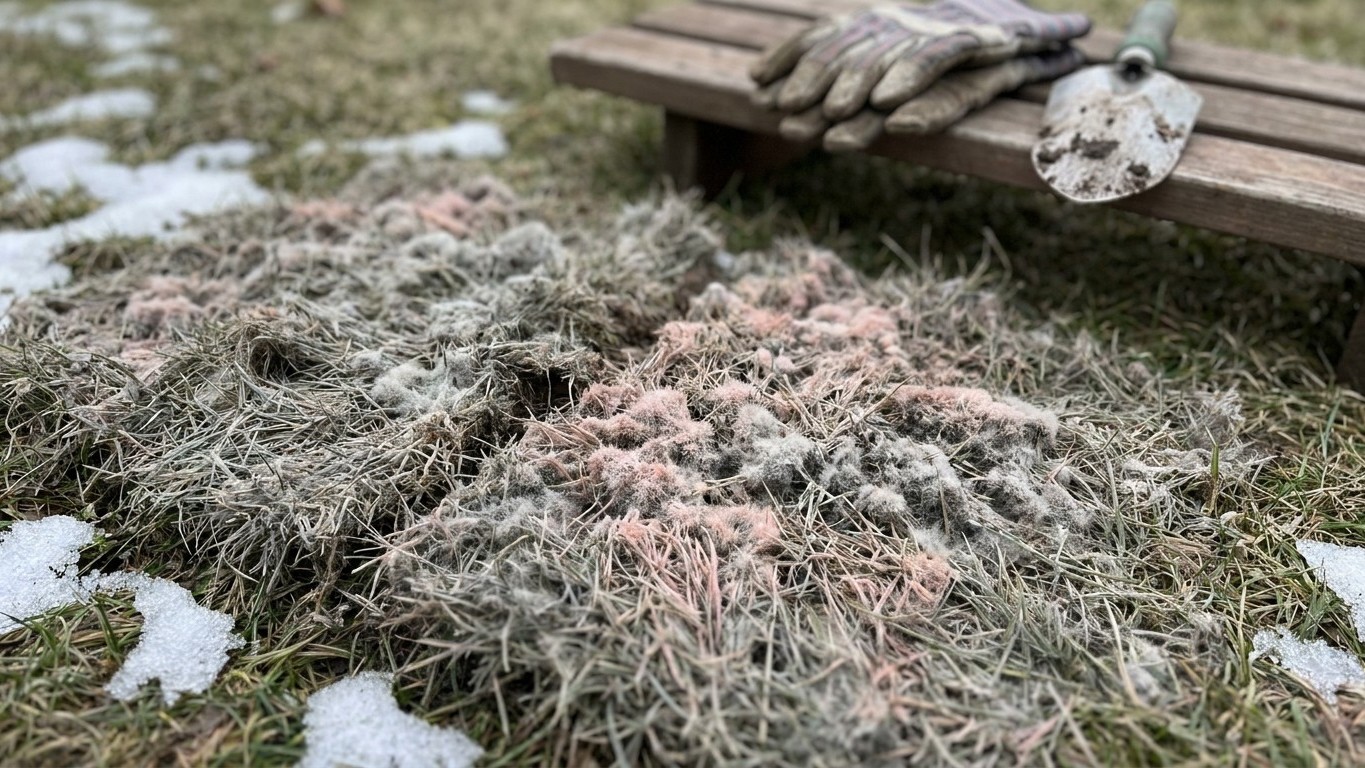

Snow mold shows up the moment the snow retreats: matted, off-color circles of grass flattened right down to the soil, running gray-white or dull pink depending on which fungus caused them. The grass underneath is not dead, only crushed and coated with fungal growth that built up while it sat wet and dark under the snowpack. Grab a rake before doing anything else, and gently fluff the matted patches so air and sun can reach the crushed blades underneath.
What you are looking at

The pattern on the lawn is the first clue. Snow mold forms roughly circular to irregular patches, anywhere from a few inches to a couple of feet across, where the grass lies flattened in one direction as if it had been combed down and left to dry that way. The patches often follow the shape of the snowbank that sat over them longest, which is why you tend to see the worst of it along a north-facing fence line or under a drift that took weeks to melt.
Two different fungi cause what gardeners lump together as snow mold, and the color tells you which one you have. Gray snow mold (caused by Typhula species) leaves patches that are grayish white to straw colored, sometimes carrying small dark or pinkish specks caught in the matted blades. These specks are sclerotia, tiny fungal survival structures about the size of a pinhead. Pink snow mold (Microdochium patch, sometimes called Fusarium patch) shows a pinkish or salmon tinge at the outer edge of the patch, most visible in the cool, damp hours of early morning, with a bleached tan center.
The mark on the individual blade is what confirms the call. Pull up a few blades from the matted crust and look closely. You should see a fine, cobwebby or cottony fungal growth clinging to the leaf, white to gray on the gray type, sometimes with a faint pink crust along the leaf margin on the pink type. The blades themselves feel slick or slimy while damp and crumble into dry straw once the mat has fully dried out.
What it is not
Most brown, matted turf that shows up right after snowmelt is not snow mold at all. The single most useful test is whether the grass is glued together in a fungal crust. If it lifts apart easily in dry, brittle blades with no cottony coating, you are looking at winter desiccation, cold and dry wind stripping moisture out of exposed leaf tissue, not a fungus.
Voles tunnel under snow all winter and leave narrow, winding trails of chewed and flattened grass, usually with soil or gnawed stems visible along the track. There is no fungal mat and the damage runs in lines rather than circles. A snow pile or plow berm left in one spot for weeks can also crush the grass underneath into a flattened, discolored patch that looks alarming, but again without the matted fungal coating, that patch is compaction and light starvation, not disease.
The most common mistake is treating ordinary dormancy as disease. Brown is not dead. Cool-season lawns go tan and lifeless-looking through the cold months and green back up on their own once soil temperatures climb. If the patch you are staring at has no fungal crust and covers the whole yard evenly rather than in isolated circles, it is very likely just winter color, not something to treat. For a broader look at what else turns up on a lawn through the year, the Lawn Diseases overview sorts by season and symptom. Orange dust that rubs off on your shoes is a different problem entirely, covered under Lawn Rust: Orange Dust on Your Shoes, and it shows up in warm, humid stretches rather than at snowmelt.
The conditions that bring it on
Snow mold needs three things at once: cold, moisture, and time. The fungi that cause it are active at temperatures close to freezing, and they do their damage while the grass sits wet under a blanket of snow that keeps light out and moisture locked against the leaf. That is why the worst patches turn up under the longest-lasting drifts and in low spots where meltwater sits rather than drains.
Which grasses are at risk
This is a cool-season grass problem. Penn State Extension’s Lawn Establishment guide lists Kentucky Bluegrass, Perennial Ryegrass, Fine Fescues, Rough Bluegrass, and Tall Fescue as the cool-season species grown across the northern lawn belt, and all of them carry mowing habits that matter here: grass left long and lush going into winter mats down under snow far more readily than grass cut to a sensible height. The table below lays out the mowing range and stress tolerances Penn State Extension gives for each.
| Grass | Mowing height | Shade tolerance | Drought tolerance | Wear tolerance |
|---|---|---|---|---|
| Kentucky Bluegrass | 2 to 3 in | Fair | Fair | Good |
| Perennial Ryegrass | 2 to 3 in | Fair | Fair | Good |
| Fine Fescues | 2.5 to 3.5 in | Excellent | Good | Poor |
| Rough Bluegrass | 2 to 3 in | Excellent | Poor | Poor |
| Tall Fescue | 2.5 to 3.5 in | Good | Fair | Fair |
Warm-season lawns, Bermudagrass, Zoysiagrass, St. Augustinegrass, Centipedegrass, Bahiagrass, Carpetgrass, and Seashore Paspalum, are grown mainly in regions where prolonged snow cover on unfrozen turf is rare, so snow mold is not a lawn disease those growers typically deal with. It is worth noting that this is a cold-season problem specifically. It has nothing to do with the humid summer circles of Brown Patch: The Summer Circle on a Humid Night, which needs heat and humidity rather than cold and snow, even though both start as a discolored patch on the lawn.
What to do now
Most snow mold damage is cosmetic and temporary. Once the matted crust dries out and the weather warms, the crowns of the grass plants usually push out new growth on their own, no spray required. The honest first move is patience: rake the flattened patches lightly to break up the crust and let air reach the crown, then wait.
Check the crown before assuming the worst. Tug gently on a few blades from the center of a bad patch. If the base of the plant, right where leaf meets root, is still firm and white or pale green, the plant is alive and will recover as soil temperatures rise. If the crown itself is soft, brown, and rotted through, that spot may need reseeding once conditions allow, matched to a cool-season species suited to the site.
A fungicide is rarely the right answer for damage you can already see, because by the time the patches are visible the fungus has largely finished its work for the season. Fungicides labeled for snow mold work as a preventive treatment applied before the first snow cover sets in, not as a rescue for turf that already looks damaged. Home lawns with a mild, one-off case almost never justify the cost or the extra chemical input. Reach for a fungicide only if the same spot has come back severely, several years running, and even then treat it as a stopgap while you fix the underlying mowing or drainage habit that is keeping that patch wet longer than the rest of the yard.
Preventing it next season
Prevention here is almost entirely about habits rather than products. Grass that goes into winter tall, wet, and covered in fallen leaves gives the fungus exactly the damp, dark, matted conditions it needs.
- Keep mowing at the height recommended for your species right up until growth stops for the season, rather than letting the last few cuts slide.
- Rake fallen leaves off the lawn promptly. A wet leaf layer under snow holds moisture against the crown the same way matted grass does.
- Avoid a heavy dose of nitrogen fertilizer late in fall. Clemson Cooperative Extension’s HGIC 1201 Fertilizing Lawns fact sheet is the reference to check for correct timing on your particular species, since a late flush of soft, lush growth is more prone to matting under snow.
- Spread snow piles out where you can, rather than letting plowed or shoveled snow sit in one deep drift over the same stretch of turf all winter.
- Improve airflow and light to slow-drying corners of the yard by thinning overhanging branches, since shaded, poorly drained spots are the ones that stay wet longest after melt.
Mowing height going into dormancy matters more than any single product decision you could make about disease control. A lawn cut and cleared on schedule through the fall, following the ranges Clemson Cooperative Extension’s HGIC 1205 Mowing Lawns fact sheet lays out for your grass type, rarely develops more than a light case even in a heavy snow year.
Common questions
Will snow mold kill my whole lawn?
No, most cases clear up on their own once the matted grass dries and the season warms. The exception is a patch where the crown itself has rotted through, which may need reseeding rather than just raking.
Should I mow the matted grass right after the snow melts?
Wait until it dries out first. Mowing wet, matted turf spreads the fungal mycelium around and can tear up crowns that are still recovering, so rake gently instead and mow once the grass has dried and started active growth again.
What is the difference between gray snow mold and pink snow mold?
They are two different fungi grouped under the same common name. Gray snow mold generally stops once the snow is gone and drying weather sets in, while pink snow mold can keep spreading in cool, wet spring conditions even after the snow has melted.
Do I need to spray fungicide every fall to stop this?
Most home lawns do not need it. Fungicide is a preventive tool used before snow cover sets in, and it only makes sense on a lawn with a history of severe, repeated damage in the same spots, not as a routine yearly step.