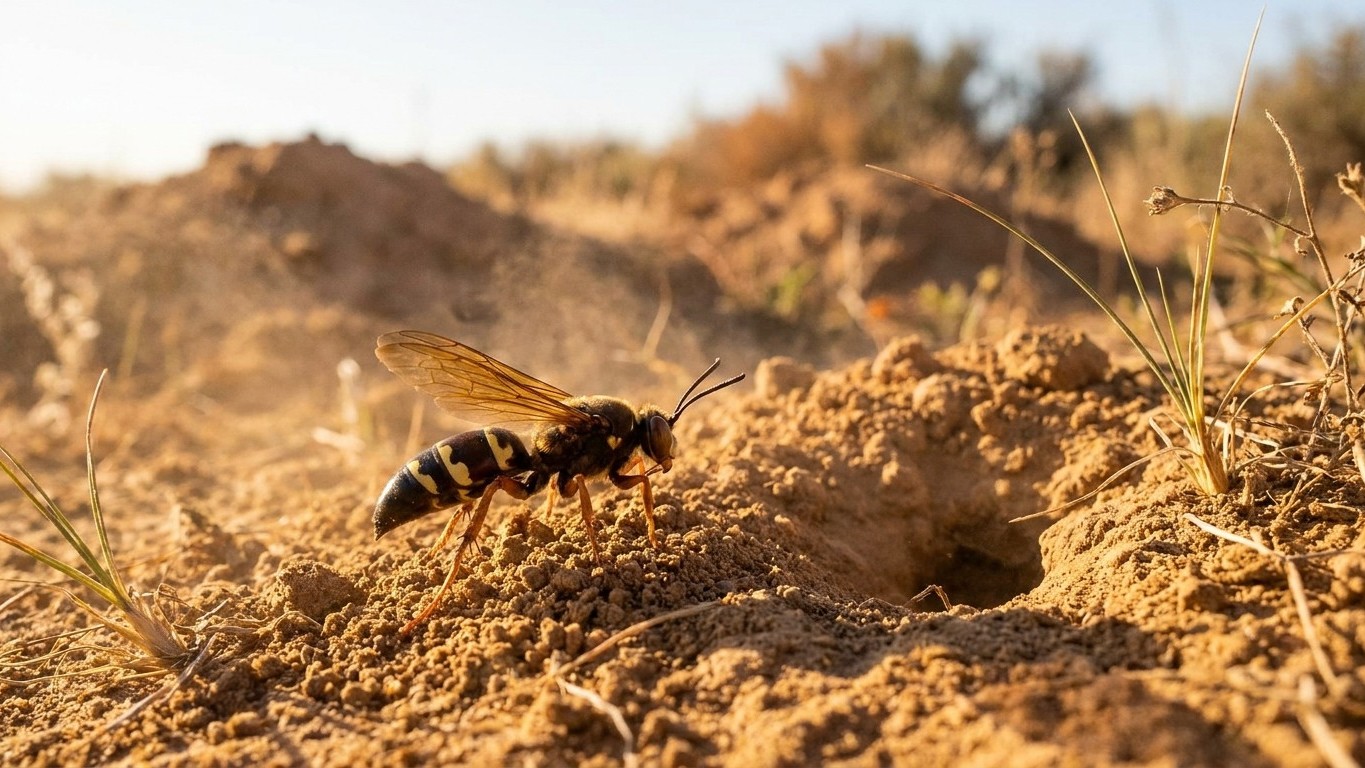

Cicada killer wasps show up in Rhode Island from mid-July through early September, digging burrows in sandy, well-drained soil during the hottest stretch of summer. They look alarming, some reach nearly two inches long, but they rarely sting people. No cataloged entry for this species exists yet from URI Cooperative Extension, so the timing below relies on the general seasonal pattern documented for the species across the Northeast.
The weeks to watch

Cicada killer wasps are active in Rhode Island roughly from the second week of July through the first two weeks of September, with the heaviest burrowing activity in late July and early August. That’s the window when adult females are provisioning nests and homeowners start noticing fresh mounds along walkways and thin lawns.
The composite pest calendar published by University of Rhode Island Cooperative Extension and URI Biocontrol Lab tracks winter moth, white grub, and viburnum leaf beetle in detail, but it does not name cicada killer wasps or give a published flight window for them. That gap is worth stating plainly rather than papering over: the dates above come from the general biology of the species, not from a Rhode Island-specific study.
One generation, one summer
Cicada killer wasps complete a single generation per year. Adults emerge from underground cells as soil warms in early summer, mate, dig new burrows, hunt annual cicadas to stock those burrows, then die off as nights cool in September. There’s no second flight to watch for and no overlapping generation to complicate the picture, unlike pests such as viburnum leaf beetle that run on a longer active season.
When the mounds actually appear
The visible sign, a mound of loose soil around a half-inch entry hole, typically doesn’t show up until soil temperatures at a few inches deep have held warm for several consecutive weeks. In most Rhode Island yards that means the first mounds appear in early to mid-July, not in June, even during a mild spring.
Reading the calendar from your last frost

The one date most Rhode Island gardeners already track is the last spring frost, which falls between April 7 and April 17 according to NOAA’s 1991-2020 climate normals for the reference weather station. Cicada killer wasps don’t respond to that date directly. They respond to how long and how consistently the soil has been warming since then, so an unusually cool, wet spring can push the first burrows back by a couple of weeks even if the calendar says otherwise.
- Mark the last frost. Use April 7 to April 17 as your starting point, remembering that suburban and rural yards away from the airport station often see frost linger a week or two later, especially at higher elevations.
- Count forward about thirteen weeks. That lands in mid-July, which is when soil at burrow depth has typically warmed enough, and annual cicadas, the wasp’s prey, have started emerging in numbers worth hunting.
That arithmetic gives a range, not a guaranteed date. A gardener in a low-lying, shaded yard should expect the wasps a bit later than one on an open, south-facing slope with sandy soil that heats up faster in early summer.
What it attacks, and what the damage looks like

The first sign most homeowners notice is a U-shaped mound of loose, fine soil, often about the size of a fist, with a clean half-inch hole at the center. It tends to show up along the edge of a sidewalk, in a bare or thinning patch of lawn, or tucked into a mulched bed where the soil stays loose and dry. Unlike most garden pests, cicada killer wasps don’t feed on plants at all. The adult females do the digging, and it’s their tunneling, not any larval feeding, that creates the visible disturbance. Once a burrow is dug and stocked with a paralyzed cicada for the larva inside, there’s nothing left on the surface to treat; the damage, such as it is, is already done.
Areas most prone to burrows share the same traits: dry, sandy, well-drained soil in full sun, with sparse vegetation to get in the way of digging. Common spots include:
- Bare or sun-baked patches of lawn with thin turf
- Sandboxes, volleyball courts, and horseshoe pits
- Loose mulch beds along house foundations
- Gaps and cracks along patios, driveways, and retaining walls
- Raised garden beds with light, sandy soil mix
How Rhode Island sits in this pest’s range

This site currently documents cicada killer wasps for one territory: Rhode Island. That single entry reflects how the site’s coverage has grown so far, not the wasp’s actual range, which stretches across most of the eastern and central United States wherever sandy, well-drained soil and annual cicadas overlap. Without a second territory published here yet, there’s no direct comparison to show whether flight season starts earlier in a warmer state to the south or wraps up sooner in a cooler one to the north.
What can be said with confidence is that Rhode Island’s short, humid summer gives the wasp just enough warm stretch to complete its single generation: emerge, dig, hunt, provision, and die back before the first cool nights of fall arrive. There’s no local data suggesting the state sees unusually heavy or light activity compared to neighboring states, only that a published comparison doesn’t exist on this site yet.
What actually works against it

Cicada killer wasps are solitary, not colonial, so there’s no nest to wipe out the way there is with yellowjackets. That changes the whole approach, starting with the cheapest option and working up only if the wasps are causing a real problem.
- Tolerate them where you can. Male cicada killers patrol aggressively but have no stinger at all, and females rarely sting unless grabbed or stepped on barefoot. Burrows close up naturally once the season ends in September.
- Thicken thin turf. Watering and overseeding bare or sparse lawn patches works because females prefer loose, exposed soil that’s easy to dig; a dense root mat makes tunneling much harder.
- Fill and tamp visible burrows in the evening. This discourages that specific burrow, though a wasp may simply dig a new one a few feet away, so it’s a partial fix at best.
- Cover exposed bare soil during peak flight weeks. A layer of mulch or a temporary tarp over sandboxes and bare patches from mid-July through mid-August removes the exposed surface the wasps need.
- Call a pest professional for persistent burrows. This is the option once mounds keep returning in a high-traffic area like a play space; treatment of individual burrows is a last resort, not a first move.
Some gardeners pour dish soap and water down active burrows as a home remedy. It’s a common practice, but there’s no controlled testing showing how well it actually discourages the wasps compared to just filling the hole, so treat it as anecdotal rather than proven.
Common questions
Are cicada killer wasps dangerous to people or pets?
Rarely. Males can’t sting at all, and females are focused on hunting cicadas, not defending territory the way social wasps do. Stings happen almost exclusively when one is handled directly or trapped against skin.
Do cicada killer wasps damage lawns or gardens?
Not in the way most pests do. They don’t feed on plants; the only visible effect is the small dirt mound and entrance hole left by their digging, which is cosmetic rather than harmful to the turf underneath.
Will cicada killer wasps come back to the same spot every year?
Individual burrows don’t persist since the adults die off each fall, but a yard with the same sandy, sunny conditions often attracts new females the following summer, which is why thickening bare turf tends to be a more lasting fix than filling in one season’s holes.