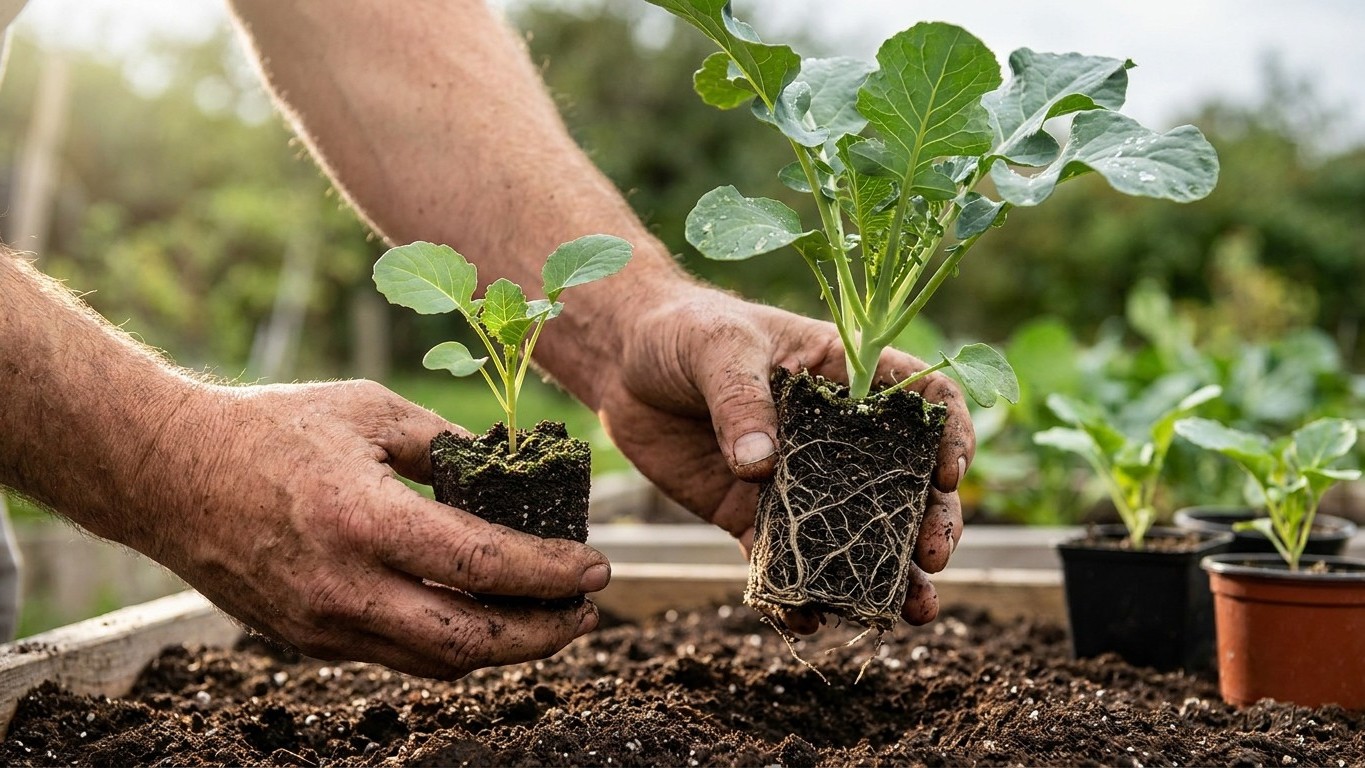

A broccoli head that stalls out the size of a marble instead of filling a dinner plate has already made its decision weeks earlier. Utah State University Extension calls this buttoning, and the fix starts at the transplant tray: pick plants with 4-6 leaves, not the biggest, healthiest-looking ones you can find, because oversized transplants button more often once they hit the garden.
The short answer
Buttoning is the formation of a tiny, premature flower head, sometimes no wider than a coat button, on a broccoli or cauliflower plant that should still be building leaves. According to Utah State University Extension, the plants that button have been exposed to cold weather or were stressed for water or nutrients, either before or after transplanting. That single sentence carries three distinct triggers, and none of them require the others to be present. A cold snap alone can do it. So can a dry week alone. So can a nitrogen shortfall alone.
What makes this more than a weather problem is the size warning attached to it. Extension specialists note that larger transplants are more prone to button, which is why they recommend selecting plants with 4-6 leaves rather than the more mature, root-bound ones that often look like the better buy. A transplant that has already grown 8 or 10 leaves in a small cell has effectively been living under chronic stress, cramped roots, drying soil, and thinning nutrients, for longer than a 4-6 leaf plant. That accumulated stress is baked in by the time it goes into the ground, so the plant is primed to button the moment any additional cold or dry spell hits.
This is why two gardeners can plant the same variety on the same day and get different results. One started with a compact, young transplant. The other started with an oversized one that had been sitting in its tray a few extra weeks, developing exactly the kind of stress history that tips a plant toward premature heading. The remedy sits upstream of the garden bed entirely: it starts with what you choose to buy or start indoors, not with what you do after the plants are in the soil.
What actually decides it
Three separate stresses drive buttoning, and treating them as one problem is where a lot of troubleshooting goes wrong. A grower who fixes the water schedule but ignores a cold snap, or who feeds the plants heavily but still starts with an oversized transplant, will keep seeing buttoned heads.
Cold exposure
Broccoli plants that sit through a stretch of cold weather, particularly while young, can shift into reproductive mode early. The plant essentially reads sustained chill as a signal that the season is ending and rushes to flower rather than continuing to build the leafy framework that would normally support a full-size head.
Water stress
A broccoli plant that runs short on moisture, either in the seedling tray before transplanting or in the bed afterward, reacts the same way it does to cold: it treats the stress as a cue to reproduce now instead of later. This can happen from a single missed watering during a hot stretch just as easily as from an extended dry spell.
Nutrient stress
Extension guidance also flags nutrient shortfalls, before or after transplanting, as an independent trigger. A plant that has been underfed in its cell tray, or that goes into nutrient-poor soil without adequate fertility, can button even if temperatures and moisture are both fine. This is a separate failure path from the boron and pH issues discussed below, which cause a different symptom pattern entirely.
Layer transplant size on top of any one of these three and the odds worsen. An oversized transplant has usually already absorbed more cumulative stress just getting to that size in a small cell, so it has less buffer left before cold, dryness, or hunger pushes it into premature heading.
How to do it
- Sow broccoli transplants indoors 6-7 weeks before the expected planting date. This is the window Utah State University Extension recommends for raising seedlings that will be ready, not oversized, by transplant time.
- Seed at 1/4 to 1/2 inch deep in trays or cells, keeping the medium consistently moist so seedlings emerge without an early water-stress setback.
- Thin seedlings once they reach 3-4 true leaves. Crowded cells compete for water and nutrients, which is exactly the kind of stress that predisposes plants to button later.
- Count backward from the last frost-free date for the growing area. Transplants go out 2-3 weeks before that date, not after it. Adding the two figures together, roughly 6-7 weeks of indoor growing plus 2-3 weeks of lead time before the last frost, puts the indoor sowing date at roughly nine weeks ahead of the last frost date for the area. Seeded broccoli can go into the ground at that same 2-3-weeks-before-frost point.
- Check the transplant before it goes out. It should show 4-6 mature leaves and a well-developed root system, not a leggy, root-bound plant that has outgrown its cell.
- For a fall crop, work forward from the anticipated maturity date instead. Plant 50-75 days before that date, keeping in mind that the maturity date itself can land several weeks after the first fall frost.
Days-to-maturity varies by cultivar, and Extension specifically names three: Packman at 50 days, Green Comet at 55 days, and Premium Crop at 65 days. That spread matters when counting backward for a fall harvest, since a 65-day type needs an earlier planting date than a 50-day type to hit the same target.
| Cultivar | Days to maturity |
|---|---|
| Packman | 50 |
| Green Comet | 55 |
| Premium Crop | 65 |
What goes wrong
- Buttoning shows up despite careful timing. This usually traces back to an oversized transplant that carried too much stress into the garden, or to a late cold snap, dry spell, or nutrient gap after planting. The remedy is preventive: buy or start plants at 4-6 leaves, not larger, and keep water and fertility steady through the transplant transition.
- Brown spotting appears on the head with a hollow, discolored stem underneath. That pattern points to boron deficiency rather than buttoning. Extension notes it can occur in high pH soils or where plants have been water stressed, and advises avoiding excess fertilizer, since heavy feeding can aggravate the imbalance rather than fix it.
- Concentric, sooty-black rings spread across the leaves. That is Alternaria leaf spot, not a nutrient or cold problem. Avoid overhead irrigation, which spreads spores on wet foliage, and rotate broccoli out of the same bed in following seasons.
- Something is hollowed out or chewed inside the developing head. Cabbage worms and loopers hide directly inside the head, which makes them easy to miss until harvest. Check heads by parting the florets, not just scanning the surface.
- Young seedlings collapse or show shot-hole damage soon after emergence. Flea beetles target seedlings specifically and can kill them outright at that vulnerable stage, well before any of the head-related problems above ever have a chance to develop.
Common questions
Can a buttoned broccoli head grow back to normal size?
No. Once a plant forms a premature head in response to cold, water stress, or nutrient stress, that head is the final size it will reach. Prevention through transplant selection and steady care is the only real control point.
Is a bigger, older transplant ever the safer choice?
Not according to Utah State University Extension’s guidance. Larger transplants are more prone to buttoning, so a compact plant with 4-6 leaves and a well-developed root system is the better pick, even if it looks less impressive on the shelf.
Does broccoli go out after the last frost, like tomatoes?
No. Broccoli transplants go into the ground 2-3 weeks before the last frost-free date for the area, not after it. Seeded broccoli can be planted on that same earlier schedule.
How is boron deficiency different from buttoning?
Buttoning produces a small, premature head early in development. Boron deficiency shows up as brown spotting on an otherwise developing head, along with a hollow, discolored stem underneath, and is tied to high pH soils, water stress, or excess fertilizer rather than transplant size.