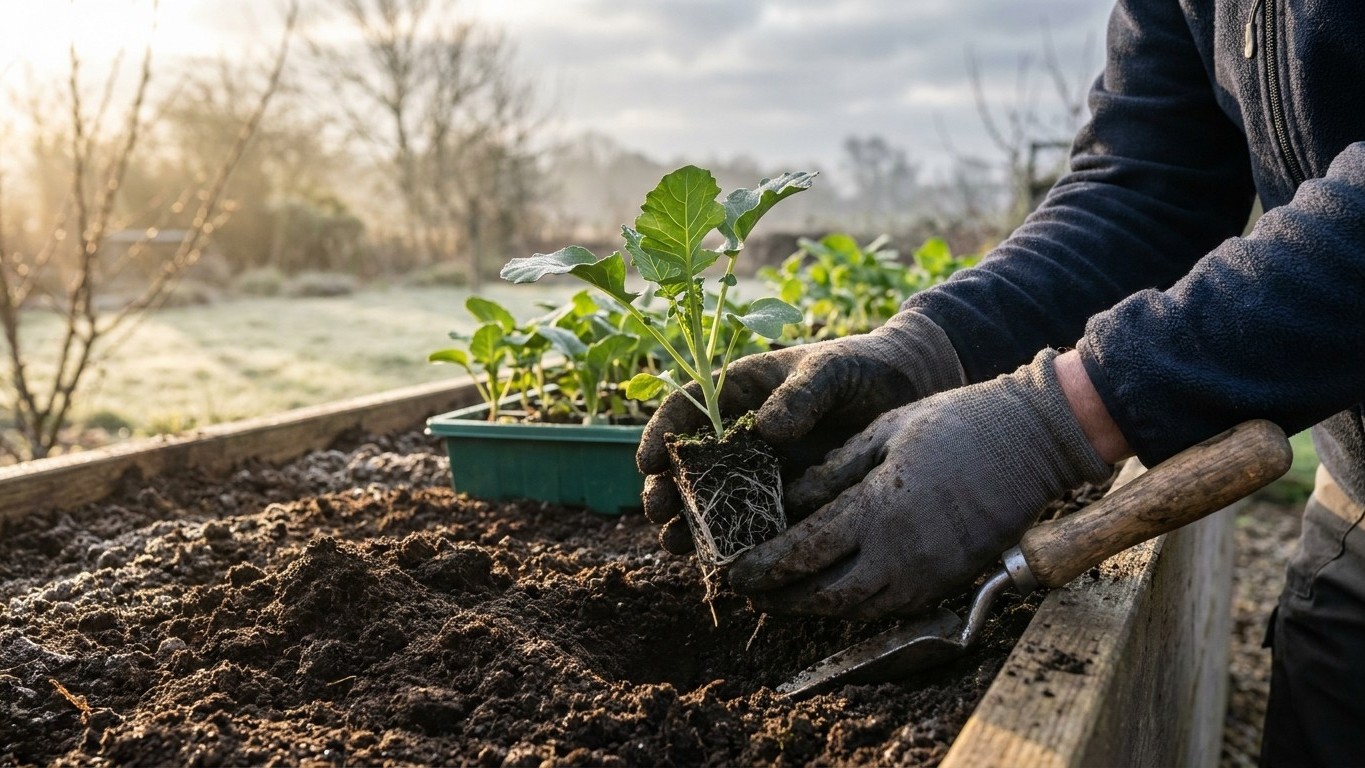

Sow broccoli seed indoors six to seven weeks before you plan to set the plants in the garden, and get those transplants outside two to three weeks before your area’s last frost free date, not after. That single reversal, going out ahead of frost instead of behind it, is what separates broccoli scheduling from tomatoes and peppers, and it’s the detail most home gardeners miss.
The short answer
According to Utah State University Extension’s guide Broccoli in the Garden, seed started for transplants “should be sown 6-7 weeks before the expected planting date.” That’s the whole rule for indoor starting. No secret formula, no adjustment for variety, just a six to seven week runway from seed tray to garden-ready plant.
The trickier part is figuring out what “expected planting date” means, because broccoli doesn’t wait for frost danger to pass the way warm-season crops do. The same source states that “transplants may be planted 2-3 weeks before the last frost free date for the growing area,” and that seeded broccoli set directly in the ground can go in on that same schedule. So the planting date isn’t the last frost date itself. It’s two to three weeks earlier than that.
Doing the math in words
Start with your area’s last frost free date. Move backward two to three weeks to land on the actual transplant date, since broccoli tolerates cold better than a lot of garden vegetables and doesn’t need to wait for frost risk to clear. Then move backward another six to seven weeks from that transplant date to find your indoor sowing date. Add the two spans together and you land on roughly nine weeks before the last frost date as the point where seed should go into trays under lights or on a warm windowsill. That’s not a number Utah State University Extension states outright, it’s what falls out of adding their two figures, and it’s worth working through on paper for your own last frost date rather than trusting a generic calendar.
A second path for fall broccoli
Spring isn’t the only broccoli season. For a fall crop, the extension guide counts forward instead of backward: “plant 50-75 days before the anticipated maturity date,” and it notes that “the maturity date can be several weeks after the first fall frost,” since broccoli heads can keep developing in cool autumn weather. Named cultivars help here because their days-to-maturity figures anchor the math. Packman matures in about 50 days, Green Comet in about 55, and Premium Crop in about 65, so a gardener aiming for a mid-October harvest can count backward from that target using whichever variety they’re growing.
What actually decides it
Three separate mechanisms drive this timeline, and they don’t substitute for one another. Getting the seed-starting date right doesn’t matter if the plant isn’t developmentally ready, and being developmentally ready doesn’t matter if it goes outside on the wrong side of the frost line.
Plant readiness, not just days on a calendar
The six to seven week window exists because that’s roughly how long it takes a broccoli seedling to reach the physical benchmark Utah State University Extension sets for transplanting: “4-6 mature leaves and a well-developed root system.” Two seedlings started the same week can hit that mark at slightly different times depending on light, warmth, and container size. The week count is a planning guide, but the leaf count and root development are the actual checkpoint before the plant leaves the tray.
Frost tolerance changes which direction you count
Warm-season transplants like tomatoes wait until frost danger has passed. Broccoli does the opposite. Because young broccoli plants handle a light frost without much damage, the extension guide has them going into the ground two to three weeks before that last frost date, not after it. That’s a mechanism unique to cold-tolerant brassicas, and it’s the single most common point of confusion for gardeners who transplant broccoli on the same schedule they use for peppers.
Maturity math shifts by cultivar and by season
Spring broccoli timing runs off the sowing-to-transplant window. Fall broccoli timing runs off days-to-maturity counted backward from a target harvest date, and that number changes with the variety, whether it’s Packman’s roughly 50 days, Green Comet’s roughly 55, or Premium Crop’s roughly 65. Mixing up these two calculation methods, using spring logic for a fall crop or vice versa, is where a lot of scheduling mistakes start.
How to do it
- Find your area’s last frost free date first, before doing anything else, since every other date in this schedule is counted backward from it.
- Sow seed 1/4 to 1/2 inch deep in trays or pots indoors, six to seven weeks before your planned outdoor planting date.
- Once seedlings show 3-4 true leaves, thin them so each plant has room to develop its own root system without crowding.
- Keep growing the seedlings indoors until each one has 4-6 mature leaves and a well-developed root system, the readiness benchmark Utah State University Extension uses rather than a fixed day count.
- Count backward from the last frost free date by two to three weeks to set the transplant date. In words: if your last frost falls in early May, the transplant date lands in mid to late April, roughly two to three weeks earlier.
- Move transplants (or direct-seeded broccoli, which can go in on the same schedule) into the garden on that date, ahead of the last frost rather than after it.
- For a fall crop, skip the frost-based countdown and instead count backward 50 to 75 days from your anticipated maturity date, adjusting for the days-to-maturity of whichever variety you’re growing.
- Remember that a fall crop’s maturity date can land several weeks after the first fall frost, so don’t assume an early frost means the crop is finished.
What goes wrong
- Seed sown too shallow or too deep. Utah State University Extension specifies 1/4 to 1/2 inch. Seed set on the surface dries out before it germinates, and seed buried much deeper than a half inch can struggle to push through. Measure it rather than eyeballing it.
- Skipping the thinning step. Leaving every seedling in place once they hit 3-4 true leaves leaves the survivors competing for root space, which slows them down right when they should be building toward that 4-6 leaf transplant benchmark. Thin promptly and give the remaining plants room.
- Transplanting on the calendar instead of on the plant. A gardener who counts exactly six weeks and moves plants outside regardless of leaf count risks setting out seedlings that haven’t developed the root system they need. Check for 4-6 mature leaves and a well-developed root system before moving day, not just a date on the wall calendar.
- Waiting for frost to pass, tomato-style. Broccoli doesn’t follow that rule. Holding transplants indoors until after the last frost date, the way you would with warm-season crops, pushes the whole schedule later than it needs to be and can crowd the harvest into hotter weather that broccoli handles poorly.
- Miscounting the fall crop backward from the wrong number. Using a spring sowing-to-transplant window for a fall planting, instead of counting 50 to 75 days backward from an anticipated maturity date, throws off harvest timing. Match the calculation method to the season, and factor in that the maturity date can fall several weeks after the first fall frost rather than expecting the crop to finish right at frost.
Common questions
Can broccoli seed be sown directly in the garden instead of started indoors?
Yes. Utah State University Extension notes that seeded broccoli may be planted at the same time as transplants, meaning direct-seeded broccoli goes into the garden two to three weeks before the last frost free date, following the seed depth of 1/4 to 1/2 inch and thinning once seedlings reach 3-4 true leaves.
Why does broccoli go outside before the last frost instead of after?
Because it tolerates cold better than warm-season vegetables, broccoli doesn’t need frost danger to clear before transplanting. Utah State University Extension sets the transplant window at two to three weeks before the last frost free date, the reverse of the wait-for-frost-to-pass approach used for tomatoes and peppers.
How do I know a transplant is actually ready to go outside?
Look for 4-6 mature leaves along with a well-developed root system, the benchmark Utah State University Extension uses. That’s a better indicator than counting exactly six or seven weeks on a calendar, since growing conditions can speed up or slow down how fast a seedling reaches that stage.
Does the six-to-seven-week rule apply to fall broccoli too?
No. Fall broccoli is timed differently: Utah State University Extension recommends planting 50 to 75 days before the anticipated maturity date, with that maturity date sometimes falling several weeks after the first fall frost. Use days-to-maturity for your variety, such as Packman’s roughly 50 days, Green Comet’s roughly 55, or Premium Crop’s roughly 65, rather than the spring sowing-to-transplant window.