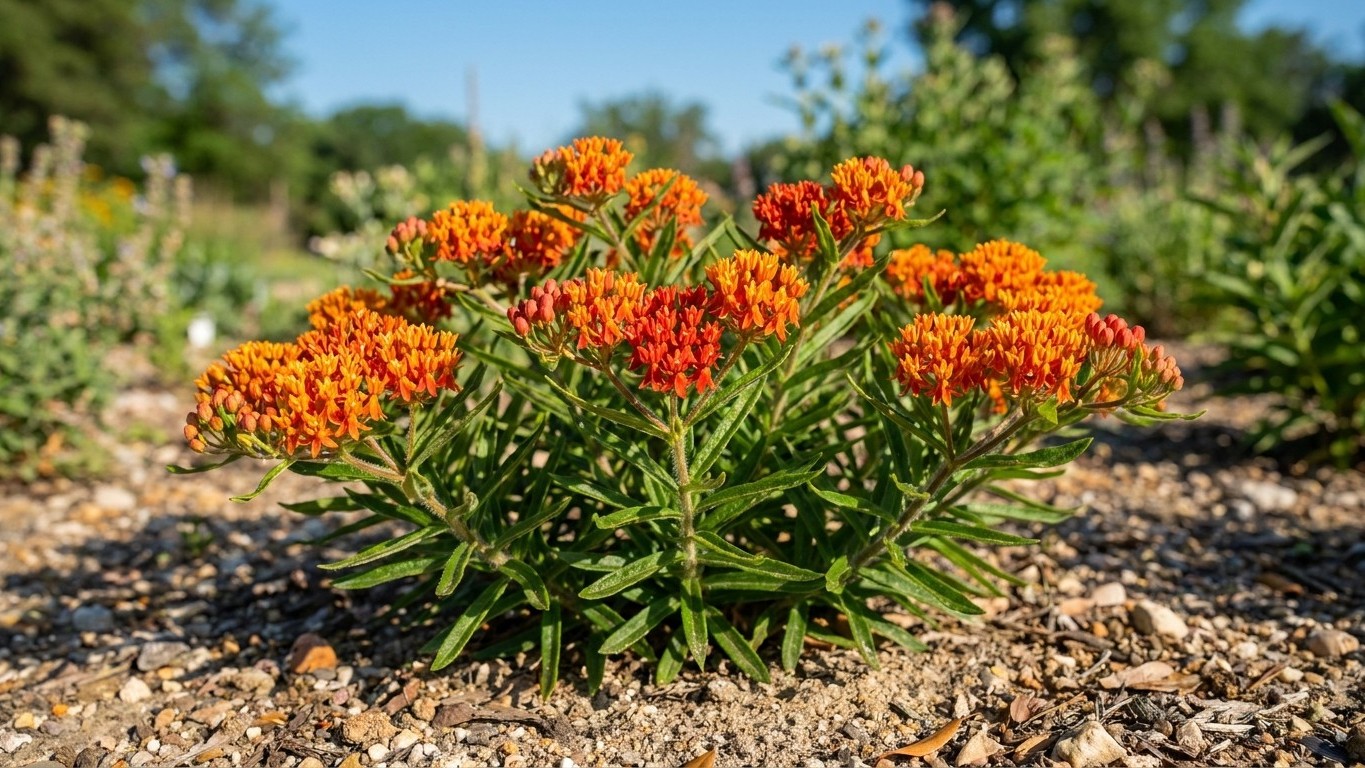

Asclepias tuberosa is a low, clump-forming perennial known almost as often by its common names, Butterfly Milkweed or Butterfly Weed, as by its botanical one. Gardeners also call it Chiggerflower, Indian Paintbrush, Milkweed, or Pleurisy Root, though one of those names deserves a flag: “Indian Paintbrush” more commonly refers to Castilleja, an entirely different genus, so don’t trust that name alone at a nursery counter. It’s a full-sun, well-drained perennial hardy from USDA zone 3a to 9b, slow-growing, and rated low-maintenance once established.
Where it will and will not survive

The USDA hardiness range for Asclepias tuberosa runs 3a to 9b. That’s a wide band, but the useful way to read it isn’t as an invitation, it’s as a boundary. Below the bottom of this range, in ground that regularly drops colder than zone 3a, this plant’s roots won’t reliably survive winter, no matter how well you mulch or how sheltered the bed. Above the top of it, past zone 9b, the plant runs into the opposite problem: not enough of a winter chill period, combined often with heat and humidity stress that a temperate-climate native perennial isn’t built to handle.
A range like 3a-9b means survival, not comfort. A plant that’s hardy to zone 9b is technically able to make it through winter there, but that doesn’t mean it will thrive the way it does in the middle of its range. Same logic at the cold edge: 3a is a survival threshold, not a zone where you should expect vigorous, floriferous growth. Think of hardiness zones as a pass/fail line, not a report card.
Find your own zone before you plant
Here’s the part most articles skip: you can’t apply a national hardiness range usefully without knowing your own zone first, and guessing is exactly how gardeners end up losing a plant they were told was “hardy.” Rather than assume where you land on the 3a-9b scale, check your specific zone using this site’s hardiness zone guide, which breaks zones down at a level fine enough to matter, sometimes county by county, since two towns forty miles apart can sit in different zones entirely.
One more caution worth naming directly. The USDA hardiness range is a national standard, but regional planting advice tied to North Carolina’s coastal, piedmont, or mountain zones is local to that state. It doesn’t transfer to a reader in a different part of the country, even if the hardiness number matches. Zone number, not regional advice, is the piece of that source that travels.
Light, soil and drainage
Asclepias tuberosa isn’t picky about soil texture, but it’s specific about drainage, and that distinction matters more than most gardeners assume when they’re shopping by hardiness zone alone.
| Condition | Tolerance |
|---|---|
| Light | Full sun (6+ hours direct) or partial shade (2-6 hours) |
| Soil texture | Clay, loam/silt, sand, or shallow rocky soil |
| Drainage | Good drainage, moist, or occasionally dry |
| Soil pH | Not specified in the source data |
Notice what’s missing from that list: waterlogged, poorly drained soil that sits wet through winter. That’s not an oversight, it’s the whole point. For a herbaceous perennial like this one, winter drainage decides survival far more often than the cold itself does. A plant rated hardy to zone 3a can still rot out and die in a spot that stays soggy from November through March, well before a hard freeze ever gets the blame. Cold kills top growth; wet feet kill the crown and roots underneath it, which is the part that actually needs to come back each spring.
A drainage check you can do yourself
Before planting, dig a hole roughly a foot deep in the spot you’re considering and fill it with water. If it drains within a few hours, you’re likely fine, especially given this plant’s tolerance for clay, loam, sand, or rocky ground. If water is still sitting there the next morning, that’s standing water in waiting, and it’s the single biggest reason a “low-maintenance” perennial fails over winter despite matching your hardiness zone on paper. Raised beds, amended soil, or a different spot in the yard solve this far more reliably than any amount of extra mulch.
When it flowers and how long
Bloom time for Asclepias tuberosa spans spring into summer, a season-long window rather than a fixed month, since that timing shifts depending on latitude and elevation. A garden further south or at lower elevation will typically see flowers open earlier in that spring-to-summer stretch; a garden further north or higher up will see the display arrive later. Rather than pin it to a calendar date, expect the show to open sometime as spring turns to summer and to hold through much of summer itself.
Deadheading spent blooms during that window can extend the display somewhat by redirecting the plant’s energy away from seed production and back into flowering, though this is a plant that will still form seed pods on its own timeline regardless. Once flowering wraps up for the season, cutting back spent flower stalks tidies the clump, though there’s no need to cut the whole plant to the ground until it goes fully dormant.
What matters more, and what most plant profiles skip entirely: this plant spends most of the year not in bloom. Outside its spring-summer flowering window, Asclepias tuberosa is a modest, upright, multi-stemmed clump of narrow deciduous foliage, unremarkable in a border until it flowers. That’s worth knowing before you plant it somewhere you’re hoping for four-season interest, because for most of the calendar it’s simply green structure, not a showpiece.
The attraction to pollinators is tied directly to the flowers themselves, not to the plant year-round. While in bloom, it draws bees, butterflies, hummingbirds, moths, and specialized bees, which is a real strength of the plant and part of why it’s a common choice in pollinator gardens. But that draw is a property of the flower. Once flowering ends for the season, so does the pollinator traffic, at least until next year’s bloom window opens again.
Planting, and dividing it later
Getting this perennial established starts with a few straightforward steps, most of which come down to respecting its drainage needs and its mature footprint.
- Plant in spring or fall, when soil is workable and temperatures are moderate, avoiding the height of summer heat for transplanting.
- Space plants according to their mature spread, which runs 12 inches to 3 feet depending on conditions and growth over time; crowding now means fighting for space later.
- Set the crown at grade, level with the surrounding soil surface, rather than burying it, since a buried crown is a common cause of rot in perennials with this drainage profile.
- Water consistently through the first growing season while roots establish, then taper off, since this is a plant that tolerates occasional dryness once settled in.
- Mulch lightly around the base to conserve moisture and moderate soil temperature, but keep mulch pulled back from direct contact with the crown so it doesn’t trap moisture against it.
This is also where a perennial parts ways with a shrub or tree: it doesn’t just sit there and get bigger year after year, it needs periodic division to stay healthy. The signs are visual and practical rather than tied to any fixed interval. Watch for a bare or dying-out center in an otherwise full clump, a noticeable drop in flower production compared to previous seasons, or a clump that has simply outgrown the space you gave it and is crowding neighboring plants. Any one of those is your cue, not a calendar reminder.
- Dig up the entire clump in early spring or fall, when the plant is dormant or close to it, keeping as much of the root system intact as possible.
- Divide the clump into sections, each with healthy roots and at least a few growth points, discarding any woody, hollow, or unproductive center material.
- Replant divisions promptly at the same depth as before, crown at grade, spaced according to the same mature-size guidance used for new plantings.
- Water the new divisions in well and keep soil consistently moist Through Their First weeks back in the ground while roots re-establish.
What it resists, and what it does not
Resistance is worth defining before listing it, because it’s a tendency, not a guarantee. A plant “resistant” to a pest or condition is less likely to be damaged by it than a susceptible species, not immune to it under every circumstance.
| Factor | Resistance |
|---|---|
| Deer | Resistant |
| Rabbits | Resistant |
| Drought | Resistant (established plants) |
| Salt | Resistant |
| Erosion control | Resistant |
The two entries that matter most for a perennial bed are deer and wet soil, and they cut in opposite directions here. Deer resistance means the plant is unlikely to be a preferred target, useful in a yard with regular deer pressure, but “resistant” is not “deer-proof.” A hungry deer in late winter will still sample plants it normally ignores. Wet soil is the other side of the equation, and it isn’t in the resistance list at all. This plant tolerates good drainage and occasional dryness, not standing water, which circles back to the drainage point made earlier: soggy winter ground is a bigger threat to this species than any deer will ever be.
Drought resistance applies specifically to established plants, meaning a specimen with a season or two of root development behind it, not one freshly transplanted this spring. A brand-new planting still needs regular watering regardless of how drought-tolerant the mature plant eventually becomes.
Maintenance is rated low, and in practical hours that means this isn’t a plant demanding weekly attention. It does not mean zero attention. Low-maintenance here translates to occasional deadheading during bloom, a post-season cutback, and eventual division once the clump shows the signs described above, spread across a season rather than concentrated into a single weekly chore.
Common questions
Is Asclepias tuberosa the same plant as common milkweed?
No. It shares the milkweed common name and family, but it’s a distinct species with its own growth habit, bloom timing, and site preferences described above.
Can I grow Asclepias tuberosa in a shaded yard?
It tolerates partial shade, defined as 2 to 6 hours of direct sun daily, but full sun of 6 or more hours is the condition it’s rated for most strongly.
Is Asclepias tuberosa poisonous?
The plant classification data lists it as poisonous, a detail worth taking seriously around pets and small children even though it draws pollinators and tolerates handling in typical garden maintenance.
Why isn’t my Asclepias tuberosa flowering as much as it used to?
A drop in flowering after several seasons is one of the clearest signs a clump needs dividing, described in the planting and dividing section above, rather than a sign of disease or poor care.