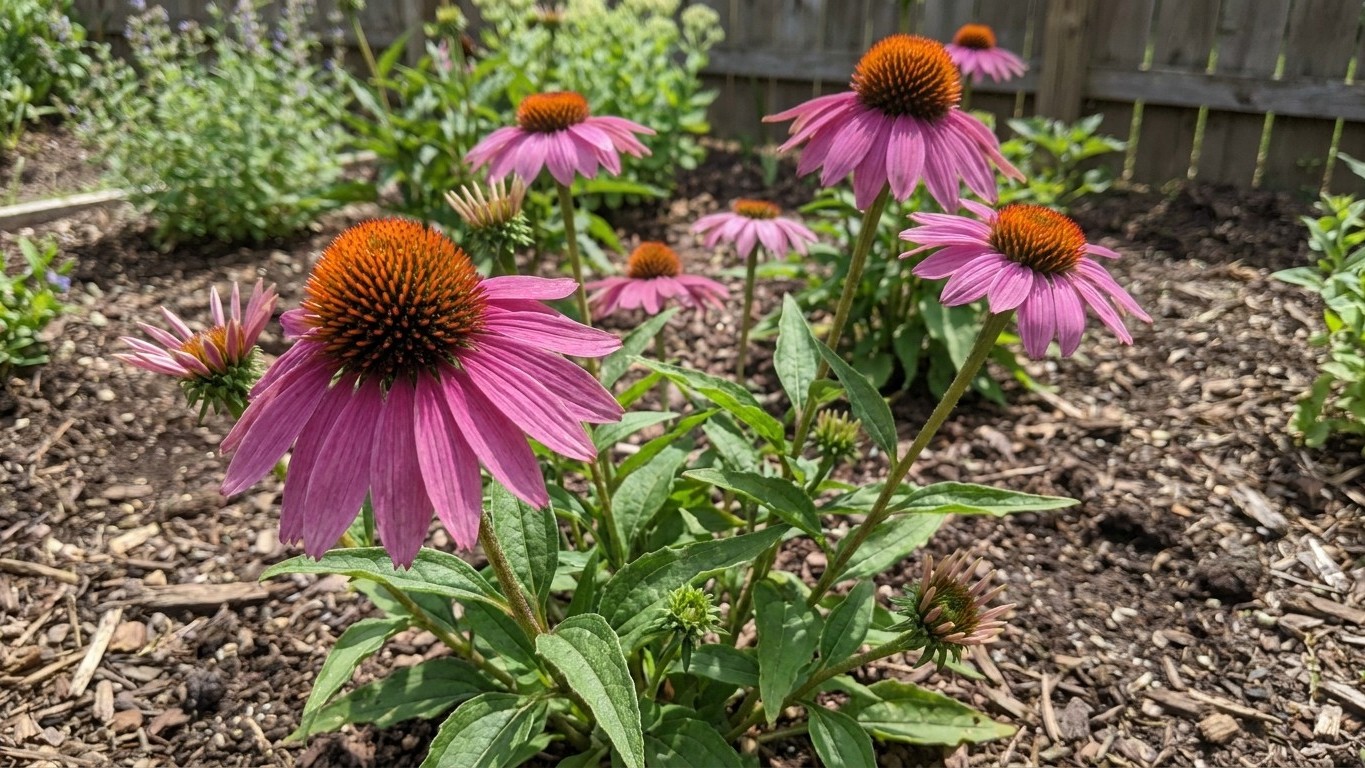

Echinacea purpurea goes by several names gardeners use interchangeably: Coneflower, Eastern Purple Coneflower, Purple Coneflower, and sometimes Purple Rudbeckia. The USDA lists it hardy from zone 3a to 8b, but that range only tells you where it survives, not where it thrives. What decides whether a clump makes it through winter has less to do with cold and more to do with how fast water leaves the soil. It’s classified as an herbaceous perennial and native wildflower, blooms through summer, and eventually needs dividing as the clump matures.
Where it will and will not survive

The USDA hardiness range for Echinacea purpurea runs from zone 3a to 8b. That’s a wide band, but the useful information sits at the edges, not the middle. Below the bottom of this range, the roots won’t reliably survive a winter freeze, no matter how well the site drains or how thick the mulch. Above the top, the plant may live, but it’s operating outside the conditions it evolved for, and long-term performance becomes unpredictable rather than guaranteed.
Surviving a zone and being comfortable in it are two different things. A plant rated to the warm edge of its range, like 8b, may persist for a few seasons, flower less vigorously, or decline faster than a specimen planted closer to the middle of its range. The same logic applies at the cold edge: 3a means the roots can take that low a temperature, not that the plant will look its best doing it.
Zone numbers also aren’t something to guess at. Elevation, local microclimates, and even how close a bed sits to a foundation or a windbreak can shift the effective zone a few notches in either direction. Rather than assuming which zone applies to a given yard, check it directly against a hardiness zone guide specific to that state, since those pages carry county-level detail this general range can’t.
The USDA hardiness range itself is a national standard and applies everywhere, but that source also gives region-specific growing notes for North Carolina’s coastal, piedmont, and mountain zones, and none of that regional guidance should be applied outside North Carolina. A gardener elsewhere needs their own state’s extension data, not North Carolina’s local notes, to make a planting decision with any confidence.
Light, soil and drainage
Echinacea purpurea tolerates a wider range of soil and light conditions than most perennials, which is part of why it shows up in so many mixed borders and native plantings. The table below lays out what the source lists as acceptable, from full sun down to partial shade, and across soil textures from sand to clay.
| Condition | Tolerance |
|---|---|
| Light | Full sun (6+ hours direct) or partial shade (2-6 hours direct) |
| Soil texture | Clay, high organic matter, loam/silt, sand, shallow rocky |
| Soil pH | Neutral (6.0-8.0) |
| Drainage | Good drainage, moist, occasionally dry |
That range of soil textures is unusually forgiving; few perennials list both clay and shallow rocky soil as acceptable. But the drainage line matters most, because for a herbaceous perennial like this one, winter drainage decides survival far more often than the cold itself does. A crown sitting in saturated, poorly drained soil through a freeze-thaw cycle rots before the cold ever becomes the deciding factor. A plant rated hardy to zone 4 can still die in its first winter if the bed holds water.
Checking your own soil before planting
The check is simple and takes about a day. Dig a hole roughly a foot deep and a foot wide, fill it with water, and let it drain completely. Fill it a second time and time how long it takes to empty. If water is still standing after eight hours, that spot drains too slowly for a plant that lists “good drainage” and “occasionally dry” as its preferred range, even though it also tolerates “moist.” Raised beds, amended planting holes, or a different spot in the yard solve the problem far more reliably than picking a more cold-hardy cultivar, since the drainage issue has nothing to do with cold tolerance.
When it flowers and how long
Echinacea purpurea blooms in summer. The exact window shifts depending on latitude and elevation, which is why the source gives a season rather than a calendar date, and why a gardener should expect it to run earlier or later than a neighbor’s garden a few hundred miles away or a few thousand feet higher.
Deadheading, removing spent flower heads as they fade, extends the bloom display by encouraging the plant to keep producing new flowers instead of putting its energy into seed. Gardeners who want the longest possible flowering window typically deadhead through the season. Those who want to leave seed heads standing for birds skip deadheading later on and simply cut the whole plant back once flowering has finished, tidying the erect habit before winter.
Outside of that bloom window, the plant is a clump of deciduous foliage with an upright, erect habit. It dies back to the ground each winter and re-emerges from the crown in spring, so there’s no evergreen structure to rely on for cold-season interest. That’s worth planning around when placing it in a bed, since a spot that looks full in July can look empty from fall through early spring.
What it attracts is tied directly to that bloom period. The source lists bees, butterflies, and pollinators generally as drawn to the flowers, an attraction active only while the plant is in bloom. Songbirds are also listed, and their interest comes from a different source: the seed heads that form after flowering, made up of small, dark, four-sided achenes in the center cone. Leaving those seed heads standing into fall and winter, rather than cutting them back immediately after bloom, is what actually brings songbirds to the bed.
Planting, and dividing it later
Getting a new planting established follows a fairly standard sequence for an herbaceous perennial, with a couple of details specific to this plant’s growth habit.
- Plant in spring or fall, avoiding the height of summer heat when a new root system has to work hardest.
- Space plants 12 inches to 3 feet apart, based on the mature size given in the source. Spacing at the tighter end suits a formal bed, while the wider end suits a naturalized planting where clumps are meant to fill in and merge.
- Set the crown, where the stems meet the roots, right at grade. Buried too deep, it’s prone to rot; set too high, the roots dry out.
- Water regularly through the first growing season while roots establish, then rely on rainfall except during extended dry spells.
- Mulch around the plant to conserve moisture and suppress weeds, but keep mulch pulled back from direct contact with the crown so it doesn’t trap moisture against the stem base.
Because it’s classified as a rapid grower with a herbaceous perennial habit, not a shrub or tree, this plant will eventually need dividing. Unlike a woody plant, it doesn’t just get bigger in place indefinitely. The signs are visible rather than tied to a fixed number of years: a bare or dead-looking patch opening up in the middle of an otherwise full clump, noticeably fewer flowers than in previous seasons, or a clump that has spread well past the space originally allotted to it and is crowding neighboring plants.
- Dig up the entire clump in early spring or fall, lifting the root mass as intact as possible.
- Divide it into sections using a sharp spade or knife, making sure each division retains healthy roots and at least one or two growth points.
- Discard the old, hollow, or unproductive center section if the clump shows the bare-middle pattern.
- Replant divisions immediately at the same spacing used for new plantings, setting the crown at grade and watering well to help them re-establish.
What it resists, and what it does not
Resistance means a tendency, not a guarantee. A plant listed as resistant to deer is one deer tend to avoid, not one they will never touch, especially when other food sources are scarce. A plant listed as drought resistant is one that handles dry spells once its root system is established, not a newly planted division still working to root in.
| Listed resistance | What it means in practice |
|---|---|
| Deer | Tends to be passed over, not guaranteed protection |
| Drought / Dry Soil | Applies to established plants, not first-season transplants |
| Heat | Handles hot summer conditions within its hardiness range |
| Salt | Tolerates some salt exposure, useful near roadways or coastal edges |
| Humidity | Performs without the fungal stress humidity causes in less tolerant species |
| Poor Soil | Doesn’t require rich, amended soil to grow adequately |
The two that matter most for a perennial bed are deer and wet soil, and they cut in opposite directions. Deer resistance is listed, making this a reasonable choice for a yard with regular deer pressure, though nothing here makes it deer-proof. Wet soil resistance is not listed at all. Drainage is listed as “good drainage” and “occasionally dry,” with “moist” as an additional tolerance, but standing water isn’t part of that range. That gap matters more than the cold-hardiness number for most gardeners, since root rot in soggy ground kills more of these plants over winter than actual freezing temperatures do.
The source rates overall maintenance as low, and that holds up against everything above: it’s not fussy about soil, tolerates heat and some drought, and isn’t a frequent target for deer. But low maintenance isn’t no maintenance. A realistic accounting still includes deadheading through the bloom season if a longer flower display is the goal, cutting the whole clump back once foliage dies down for winter, and eventually digging and dividing it when the signs of a crowded or declining clump show up. That’s a handful of afternoons across a year, not a demanding weekly chore, but it’s not zero either.
Common questions
Is Echinacea purpurea native to my area?
The source classifies it as a native plant, but that designation refers to the southeastern United States specifically, not to every region of the country. A gardener outside that area is planting a non-invasive introduced native rather than a locally native species, which is worth knowing for anyone building a garden around regional native plantings.
Can the leaves and flowers be used for anything besides looks?
The source notes that the herbaceous parts may be steeped as a tea. That’s the extent of the use it describes, without any further claim about taste or benefit attached.
Do the seeds attract wildlife?
Yes. The seeds form in the center cone as small, dark, four-sided achenes, and they’re described as attractive to birds, particularly songbirds, once the flowering period has ended and the seed heads are left standing.
How much space should I leave between plants?
The source lists a mature spread of 12 inches to 3 feet, which is a broad range. Planting near the tighter end suits a structured bed where clumps stay distinct, while the wider spacing suits a naturalized area where the planting is meant to fill in over time.