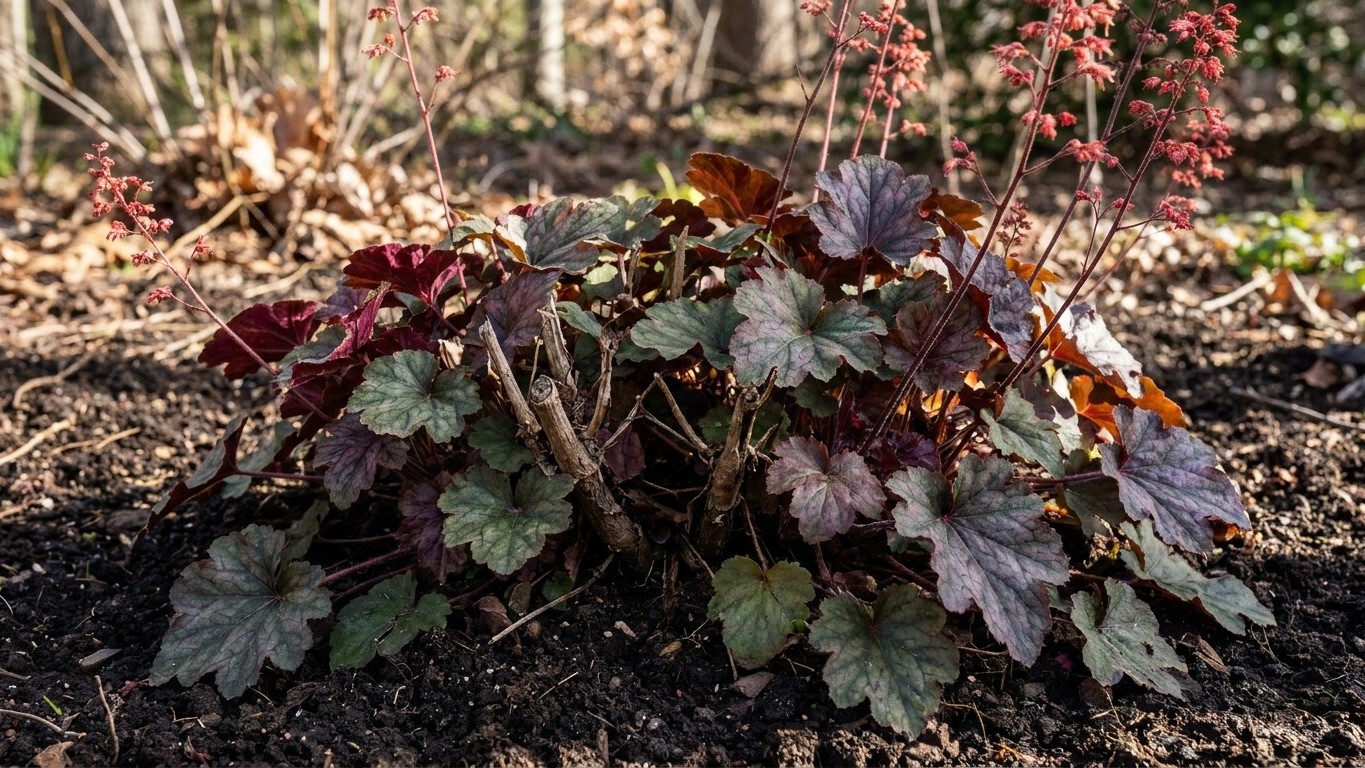

Heuchera americana survives USDA hardiness zones 4a through 9b, needs sharp winter drainage more than raw cold tolerance to make it through the off-season, and asks to be divided once its center goes bare rather than on any fixed schedule. Gardeners know it as Alumroot, American Alumroot, American Alum Root, American Sanicle, Coral Bells, or Rock Geranium, though that last set of names is not as tidy as it looks. Classified by the North Carolina Extension Gardener Plant Toolbox as a native herbaceous perennial and wildflower, it grows in low clumps of scalloped leaves that carry the show for most of the year, long after the flower spikes are gone.
One name on that list deserves a flag before moving on. “American Sanicle” is a common name most often attached to Sanicula, a different genus entirely, not to Heuchera. When a plant’s common names overlap with another plant’s, that ambiguity belongs to the reader as much as to the source, and it is worth remembering next time a nursery tag or a neighbor’s recommendation uses a common name instead of the botanical one.
Where it will and will not survive

The USDA hardiness range for Heuchera americana is 4a-9b. That range answers a narrower question than most gardeners expect: it says where the plant can survive, not where it will thrive. A garden colder than zone 4a is outside the rated range, full stop, and a garden warmer than 9b is outside it at the other end. Neither extreme is where this plant does its best work, either. A perennial rated to the top of its range is not necessarily comfortable there through a long, humid summer, any more than one rated to the bottom of its range is thriving through the coldest nights it can technically survive. Hardiness numbers describe a floor and a ceiling, not a sweet spot.
The practical step here is simple and often skipped: find your own zone before planting, rather than assuming it from a general sense of climate. Zone boundaries shift block by block in hilly terrain and can differ by a full zone between a valley floor and a nearby ridge. This site’s hardiness zone guide breaks that down county by county, and it is worth five minutes before a plant goes in the ground, especially near either edge of the 4a-9b range.
One more distinction matters here. The North Carolina Extension Gardener Plant Toolbox reports the USDA hardiness range, a national standard usable anywhere in the country. The same source also classifies this plant as a “Native Plant,” and in that context native means native to the southeastern United States specifically, not native to every region where it happens to survive. A gardener in a different part of the country can grow it successfully within its hardiness range without it being a native species locally. Any planting advice tied to North Carolina’s own coastal, piedmont, or mountain regions stays local to North Carolina and should not be carried into a different state’s growing guide.
Light, soil and drainage
The growing conditions reported for this plant cover a fairly wide band, which is good news for placement but does not mean any condition within that band is equally good for it.
| Condition | What it tolerates |
|---|---|
| Light | Dappled Sunlight, Full sun, Partial Shade |
| Soil texture | High Organic Matter, Loam (Silt) |
| Soil pH | Acid (<6.0) |
| Drainage | Good Drainage, Moist, Occasionally Dry |
Notice what is not on that list. There is no wet or poorly drained condition listed as tolerated, and that omission matters more than the hardiness number does for whether this plant survives a given winter. For a herbaceous perennial, winter drainage decides survival more often than cold does. A plant rated for zone 4a can still rot out in a spot where meltwater sits against the crown, because it is the combination of cold and wet, not cold alone, that kills roots that cannot breathe. A raised bed, a slope, or a soil heavily amended with organic matter will do more for this plant’s winter survival than picking the warmest microclimate in the yard.
A soil check anyone can run
Before planting, dig a hole about a foot deep in the spot you have in mind and fill it with water. If it drains within a few hours, the site matches the “Good Drainage” tolerance listed above. If water is still standing after eight hours, that spot behaves more like poorly drained soil, and this plant’s tolerance list does not cover that condition. For the acid soil pH this plant wants, a basic home soil test, or a sample sent to a local extension office, will tell you whether the bed needs sulfur or an acidifying amendment before anything goes in the ground. Guessing at pH from the color or feel of soil is unreliable enough that it is not worth skipping the test.
When it flowers and how long
Bloom time for this plant runs through spring and summer, not a single month. Exactly when it starts and how long it lasts within that window shifts with latitude and elevation, so a plant blooming in late spring in one location may not open until early summer somewhere colder or higher up. That is one more reason to treat this as a season, not a date on a calendar.
Deadheading spent flower spikes can extend the bloom show somewhat by redirecting the plant’s energy away from seed production, though it will not turn a spring-and-summer bloomer into a repeat bloomer through fall. Once flowering winds down, cutting the bare spikes back to the base tidies the clump without harming it. What is left after that, for most of the year, is the foliage: the scalloped, often mottled leaves that give this plant its clumping habit and its garden presence outside of bloom season. That foliage is the reason this plant earns a spot in shade gardens even in years when the flower display is modest.
The source lists this plant as attracting pollinators and specialized bees, and that draw is tied directly to the flowers. It is accurate for the bloom window and stops being accurate once the flowers are spent, since a plant out of bloom offers no nectar or pollen regardless of its foliage. In North Carolina, the extension notes fruit forming from May into September, following behind the flowers as expected; that timing, like bloom time itself, will shift earlier or later outside that state depending on local climate.
Planting, and dividing it later
Spacing at maturity is reported in two bands, less than 12 inches and 12 inches to 3 feet, which reflects how much this plant’s mature spread varies with site conditions and selection. Plan for the larger figure if the spot has rich, evenly moist soil, since a clump that spreads more than expected is a common and avoidable frustration.
- Plant in spring or fall, when soil is workable and temperatures are moderate, rather than during the height of summer heat.
- Space plants 12 inches to 3 feet apart based on the mature spread expected for the site, closer if space is tight and the smaller size band is more likely.
- Set the crown at soil grade, not buried under it; a crown planted too deep is a common cause of rot in this genus.
- Water regularly through the first growing season while roots establish, then rely on rainfall except during extended dry spells.
- Mulch two to three inches deep around, not over, the crown, leaving a small gap so moisture does not sit directly against the base of the plant.
Being a clumping herbaceous perennial, this plant will eventually need dividing, and the plant itself will show the signs rather than a calendar dictating them. A bare or woody center with growth only around the outer edge, a noticeably reduced flower display compared to previous years, or a clump that has simply outgrown its allotted space are all signals that division is due. There is no fixed interval given for this plant, and forcing a schedule onto it ignores what the plant is actually telling you.
- Dig up the entire clump in spring or early fall, lifting it with as much root intact as possible.
- Separate it into sections by hand or with a clean knife, keeping several healthy shoots and a good portion of roots with each division.
- Discard the old, woody center if it is no longer producing vigorous new growth.
- Replant divisions immediately at the same crown depth as the original planting, spaced according to the mature size expected.
- Water divisions in well and treat them as New Plantings Through Their First season.
What it resists, and what it does not
Resistance in these listings means a tendency, not a guarantee. A plant “resistant” to deer is one deer browse less often than a preferred alternative, not one they will never touch, especially when other food is scarce. A plant resistant to drought is one that tolerates dry spells once its root system is established, not a plant that shrugs off dry conditions the year it goes into the ground.
| Resists | What that means in practice |
|---|---|
| Deer | Browsed less often than many perennials, not immune to it |
| Rabbits | Same qualified tolerance as deer resistance |
| Drought | Applies to established plants with developed root systems |
| Dry Soil | Tolerates periods of dry soil once settled in |
The two resistances that matter most for a perennial are deer pressure and wet soil, and only one of them shows up on this list. Dry soil tolerance is documented; wet or poorly drained soil tolerance is not, which lines up with the earlier point about winter drainage deciding survival more often than cold does. A gardener battling deer gets a plant with some built-in resistance. A gardener working with heavy, slow-draining soil gets no such advantage and needs to fix the site instead.
Maintenance is listed as low, which in practical hours means this plant does not demand feeding schedules, staking, or frequent pest treatment. It still needs its spent flower stalks cut back after bloom, an occasional division once the signs above appear, and a check on soil moisture during dry stretches while it is getting established. Low maintenance describes the plant’s demands relative to a high-maintenance perennial, not a plant that can be ignored entirely.
Common questions
Is Heuchera americana the same plant as Coral Bells?
Coral Bells is one of several common names used for this plant, alongside Alumroot and Rock Geranium. None of those common names is the official label; the botanical name is used for that reason.
Will it survive a cold zone 3 winter?
No. The rated USDA hardiness range starts at zone 4a, so a garden in a colder zone falls outside that range and the plant is not expected to survive there.
Does it need full sun to bloom well?
It tolerates full sun, partial shade, and dappled shade under a tree canopy, so full sun is not a requirement, just one of several light conditions it can handle.
Why did my clump stop flowering as much as it used to?
A declining flower display, along with a bare center and a clump that has outgrown its space, are the signs that division is due rather than a sign of disease or poor care.