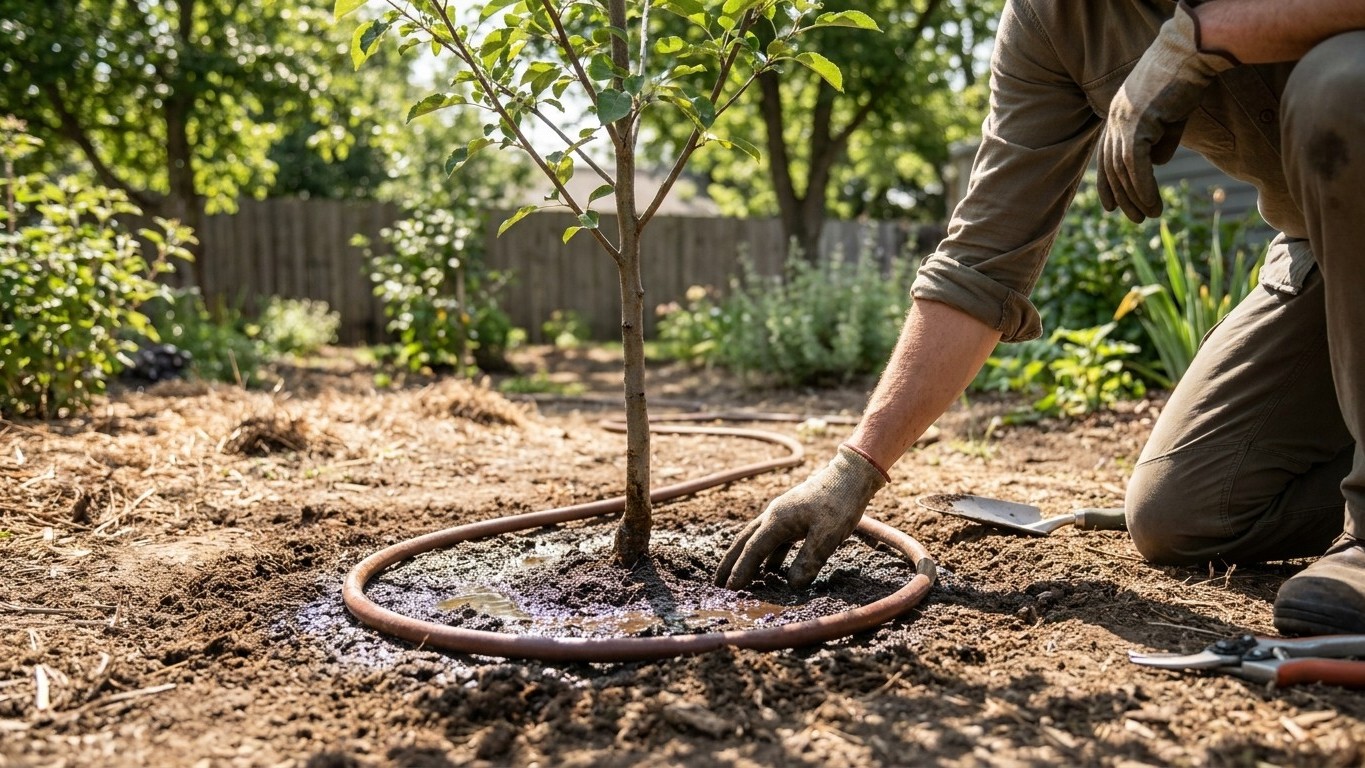

There’s no universal number of days between waterings for a newly planted tree or shrub, and any answer that gives you one is guessing. The right approach is a shape, not a schedule: water deeply, let the soil dry partway down between waterings, and check the root zone with your hands instead of your calendar. Soil type, season, sun exposure and the plant itself all move the target, so the method has to travel with you from a sandy backyard in Arizona to a clay slope in Ohio.
Deep and rare, not little and often

Roots grow toward water, and they stop growing once they find it. That single fact explains almost every watering mistake made on a new planting. Give a young tree a light sprinkle every day and the top few inches of soil stay damp, so the roots have no reason to go anywhere else. They stay shallow, they stay soft, and they stay entirely dependent on you. The first time a vacation, a hose bib that freezes, or just a busy week gets in the way, that root system has nothing in reserve and the plant collapses fast.
A deep, infrequent soak does the opposite job. Water that reaches well below the root ball pulls the roots down after it, because that’s where the moisture and, eventually, the air pockets are. A root system that has been trained downward through its first two seasons is a root system that can survive a skipped week later on. This is the entire point of watering a new planting the way nurseries and extension programs describe it: you’re not maintaining a plant, you’re building the plant’s future drought tolerance from scratch.
This is also why giving a frequency here would be the wrong kind of helpful. A silty loam in the Pacific Northwest holds water for days. A sandy soil in central Florida can drain it away in hours. A shrub planted in April in Minnesota faces cool nights and slow evaporation; the same shrub planted in April in Texas is already fighting real heat. Multiply that by root ball size, mulch depth, wind exposure and whether the spot gets morning sun or afternoon sun, and any single number of “waterings per week” becomes a number that’s right for almost nobody who reads it.
What travels across all of those conditions is the rule itself. Water slowly enough that it soaks in rather than running off. Water enough that moisture reaches past the bottom of the root ball, not just the surface of the soil. Then leave it alone until the soil tells you, at depth, that it’s time again. That’s the whole system, and it works whether you planted a bare-root shrub in Vermont or a container-grown tree in Nevada.
The uncomfortable part is that this asks for attention rather than routine. A schedule is easy because it asks nothing of you between waterings. Checking the soil asks you to actually go look, at least for the first two growing seasons. After that, an established root system spreads its own search for water wide enough that you can mostly step back.
How to tell whether it needs water
The soil check replaces the schedule, and it’s simple enough to do in under a minute. Do it in this order:
- Dig or push a finger into the soil next to the root ball, not into the mulch layer sitting on top of it. Mulch can look and feel dry on the surface while the soil beneath stays soaked, or the reverse, so mulch tells you almost nothing.
- Check at a depth of several inches, roughly where the lower half of the root ball sits, rather than just at the surface. Surface soil dries first regardless of what’s happening below, so a dry top inch doesn’t mean the plant is thirsty.
- Look at the plant in the morning, before the heat of the day, rather than in the afternoon. Morning appearance reflects how much water the roots actually have access to. Afternoon appearance reflects how hot it is outside.
- Learn what this specific plant looks like when it’s well watered. Leaf color, leaf angle and general posture vary by species, so the useful comparison is the plant against itself on a good day, not against a neighbor’s tree or a photo online.
The afternoon-wilt trap deserves its own warning because it drowns more plants than it saves. Plenty of species, especially broadleaf trees and shrubs with large leaves, wilt visibly on a hot afternoon and look completely fine again by evening. That wilt is a temporary response to heat and transpiration outpacing what the roots can pull up in real time, not a sign of drought stress. Water on that signal, day after day, and you’re adding moisture to soil that was never actually short of it. The roots, already sitting in wet soil, lose access to oxygen and start to fail, which produces more wilting, which reads as more of a reason to water. That loop is how a plant gets killed by kindness.
The finger-in-the-soil check breaks that loop because it measures the thing that actually matters, moisture at the root, rather than a symptom that has more than one cause. It takes longer to learn than checking a calendar, but it’s the only method that works across every soil type, every climate and every species covered on this site.
Why « drought tolerant » does not apply yet
Every drought-tolerance rating you’ll find, here or on a nursery tag or a state extension bulletin, describes a plant that is established. Establishment means the root system has grown out past the original container or root ball and spread into the surrounding native soil, wide and deep enough to find water on its own during a dry stretch. A plant tagged as tolerating drought once it’s established is being rated on that mature root system, not on the one it arrives with.
A newly planted tree or shrub doesn’t have that root system yet. It has the roots it grew in a nursery container or a burlapped root ball, confined to a volume of soil that’s often smaller than a five-gallon bucket even on a good-sized specimen. Those roots haven’t reached the surrounding soil in any meaningful way, so a rating that says “drought tolerant once established” is describing a future version of the plant, not the one sitting in your yard right now.
That’s why the first two growing seasons are the ones that decide the outcome, no matter what the plant’s label promises. During that window, the plant depends on the water you give it at the root ball, because its own roots haven’t grown far enough to look elsewhere. A species rated as extremely drought tolerant can still die of thirst in its first summer if nobody waters the confined root ball it arrived with. The rating isn’t wrong; it just doesn’t start applying until establishment is finished.
Every plant covered on this site has its own page with its actual hardiness range, its size at maturity and what it resists once established, along with the local frost-date and zone information for your state. Those numbers belong there, tied to the specific plant, rather than repeated in a general watering guide where they’d go stale the moment one of them gets corrected. If you’re trying to figure out how long establishment takes for a given species, or what that plant looks like at year five, that’s the page to check.
Too much water looks like too little
Overwatering and underwatering produce symptoms that look almost identical from across the yard: wilting leaves, yellowing foliage, dieback at the tips. That overlap exists because both problems end the same way, with roots that can’t move water and nutrients into the plant. Dry roots can’t do it because there’s nothing to absorb. Waterlogged roots can’t do it because they’re suffocating without oxygen and starting to rot. The plant above ground doesn’t know or show the difference; it just shows distress.
The discriminator is in the details, not in the overall picture:
| Signal | Underwatered | Overwatered |
|---|---|---|
| Soil feel at root depth | Dry, crumbly, sometimes pulling away from the root ball edge | Wet, heavy, cool to the touch, sometimes sticky or muddy |
| Where yellowing starts | Leaf edges and tips first, often on the whole plant evenly | Lower or interior leaves first, often with the leaf staying soft rather than crisp |
| Overnight recovery of wilt | Usually recovers by morning if watered | Often does not recover, since the roots themselves are damaged |
| Smell at the root zone | No unusual smell | Sour, rotten-egg, or swampy smell from the soil |
That smell test is worth taking seriously. Healthy wet soil smells like nothing in particular, or faintly earthy. Soil that’s been sitting saturated around dying roots tends to smell sour or sulfurous, and that’s as close to a definitive sign as this gets without pulling the plant to inspect the roots directly.
In heavy clay soil, and in any spot that already drains poorly, more water is almost never the fix for a struggling plant, even when the symptoms look like thirst. Adding water to soil that already can’t shed what it has just extends the time the roots spend without oxygen. If a plant in that kind of spot is declining, the drainage guidance on that plant’s own page is the place to check before reaching for the hose again.
Common questions
Should I water a new tree every day for the first week?
Daily light watering trains roots to stay shallow rather than growing down, which works against the plant’s long-term drought tolerance. A slower, deeper soak with longer gaps between waterings, guided by checking the soil at root depth, does more for establishment than a daily routine does.
How long does it take for a new tree to become established?
Establishment is tied to the plant regaining a root system wide and deep enough to reach native soil on its own, and that timeline varies by species and by soil conditions rather than following one fixed number. This site’s rule of thumb points to the first two growing seasons as the period when watering attention matters most, regardless of what a plant’s mature drought rating says.
Does mulch mean I can water less often?
Mulch slows evaporation from the soil surface, so it does reduce how quickly the root zone dries out. But mulch can also mask what’s actually happening underneath, which is exactly why the soil check for a new planting should always happen beside the root ball in the soil itself, not by feeling the mulch layer sitting on top.
Can a wilted plant recover if I catch it in time?
It depends entirely on which kind of wilt it is. A plant wilting from heat and dry soil generally bounces back once it’s watered and the roots rehydrate. A plant wilting because its roots are already rotting from too much water usually doesn’t recover from more water, and may need the drainage around it addressed instead, which is covered on that plant’s own page.