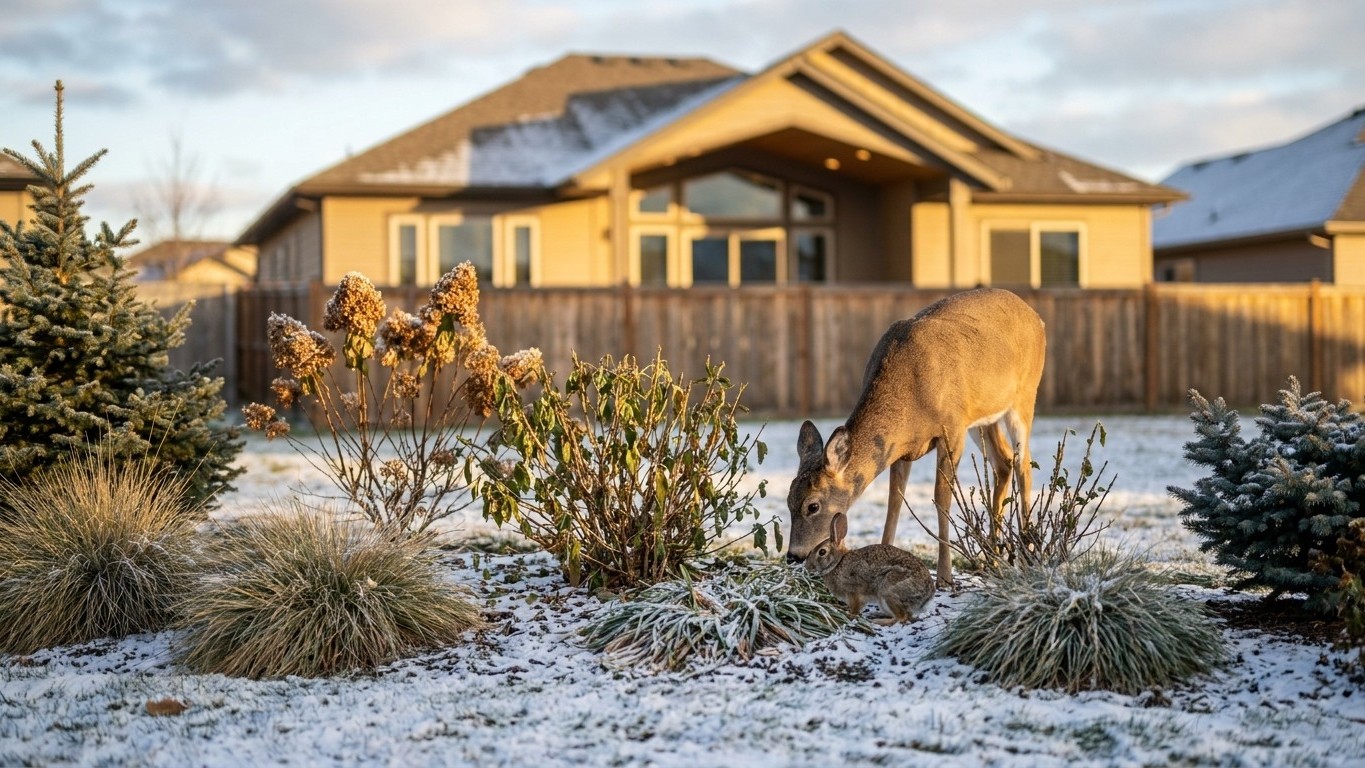

“Deer resistant” is a probability, not a guarantee. It means a plant gets browsed less often than the alternatives nearby, based on documented feeding patterns, not that deer or rabbits will leave it alone. Nothing sold as a landscape plant is genuinely off-limits to a hungry animal. Understanding that distinction changes how you read every label, every list, and every claim you’ll run into while planning a yard that wildlife also has opinions about.
Resistant is not proof

Start with the word itself, because the whole subject hinges on it. A plant rated deer resistant has been observed, across enough gardens and enough seasons, to be browsed less frequently than plants deer clearly prefer. That’s the entire claim. It says nothing about immunity, nothing about a guaranteed outcome in your specific yard, and nothing about what happens when conditions change.
Conditions change constantly. A plant that sat untouched for three years can get stripped in a fourth if the winter runs long and snow covers the usual browse. Deer don’t consult a resistance chart before they eat. They eat what’s available, what’s easiest to reach, and what hasn’t already been picked over by the herd ahead of them. In a hard winter, with deep snow burying low shrubs and native forage scarce, a starving animal will eat plants it normally walks past without a glance. Resistance ratings are built from average conditions, not worst-case ones, and a bad winter is exactly when the average stops applying.
The same logic applies to rabbits, though on a shorter cycle. A young rabbit population exploding in a mild spring will test plants an established colony ignored the year before. Resistance is a population-level pattern, not an individual guarantee, and populations shift year to year based on predators, disease, and food supply well outside a gardener’s control.
This matters because resistance ratings get treated as a shopping shortcut, as though checking a box solves the browsing problem permanently. It doesn’t. It shifts the odds in your favor, which is genuinely useful when you’re deciding what to plant along a property line that borders woods, but it doesn’t remove the need for judgment once the plant is in the ground. A newly planted specimen, still small and still recovering from transplant stress, is more vulnerable than the same species once it’s mature and established, regardless of what the resistance list says.
Every resistance rating referenced on this site, and on any nursery label you’ll come across, carries this same qualifier even when it isn’t printed out loud. When you’re choosing a specific plant, its own page here lists what it resists and how reliably, based on the same regional feeding patterns that inform ratings generally. Read that list as a planning tool, not as insurance.
Telling which animal did it
Figuring out what actually chewed your plant decides what you do next, and the physical evidence is more reliable than guessing based on which animal you’ve seen in the yard. Three things tell the story: the pattern of the damage relative to the ground, the texture of the cut, and the season it happened in.
| Clue | Points to a large browser (deer) | Points to a small browser (rabbit, vole) |
|---|---|---|
| Location of damage | At browsing height, reachable by a standing animal stretching upward | At ground level, or at whatever height snow cover reached that winter |
| Cut texture | Ragged, torn, shredded edges on twigs and stems | Clean, angled cuts that look almost scissored |
| Bark stripping | Wider bands, often higher up the trunk | Narrow bands near the base, sometimes hidden until snow melts |
| Season | Any season, worse in winter when other forage is scarce | Most damage discovered in late winter or early spring |
The cleanest tell comes down to anatomy. Deer have no upper front teeth, only a hard dental pad, so they can’t cut cleanly. They grip a stem and pull, which tears the fibers and leaves a rough, splintered end. Rabbits and voles have sharp incisors top and bottom, and they cut at an angle the way pruning shears would, leaving a smooth, precise edge. If you’re looking at a twig and the end looks torn rather than cut, a deer did it. If it looks snipped, look lower and smaller.
Height does most of the rest of the work, but not in the way people expect, because there’s no fixed number that applies everywhere. What matters is the pattern relative to the animal and the season. Damage at a height a person could reach while standing points to a large browser. Damage confined to ground level, or damage that appears in a band that makes sense only if you picture where the snowpack sat that winter, points to something small working under cover. Voles in particular do their damage completely hidden, tunneling under snow against the trunk where nobody sees it happen until the thaw uncovers the result. That’s why a lot of rabbit and vole damage gets discovered weeks after the fact, while deer damage is usually obvious the next morning.
What actually reduces it
There’s a real hierarchy here, and it’s worth being honest about which measures are proven and which are just popular. Ranked from most reliable to least:
- Physical exclusion. A fence tall and solid enough to stop the animal in question is the only method that works close to 100% of the time, because it removes the option rather than discouraging it.
- Siting away from established paths. Deer and rabbits are creatures of habit, moving along the same travel corridors along a property edge or through a gap in a hedgerow. Planting a vulnerable specimen well off that line reduces the chance it gets found at all, simply because it’s not sitting in the animal’s regular route.
- Protecting the individual plant through its vulnerable years. A young tree or shrub is at its most attractive and its most damage-prone in its first few winters. A physical guard around the trunk, sized for the specific threat, is a realistic and proven step during that window, and it can come off once the plant is established and less appealing as a browse target.
- Plant choice. Choosing something rated as resistant shifts the odds in your favor over the life of the landscape, but as covered above, it settles nothing by itself. It’s the last lever to pull, not the first.
What’s deliberately missing from that list is anything involving repellent sprays, scent deterrents, motion-activated devices, or home remedies passed around between neighbors. This isn’t an oversight. There’s no reliable evidence behind most of these products holding up across a real winter with real hunger driving the animal’s decisions, and the market is full of confident claims that don’t survive scrutiny. Some gardeners report short-term success with certain repellents, and that’s plausible, since deer and rabbits do respond to smell and taste in the moment. But rain washes products off, new growth goes uncovered, and animals habituate to a scent that doesn’t change. Rather than recommend something without solid backing, it’s more honest to say plainly: exclusion, siting, and physical protection are the measures with a track record. Everything else is a gamble you’re free to try, but shouldn’t plan your protection strategy around.
The damage that kills rather than disfigures
Most browsing damage looks worse than it is. A deer strips the tender tips off a shrub, and by the following season new shoots have filled the gaps back in. Rabbits nibble the lower branches of a young tree, and the plant channels growth elsewhere to compensate. This kind of damage is cosmetic, frustrating, and usually temporary.
Girdling is different, and it’s the one outcome that turns a browsing problem into a dead plant. It happens when an animal, usually a rabbit or a vole working under snow cover, strips bark all the way around the trunk’s circumference rather than in a partial band. The bark carries the tissue that moves sugars produced by the leaves down to the roots. When that ring is severed completely, the roots stop receiving what they need, and the plant above the girdled point dies even though the roots themselves may still be alive and the trunk still standing. A partial strip, covering less than the full circumference, usually heals over time. A complete ring doesn’t.
Girdling is discovered almost exclusively in spring, once the snow that hid it has melted away, because the damage happens at ground level under cover and the tree often shows no symptoms until the growing season starts and the canopy that should be leafing out simply doesn’t. By the time it’s visible, there’s nothing left to do for that plant. Prevention has to happen before the snow falls, not after.
Three habits reduce the risk meaningfully:
- Install a guard around the trunk base that stays clear of the bark itself rather than pressing against it, sized to outlast a full winter of snow accumulation at the base.
- Pull mulch 6 inches away from the base of plants to prevent bark decay and vole damage. A ring of mulch pushed right up against a trunk gives voles cover to work unseen, which is exactly the setup that produces a hidden winter girdling injury.
- Check the base of the trunk once the snow melts, every year, before assuming the plant made it through fine. The trunk should be visible and the bark intact all the way around; if a band of missing bark rings the base, that’s the signal that this plant’s future is now uncertain, regardless of how healthy the canopy still looks.
Mulch itself isn’t the enemy here, only mulch piled against bark is. A 2-inch to 3-inch layer kept away from the trunk still does its job of moderating soil temperature and moisture without creating vole habitat right against the plant it’s meant to protect. For a full winter protection routine, including timing that depends on your local frost dates, the winter protection guide on this site walks through the season month by month.
Common questions
Can a plant be both deer resistant and rabbit resistant?
Yes, but the ratings are separate and don’t automatically transfer. A plant deer tend to avoid because of scent or texture can still be attractive to rabbits, which respond to different cues. Check both ratings on the plant’s own page rather than assuming one implies the other.
Does deer resistance change as a plant matures?
Generally it improves. Young, tender growth is more palatable across nearly every species, and a plant becomes less attractive as its tissue toughens and its chemical defenses, where it has them, reach full strength. That’s part of why protecting the first few years matters more than protecting the plant once it’s established.
Is bark stripping always fatal to the plant?
No. It’s fatal only when the stripped band runs all the way around the trunk’s circumference. A partial strip, even a wide one, leaves enough intact bark for the plant to transport nutrients and usually heals over subsequent seasons.
Should I check for damage even if I never see deer or rabbits in the yard?
Yes, particularly for vole and rabbit damage, which happens under snow cover and at night. Not seeing the animal tells you nothing about whether it visited. A spring check at the base of every young tree and shrub, once snow has fully melted, is the only reliable way to catch girdling before it’s mistaken for something else.