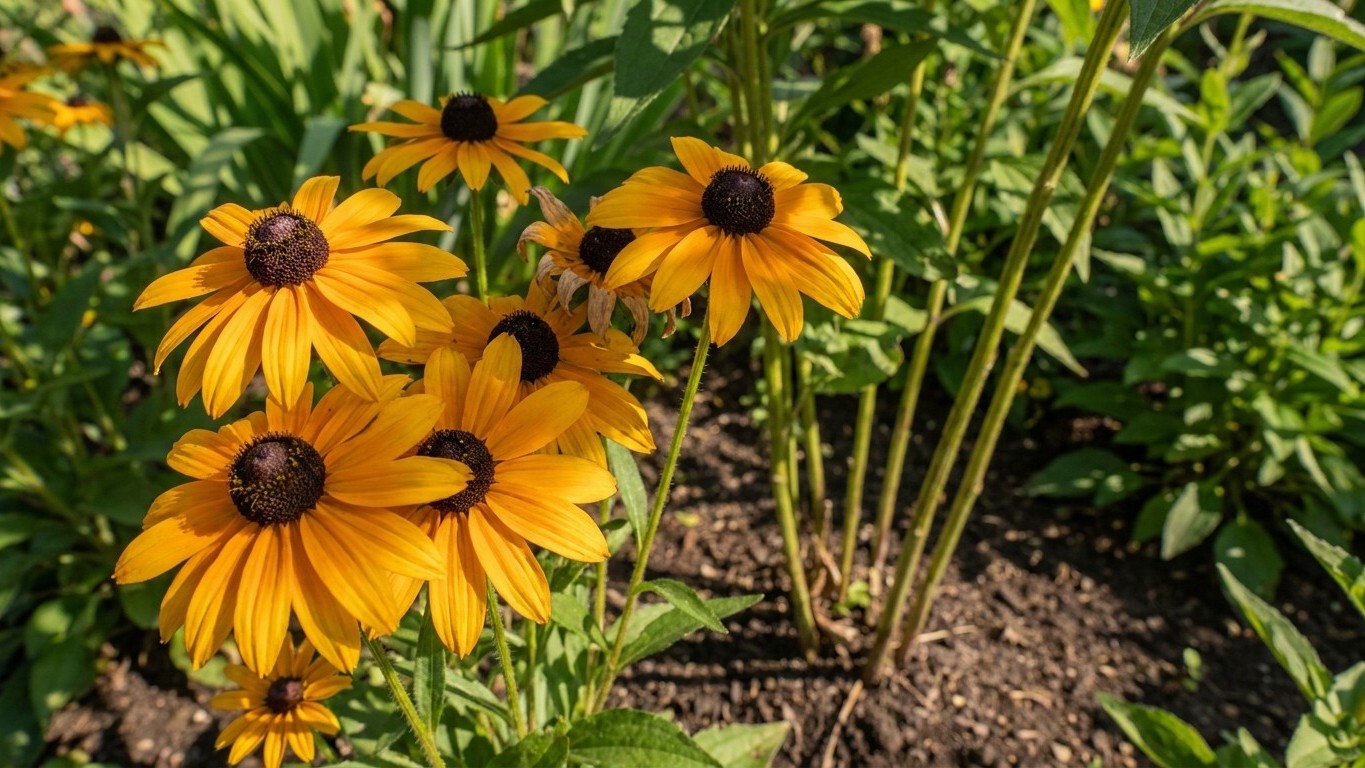

Rudbeckia fulgida, sold as Black-eyed Susan or Orange Coneflower, is a herbaceous perennial wildflower hardy in USDA zones 3a-9b. It wants full sun, tolerates clay and shallow rocky soil as long as drainage is good, blooms through summer into fall, and forms clumps 12 inches to 3 feet wide that need dividing once the center thins out. The zone number is only the starting point, drainage and clump management decide whether it actually lasts.
Where it will and will not survive

The USDA hardiness range for Rudbeckia fulgida is 3a-9b. That’s a wide band, but it’s a survival range, not a comfort range. A plant that’s rated to the warm edge of its zone isn’t necessarily happy there in a long, humid summer, just as a plant listed down to the cold edge isn’t guaranteed to look its best after a hard winter, it’s simply expected to come back.
What the range actually tells you is where the plant runs out of road on either end. Below the bottom of this range, winter cold is expected to kill it outright, roots and all, regardless of mulch or siting. Above the top of it, the problem usually isn’t a single freeze but the lack of a cold dormant period the plant needs, combined with heat and humidity that wear it down over a season or two rather than one bad night. Either way, the practical result for a gardener is the same: the plant isn’t a safe long-term bet outside 3a-9b.
The number that matters here is your own zone, not a name you’ve heard attached to a general region. Zone lines shift with elevation, with distance from water, and from one county to the next in ways that a broad regional label glosses over. Rather than assume where you fall, check your zone directly using the hardiness zone guide on this site, which breaks it down at a finer level than a state name can.
One more distinction worth keeping straight: the 3a-9b figure is a national USDA measure, so it applies wherever you garden. The North Carolina Extension Gardener Plant Toolbox also publishes region-specific growing notes for North Carolina’s own coastal, piedmont, and mountain zones. Those regional notes are useful if you happen to garden in North Carolina, but they don’t transfer to a reader elsewhere, the USDA hardiness figure is the only piece of that source meant to travel.
Light, soil and drainage
The growing conditions listed for Rudbeckia fulgida are specific enough to check against your own yard before you plant, rather than after.
| Condition | What the source lists | What it means for you |
|---|---|---|
| Light | Full sun (6+ hours of direct sun daily) | Shade for part of the afternoon will thin the clump and reduce bloom |
| Soil texture | Clay, Shallow Rocky | Tolerant of poor, thin, or heavy soils that many perennials reject |
| Drainage | Good Drainage, Moist, Occasionally Dry | Wants consistent moisture but not standing water, and shrugs off short dry spells |
| Growth rate | Rapid | Fills in quickly, which also means it needs room and eventual dividing |
For a herbaceous perennial like this one, winter drainage decides survival more often than the cold itself does. A crown sitting in saturated clay through a freeze-thaw cycle can rot before spring even shows whether the plant was hardy enough for your zone. The hardiness rating assumes reasonably drained soil; it doesn’t account for a low spot that holds water every March.
You can check your own soil without any equipment. Dig a hole about a foot deep, fill it with water, and time how long it takes to drain. If water is still sitting there after several hours, that spot is a poor match for this plant regardless of what zone map says you’re in, raising the bed, working in coarse material, or picking a different spot in the yard solves the problem more reliably than any amount of winter mulch.
Clay soil isn’t automatically disqualifying here, since the source lists clay as a tolerated texture. The distinction is between clay that drains, even slowly, and clay that pools. The first is workable; the second is where this plant, and most perennials rated for “good drainage,” tend to fail.
When it flowers and how long
Rudbeckia fulgida blooms across summer and into fall — a season-long window rather than a single month, and one that will shift earlier or later depending on your latitude and elevation. Two readers in different parts of the same hardiness zone can see first bloom weeks apart.
Deadheading, snipping off spent flower heads before they set seed, extends that summer-to-fall display by pushing the plant to keep producing new buds instead of finishing its bloom cycle early. If you’d rather let the plant self-sow or leave seed heads standing, skip deadheading and cut the whole clump back once flowering winds down for the season, which also tidies up the planting before winter.
Outside of that bloom window, which covers most but not all of the growing year, the plant is straightforward green foliage in a clumping habit, listed by the source as broadleaf evergreen. It’s not a plant grown for winter structure or off-season interest; its job is the flower display, and the rest of the year it simply holds its ground.
The source notes it attracts butterflies, pollinators, and songbirds, but that draw is tied directly to the flower and, for songbirds, to the seed that follows it. Once the bloom is finished and seed heads are removed or fade, that pollinator traffic stops, it’s a property of the flowering plant, not a year-round feature of having it in the yard.
Planting, and dividing it later
Getting the clump sited correctly the first time saves a transplant later, since this is a rapid grower that fills its allotted space fast.
- Plant in spring or fall, when soil is workable and temperatures are moderate enough to avoid stressing new roots.
- Space plants according to the mature spread of 12 inches to 3 feet, so a young clump that looks sparse at planting has room to fill in without crowding its neighbors within a season or two.
- Set the crown, where roots meet stems, at grade rather than burying it, planting too deep is a common way to stall or rot a perennial before it establishes.
- Water regularly through the first growing season while roots establish, then rely on the plant’s occasional-dry tolerance once it’s settled in.
- Mulch around the plant to conserve moisture and suppress weeds, but keep mulch pulled back from direct contact with the crown to avoid trapping moisture against it.
Because this is a clumping herbaceous perennial and not a shrub or tree, it doesn’t simply get larger and stay put. It spreads outward, and eventually needs dividing to stay healthy and to keep the display looking full rather than ragged.
Watch for three signs rather than counting years: a bare or woody-looking center with growth only around the outer ring of the clump, noticeably fewer flowers than in previous seasons, and a clump that has physically outgrown the space you gave it at planting. Any one of those is your signal, whenever it shows up.
- Dig up the entire clump in spring or fall, lifting it with as much root mass intact as possible.
- Divide it into smaller sections with a sharp spade or knife, making sure each section keeps both roots and some top growth.
- Discard the old, woody center if it’s no longer producing new growth.
- Replant the healthy divisions promptly at the same spacing you’d use for new plants, and water them in well.
What it resists, and what it does not
Resistance on a plant label means a tendency, not immunity. A deer-resistant plant is one deer usually pass over, not one they never touch when other food is scarce; drought resistance describes an established plant with a developed root system, not one still settling in during its first season.
| Listed resistance | What it covers |
|---|---|
| Deer | Generally avoided, but not guaranteed immune to browsing |
| Drought | Tolerated once the plant is established, not immediately after planting |
| Dry Soil | Handles periods without consistent moisture better than many perennials |
| Pollution | Tolerates roadside and urban growing conditions |
For a perennial, the two that matter most in practice are deer and wet soil. Deer resistance is a genuine point in this plant’s favor in yards where browsing pressure is a real cost. Wet soil is the opposite story: nothing in the resistance list covers standing water, and as noted earlier, poor winter drainage is a more common cause of failure than the cold itself.
The source rates overall maintenance as Low, which is accurate but shouldn’t be read as “no maintenance.” Low-maintenance still means an annual pass to cut the clump back after bloom, occasional deadheading if you want a longer flower display, and eventually the division work described above. It’s a modest time commitment measured in an hour or two a few times a year, not zero.
Common questions
Is Rudbeckia fulgida the same plant as a common Black-eyed Susan?
Black-eyed Susan and Orange Coneflower are both common names used for this plant, but common names are applied loosely across the Rudbeckia group and can overlap with related species. If you need certainty about what you’re buying, the botanical name Rudbeckia fulgida is the more reliable reference point.
Does “Native Plant” mean it’s native to my area?
Not necessarily. The North Carolina Extension source classifies it as a native plant, and in that context “native” refers to the southeastern United States, not to every region where the plant is sold or grown.
Will it survive in wet, heavy clay soil?
It tolerates clay texture and even shallow rocky soil, but the source lists good drainage as a condition alongside occasional dryness. Clay that stays saturated through winter is a different problem from clay that simply drains slowly, and the former is more likely to cause failure than the plant’s cold hardiness ever would.
How much space does one plant actually need?
Plan for a mature spread of 12 inches to 3 feet, depending on conditions and how long it’s been in the ground. Given its rapid growth rate, a plant that looks small at planting can fill that entire footprint within a couple of seasons.