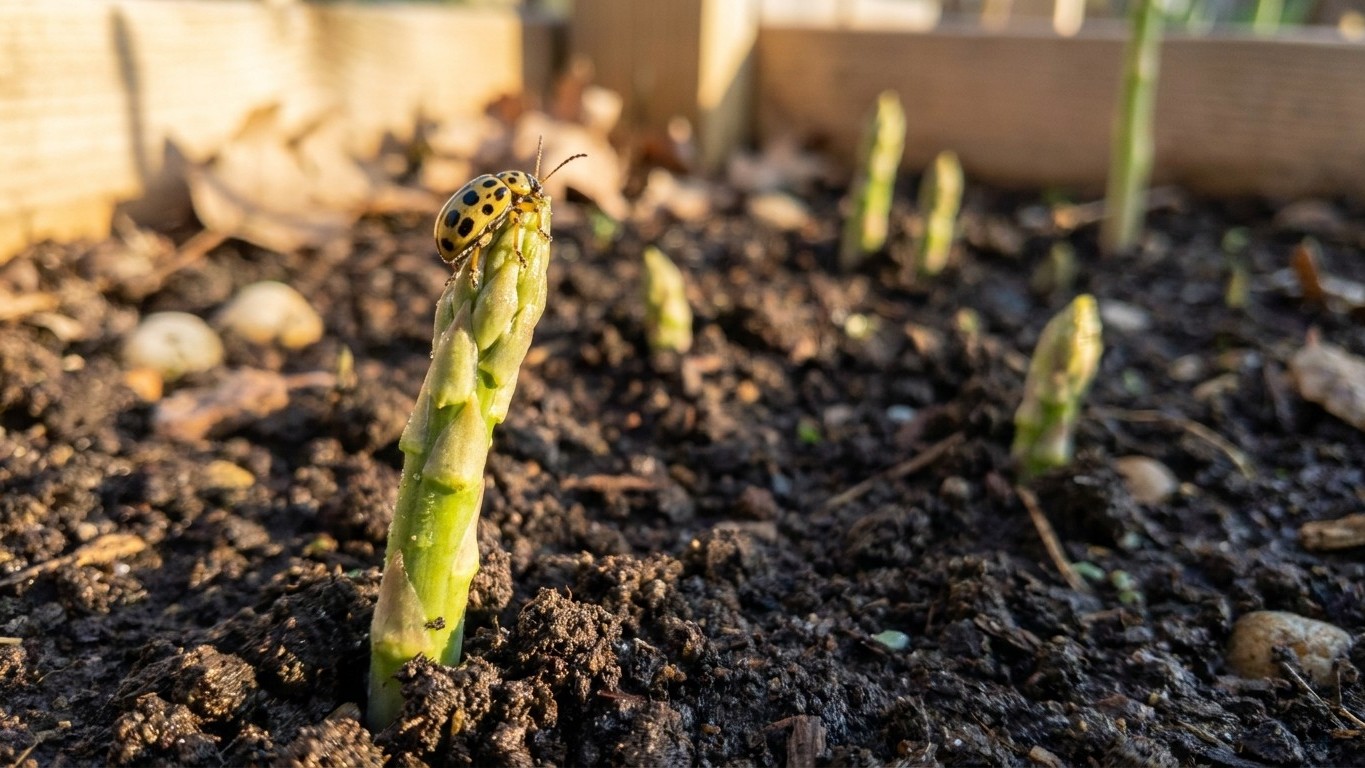

Spotted asparagus beetle season in New Jersey generally tracks the emergence of asparagus spears in early spring, then continues through a second generation on the ferny summer growth. There’s no single day that marks its arrival: it follows soil temperature and plant growth stage, not the calendar, and its presence on this site is currently documented for New Jersey only.
The weeks to watch

Rutgers NJAES Cooperative Extension publishes seasonal windows for several New Jersey vegetable pests, including cucumber beetles, bean leaf beetle, Colorado potato beetle, and spotted lanternfly, but its FS1123 guidance does not name a specific emergence window for the spotted asparagus beetle. That gap matters: it means the timing below comes from the general biological pattern of the species rather than a New Jersey-specific date range published by the extension service.
First generation, spring
Adults overwinter in hollow asparagus stems, garden debris, and nearby wood edges. They become active as soil warms and asparagus crowns push spears above ground, feeding on new spears and laying eggs along the spear tips and ferny growth as it develops. This is when scarred, notched spears show up first.
Second generation, summer
A second generation develops on the fern-like foliage that grows once harvest ends. Larvae feed through midsummer, and new adults emerge later in the season to feed briefly before seeking overwintering sites as temperatures drop. Because this generation works on foliage rather than harvestable spears, damage is often more cosmetic to the plant’s long-term vigor than to the crop you actually eat that year.
Reading the calendar from your last frost

NOAA’s 1991-2020 climate normals put the 32°F freeze probability window for this reference station at March 29 to April 6. That’s a range, not a promise, and it comes from an airport weather station. Gardens in suburban and rural New Jersey typically see their own last frost run one to two weeks later than that station’s figures, more at higher elevation, so check your county’s local data before planning around it.
Asparagus crowns don’t wait for frost risk to clear the way annual transplants do. Spears often break ground right around that same frost-risk window, sometimes a little before it closes, because the crown responds to soil warmth at a shallow depth rather than to air temperature alone. Beetles that overwintered nearby tend to show up within the first week or two after spears emerge, since their food source and their winter shelter sit in the same bed.
- Start from your local last frost window (use March 29 to April 6 as the reference-station figure, adjusted later for your specific county).
- Expect spears to break ground around that same window, with beetle activity following within roughly the first one to two weeks after spears appear.
What it attacks, and what the damage looks like


A gardener usually notices the damage before spotting the insect itself. On spears, look for shallow gouges, scarring, or notched, discolored tips that make the harvest look rough even though the spear is still edible underneath. On the summer fern growth, the giveaway is skeletonized or lace-holed foliage, sometimes paired with small dark eggs standing in single rows glued to the plant tissue.
The crop list for this pest is short and specific:
- Asparagus (the only cultivated host)
Both adults and larvae cause damage, but they favor different plant parts. Adults do most of the spear scarring in spring; larvae do most of the foliage skeletonizing in summer, after harvest has ended. That distinction matters for treatment: spear damage from adults affects this year’s harvest appearance, while larval feeding on fern growth mostly affects the plant’s ability to store energy for next year’s crop, which is a longer-term concern rather than an immediate one.
How New Jersey sits in this pest’s range

This site currently documents the spotted asparagus beetle for New Jersey only, with no neighboring state page yet published to compare timing against. That narrow documentation doesn’t mean the insect is rare here or elsewhere, only that no comparative data across territories exists on this site yet to say whether New Jersey sees it earlier, later, or in different numbers than a bordering state.
What can be said plainly is that Rutgers NJAES Cooperative Extension, the state’s own agricultural extension service, tracks a set of vegetable pests closely enough to publish seasonal guidance for several of them, just not a dedicated window for this particular beetle in FS1123. Gardeners growing asparagus in New Jersey are working from the same general biological pattern described above rather than a state-calibrated forecast, which is a fair starting point but not a substitute for watching your own bed each spring.
What actually works against it

- Harvest spears daily during the cutting season. Removing spears regularly also removes eggs laid on them before those eggs hatch, cutting the next generation off at no cost beyond the harvesting you’re already doing.
- Hand-pick adults and crush visible egg rows. Free and immediate, this works because the beetles are slow-moving and easy to spot against green spears; it stops working once larvae have already tunneled into fern tissue where they’re no longer visible or reachable by hand.
- Clear and destroy old fern debris in fall. Adults overwinter in hollow stems and garden trash near the bed, so removing that material removes their shelter before winter, reducing how many survive to emerge the following spring.
- Site new asparagus beds away from old, heavily infested plantings. Since asparagus is a perennial crop, true rotation isn’t practical the way it is with annual vegetables, but distance from an established infestation still limits how quickly beetles find a new bed.
- Cover new spear growth with row covers in early spring. This physically blocks adults from reaching spears, but covers must come off before pollinators are needed and before harvest begins, and they do nothing once eggs are already laid or larvae are established in the foliage.
Some gardeners also use diatomaceous earth dusted on foliage as a home remedy; trials on its field effectiveness against asparagus beetle are inconclusive, so treat it as a commonly used practice rather than a proven fix.
Common questions
Does the spotted asparagus beetle damage the spears I eat?
Adults do feed on spears in spring, causing surface scarring and discoloration, but the damage is mostly cosmetic. Trimming the scarred portion before cooking generally solves the problem for that harvest.
Is this the same insect as the common asparagus beetle?
No. The spotted asparagus beetle is a separate species that tends to feed more on the ferny summer foliage and berries than directly on spears, while the common asparagus beetle is the one more associated with early spear damage.
Can I treat this pest with the same approach used for cucumber beetles or Colorado potato beetle in New Jersey gardens?
Not directly. Rutgers NJAES Cooperative Extension publishes separate seasonal windows for those pests because their life cycles differ; the timing and non-chemical measures above are specific to the asparagus beetle’s own biology rather than borrowed from another species’ schedule.