
A Colorado potato beetle problem in June looks manageable — a few chewed leaves, easy to ignore. By August, that same garden can be stripped to stems, because the beetles that survived early summer bred again, and the second generation always outnumbers the first. Cucumber beetles run the same trick on squash and melons. Gardeners who spray once and stop are usually the ones pulling out defoliated plants by Labor Day, wondering what happened between the two visits they didn’t think to make.
What New Jersey gardens actually deal with

New Jersey’s growing season runs long enough, and warm enough, for several of these insects to complete two generations rather than one. Rutgers NJAES notes that both the Colorado potato beetle and the spotted cucumber beetle populations, along with the striped cucumber beetle population, produce a second generation by midsummer in New Jersey, which is why a garden that looked clean in June can be overrun by August. The same pattern shows up on beans, where the Mexican bean beetle population in New Jersey also builds through a second generation before gardeners notice the skeletonized leaves, a problem often compounded by the Bean leaf beetle New Jersey population feeding alongside it. The timing of that second wave, not the first one, is usually the difference between mild leaf damage and a defoliated plant. Gardeners just across the Hudson deal with a similar cast under different pressure, covered in Garden Pests in New York: What Shows Up, When, and How to Stop It, though the mix and timing shift with the climate.
Colorado potato beetle

The Colorado potato beetle in New Jersey is an adult that is oval, about 3/8 inch long, cream-yellow with ten black stripes running down the wing covers. It overwinters in the soil and emerges in early spring to feed on potato, eggplant and tomato foliage. The larva, a humped, brick-red grub with two rows of black spots, does the heavier damage, stripping leaves down to the veins. Hand-picking adults before egg masses hatch is the most reliable home-garden control Rutgers NJAES lists.
Tomato hornworm

This caterpillar grows to about 4 inches, bright green with white V-shaped marks along its sides and a dark horn at the tail end. It’s often confused with its close relative, the Tobacco hornworm in New Jersey, though the two can be told apart by their markings. The Tomato hornworm in New Jersey feeds on tomato foliage and can strip a plant of leaves in a few days once it reaches full size. Its droppings, dark green pellets on lower leaves, are often the first sign a hornworm is present before the caterpillar itself is spotted.
Tobacco hornworm

Similar in size and color to the tomato hornworm, but its side stripes run as straight diagonal lines rather than V shapes, and its rear horn is red rather than dark. It feeds on the same solanaceous crops and is controlled the same way. Hand removal works because the caterpillar is large and slow enough to spot and pick off once you know where to look.
Bean leaf beetle

An oval beetle around 1/4 inch, with a background color that ranges from pale yellow to red and a black triangle behind the head. It chews rounded holes between the leaf veins of bean plants and can also scar pods. Rutgers NJAES lists this beetle as active from mid-May to early June, which is when new bean seedlings need the closest watching.
Striped cucumber beetle

Yellow, about 1/5 inch long, with three black stripes running the length of the wing covers. It feeds on cucumber, squash and melon seedlings and can kill young plants outright by feeding on the stem at the soil line. It also spreads bacterial wilt, so a wilting vine with beetle feeding nearby is not a coincidence.
Spotted cucumber beetle

Yellow-green with twelve black spots scattered across the wing covers, roughly the same size as its striped relative. It causes similar chewing damage on the same cucurbit crops and shows up in the same window, so row cover timed for one controls the other.
Common asparagus beetle
A slender, metallic blue-black beetle with orange-red margins and cream-colored spots on the wing covers, about 1/4 inch long. It attacks asparagus spears as they emerge, leaving brown scarring and sometimes causing spears to bend or turn brown at the tip.
Spotted asparagus beetle
Rounder and slightly larger than the common asparagus beetle, orange-red with about a dozen black spots. It feeds mainly on the ferny foliage rather than the spears, so it is more of a long-season nuisance than a spring emergency.
Spotted lanternfly
The adult is about 1 inch long, with gray, black-spotted forewings that fold over red-and-black hindwings visible only in flight. Nymphs are black with white spots when young, turning red with white spots before their final molt. It does not chew leaves the way beetles do. It feeds by piercing stems and leaves and excreting sticky honeydew, which then grows sooty mold. Rutgers NJAES reports nymphs hatching around mid-May near Newark, with adults present from late July through the first frost.
Mexican bean beetle
Coppery yellow to tan, rounded like a ladybug, with sixteen black spots across the wing covers, about 1/4 to 3/8 inch long. Both adults and the spiny yellow larvae feed on the undersides of bean leaves, skeletonizing them between the veins while leaving the upper leaf surface intact.
Telling damage apart

The shape of the damage tells you what you are dealing with before you ever see the insect. Chewed edges and ragged holes point to a chewing insect like a beetle or caterpillar, feeding from the outside of the leaf inward. Stippling, a fine pale speckling that makes a leaf look bleached, usually means something is piercing and sucking cell contents rather than biting off tissue. Skeletonized leaves, where only the veins remain, are the signature of Mexican bean beetle larvae or a heavy hornworm infestation left unchecked.
Insect, disease or watering
Wilting is the trickiest symptom because three different causes produce it. A plant wilting despite moist soil, especially a cucumber or squash vine with beetle feeding scars near the base, points to bacterial wilt spread by cucumber beetles. Cut the stem and squeeze it, and a milky ooze confirms disease rather than drought. A plant wilting because the soil is dry simply perks back up within a few hours of watering. A plant with yellowing between the veins, rather than wilting, is more often a nutrient issue than a pest at all.
Sticky residue on leaves or on the ground beneath a plant, sometimes with a black sooty film, is honeydew from sap-feeding insects like spotted lanternfly, not a fungus starting on its own. The sooty mold itself does little direct harm. It grows on the honeydew and blocks light, so treating the insect responsible for the honeydew, not the mold, is the actual fix.
Holes that appear overnight in large numbers, versus damage that develops gradually over a week, is another useful clue. Beetles tend to move in numbers and can skeletonize a planting fast. A single hornworm, by contrast, can defoliate one branch over several days while leaving the rest of the plant alone, simply because there are far fewer of them per plant.
When each one shows up
Pest activity in New Jersey tracks soil and air temperature more closely than the calendar, but Rutgers NJAES ties several of these insects to specific windows measured near Newark. Cucumber beetles, both striped and spotted, emerge once temperatures climb above 60F in early May, which in practice means they show up within days of cucumber and squash seedlings going into the ground. A second generation follows midsummer, so a garden that got through the seedling stage clean is not out of danger for the rest of the season.
Colorado potato beetle adults appear in early spring as soon as potato foliage is up, having overwintered a few inches down in the soil. Rutgers NJAES notes a second generation emerges in late summer, which is often the one that does the most visible damage, since the plant has less foliage left to spare by then.
Bean leaf beetle activity runs from mid-May to early June according to Rutgers NJAES, which lines up with when bean seedlings are putting out their first true leaves and are least able to tolerate feeding damage. Asparagus beetles show up earlier, as soon as spears break the soil surface in spring, since that is the only tissue the common asparagus beetle feeds on.
Spotted lanternfly follows its own separate rhythm. Rutgers NJAES reports nymphs hatching around mid-May near Newark, feeding on a wide range of plants through the summer as they move through several immature stages, with winged adults present from late July through the first frost. That makes it a season-long presence rather than a single window to watch for.
These figures come from monitoring near Newark, and Rutgers NJAES is explicit that timing shifts across the state. Coastal counties and the warmer parts of South Jersey tend to see earlier emergence than the ridge-and-valley region in the northwest. A gardener who has also kept a plot in a far colder state notices how different the calendar can get: the pattern covered in Garden Pests in Alaska: What Shows Up, When, and How to Stop It runs on a compressed few weeks rather than the long, overlapping windows New Jersey deals with. Local scouting still beats any fixed date, since a warm early spring can pull every one of these windows forward.
What actually works
Prevention beats intervention for nearly every insect on this list. Crop rotation matters most for Colorado potato beetle, since the adults overwinter in the soil right where last year’s potato patch stood. Moving nightshades to a different bed each year forces the emerging adults to travel farther to find a host, and many simply do not make it.
Barriers and timing
Floating row cover, put down at planting and removed only when flowers need pollinator access, keeps striped and spotted cucumber beetles off young cucurbits during the most vulnerable seedling stage. The same cover works against bean leaf beetle if it goes on before the mid-May to early June window Rutgers NJAES flags for that insect. Cover has to come off once female flowers appear on cucurbits, or pollination stops along with the beetles.
Encouraging predators helps more than most gardeners expect. Ground beetles and birds take a steady toll on hornworm caterpillars and beetle larvae, and a garden that skips broad-spectrum insecticide sprays keeps more of those predators around from one season to the next.
Direct intervention
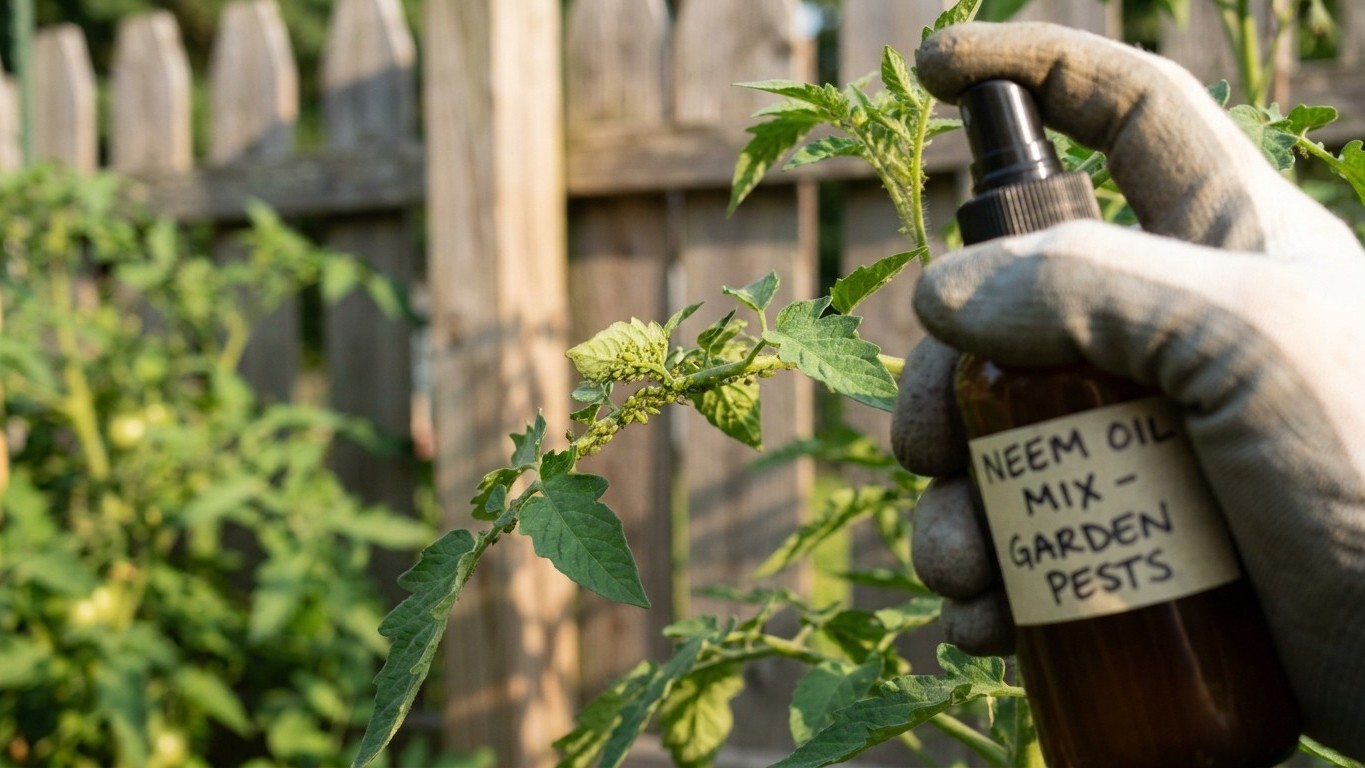
Hand-picking works well against large, slow-moving pests. Colorado potato beetle adults, hornworm caterpillars, and Mexican bean beetle larvae are all big enough to spot and remove by hand, and doing it every few days during peak activity keeps numbers down without any product cost. For heavier infestations, Bacillus thuringiensis (Bt) targets caterpillars like the tomato and tobacco hornworms without harming bees or beetles, and insecticidal soap or neem oil can knock back soft-bodied lanternfly nymphs if it reaches the insect directly.
Spotted lanternfly adults are harder. They are strong fliers and often move in from wooded edges rather than breeding in the garden itself, so spraying the vegetable bed does little. Managing host trees like tree of heaven along the property line matters more than anything sprayed on tomatoes.
A few widely repeated home remedies do not hold up. Dish soap sprays mixed at kitchen-sink strength can burn leaf tissue without killing much of anything, and companion planting marigolds around the garden has no measurable effect on cucumber beetle or bean leaf beetle numbers. Diatomaceous earth washes off with the first rain and needs constant reapplication to matter at all.
What control costs
None of these controls carry a state-set price, so treat the comparison below as relative rather than exact. For a typical home vegetable garden, hand-picking and row cover cost mostly time and a small amount of material, while sprays cost money repeated every one to two weeks through the season.
| Method | Money cost | Time cost | Repeat frequency |
|---|---|---|---|
| Hand-picking | None | A few minutes per bed, several times a week during peak activity | Ongoing through each pest’s active window |
| Row cover / barriers | One-time material cost, reusable for several seasons | Low after initial setup, removed for pollination | Installed once per planting, checked occasionally for gaps |
| Biological controls (Bt, beneficial insects) | Moderate, priced per application | Low, applied as a spray or released once | Reapplied after rain or every 1-2 weeks during an outbreak |
| Insecticidal soap / neem / other sprays | Moderate, ongoing purchase | Moderate, requires direct contact with the insect | Every 1-2 weeks, more often after rain |
Hand-picking is the cheapest option in a small garden and the only one that costs nothing beyond attention, but it does not scale past a few raised beds or a modest row of potatoes. Row cover has an upfront cost but pays for itself across several seasons, since the same length of fabric can be reused if it is stored dry and patched rather than replaced whole.
Sprays, whether an insecticidal soap, neem oil, or a Bt product for caterpillars, need repeat applications because they break down in sunlight and wash off in rain, and because they only kill what they contact directly at the time of spraying. That repeat cost adds up over a season faster than a one-time row cover purchase, which is why row cover plus hand-picking is the lowest-cost combination for most home gardens working through the pests on this list.
Local help
Rutgers NJAES Cooperative Extension is the best first call for identifying an unfamiliar insect or confirming an outbreak, since county offices can look at a sample or a clear photo and name the pest correctly before any control decision gets made. The extension service’s website lists county office contacts and current pest alerts. For other seasonal tasks around the state, our New Jersey guides cover more than pest identification.
Two Pests Worth Watching Closely
Not every pest on this list follows a loose, weather-dependent schedule — some are tied to a much tighter clock, and that’s worth knowing before you plan your defenses. The bean leaf beetle is one of them: it arrives in New Jersey gardens during a narrow window each spring, and that window is set by the beetle’s own biology, not by anything on your calendar. If you grow beans, that timing detail matters more than any generic spray schedule, because missing the window means missing your best chance to act before damage starts.
The other is the spotted lanternfly, which moves through the state in three distinct waves that track its life cycle from egg to adult. Egg masses hatch into nymphs from late April through July, adults show up by mid-summer, and egg-laying runs from September into early fall. That spread means this isn’t a one-time problem you can handle in a single afternoon — it’s a season-long watch, with a different pest to look for depending on when you check your yard. Both pages walk through what to look for at each stage and what actually stops them.
Common questions
Do I need to spray as soon as I see one beetle?
No. A handful of beetles on an established plant rarely justifies a spray, and hand-picking a few insects a day usually keeps a small population from becoming a problem. Reach for a spray only once feeding damage is spreading fast or a seedling is being defoliated outright.
Is the Mexican bean beetle just a type of ladybug?
No, though it is easy to mistake one for the other since both are round and roughly the same size. Mexican bean beetle is coppery yellow to tan with sixteen black spots and feeds on bean foliage, while most ladybugs are red or orange with fewer spots and eat aphids rather than leaves. If the beetle is on a bean plant and the leaf underneath is skeletonized, it is the pest, not the beneficial.
Is spotted lanternfly going to kill my tomatoes?
Unlikely on its own. Spotted lanternfly feeds by piercing stems to draw sap and tends to prefer woody plants and vines over annual vegetables, so a vegetable garden usually sees honeydew and sooty mold rather than a dying plant. Report large populations to Rutgers NJAES regardless, since tracking where the insect is spreading matters even when the damage to a given plant is minor.
Should I kill every hornworm I find?
Not if it has small white cocoons attached to its back. Those are the pupal cases of a parasitic braconid wasp that is already killing the caterpillar from the inside, and leaving that one in place lets the wasps emerge and go on to attack other hornworms in the garden. A hornworm without any white cocoons is fair game to remove by hand.