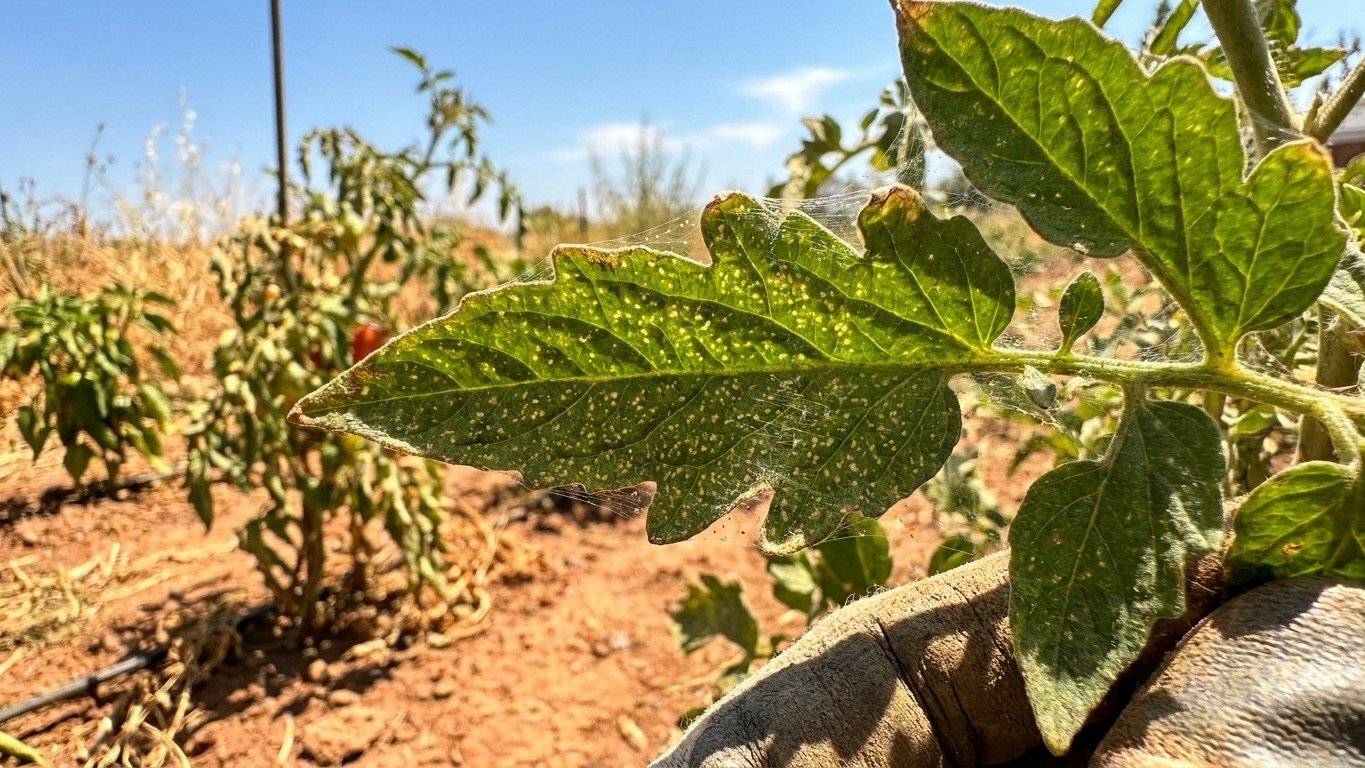

Spider mites turn up in Virginia gardens whenever a stretch of hot, dry weather settles in, most often from late May through September. There’s no single “spider mite season” the way there is for a specific beetle flight. A strong jet of water, less drought stress on the plant, and predatory insects left alone to do their job stop more mite damage than most home treatments. Coastal Virginia sees pressure build earlier than the mountains, since warmth arrives sooner along the Chesapeake Bay.
The weeks to watch

Virginia Cooperative Extension does not publish a specific calendar window for two-spotted spider mites the way it does for pests tied to a single generation or flight, like Japanese beetle. That’s because mites don’t follow a date on the calendar. They follow heat and dryness, and in a state that stretches from tidal marsh to mountain ridge, those conditions show up at different times depending on where you garden.
Spring wake-up
Adult females overwinter tucked into leaf litter, loose bark, and plant debris left standing over winter. They become active once a run of warm days breaks the cold, well before most gardeners are thinking about mites at all. In coastal Virginia that can happen weeks earlier than it does west of Richmond.
Summer buildup
Once daytime heat holds and rain gets scarce, populations climb fast. Spider mites move through their life cycle far quicker than most garden pests, which is why a plant that looked fine one week can be covered in fine webbing the next. Overlapping generations mean adults, nymphs, and eggs are all present on the same leaf at the same time by midsummer.
Late-season pressure
Dry spells in August and into September, common across much of Virginia, tend to produce the heaviest damage of the year. A wet, humid stretch can knock populations back on its own, which is part of why outbreaks track drought rather than a fixed month.
Reading the calendar from your last frost

Spider mites don’t answer to frost the way a cold-sensitive pest does. But your last spring frost date still matters, because it sets when tender transplants like tomatoes, beans, and cucumbers go into the ground, and stressed young transplants hit by an early dry spell are exactly what mites look for.
For coastal Virginia, NOAA’s 30-year climate normals from the Oceana station put the last spring freeze between March 20 and April 3. That’s a range, not a guaranteed date, and it applies to the mild coastal end of the state. The Blue Ridge and southwest Virginia run weeks later in spring, so gardeners there should shift this whole calculation back accordingly.
- Step 1: Mark your local last frost date. For coastal Virginia, that’s the March 20 to April 3 window; inland and mountain gardeners should check their own county’s normal, since it runs later.
- Step 2: Count forward to the first sustained hot, dry stretch after transplants are established, roughly the point where many coastal Virginia gardeners spot the first fine stippling on tomato or bean leaves, often by early-to-mid June, later inland.
That gives a rough window for when a lightweight row cover should come off (mites thrive in heat, and covers trap it) and when to start checking leaf undersides regularly.
What it attacks, and what the damage looks like

The first sign is rarely the insect itself. Most gardeners notice fine yellow or white speckling across the top of a leaf, almost like the leaf has been dusted with pepper, before they ever spot anything moving. Left alone, that stippling spreads, the leaf takes on a bronze or gray cast, and fine silk webbing shows up on the undersides and between stems in heavy infestations. Badly hit leaves curl, dry out, and drop.
Spider mites don’t chew. Both the nymphs and the adults feed by piercing individual plant cells with a needle-like mouthpart and drawing out the contents, which is why the damage looks like stippled dots rather than holes or ragged edges. Eggs don’t feed at all, so any control effort only needs to reach the moving stages, not the eggs stuck to the leaf surface.
Plants commonly affected in Virginia gardens and landscapes include:
- Tomatoes and peppers
- Beans and cucumbers
- Melons and squash
- Strawberries
- Roses and many ornamental shrubs
- Houseplants that spend summer outdoors
How Virginia sits in this pest’s range

Spider mites are among the most widespread plant pests in North America, found in essentially every state. That matters for how you read any advice about them: the difference between Virginia and, say, Georgia or Pennsylvania isn’t whether mites show up, it’s when and how badly. A widespread pest like this doesn’t have edges of its range the way a regional insect does.
Inside Virginia itself, the state’s own geography creates the real variation. NOAA’s climate data for the coastal station at Oceana shows an early, mild spring, which lines up with earlier mite activity along the Chesapeake Bay and Tidewater region. Move west toward the Blue Ridge and into southwest Virginia, and both the last frost and the arrival of consistent summer heat run weeks behind the coast, pushing the whole mite season later as well.
None of this means one part of the state has it worse overall. It means a gardener in Virginia Beach and a gardener in Roanoke should be watching different weeks, not comparing severity.
What actually works against it

Cheapest and simplest measures come first here, and each one has a point where it stops helping.
- Spray plants with a strong jet of water. Mites are small and don’t hold on well once dislodged. This knocks adults and nymphs off the leaf but does nothing to eggs already glued in place, so it has to be repeated every few days through a hot spell.
- Keep plants watered through dry stretches. Drought-stressed plants concentrate sugars in their sap, and mites build populations faster on stressed foliage than on well-watered plants. This works as prevention, not as a cure once mites are already established in large numbers.
- Leave predatory insects alone. Ladybugs, lacewings, and predatory mites eat spider mites naturally, and broad-spectrum insecticide use tends to kill off those predators faster than it controls the mites themselves, a pattern entomologists refer to as mite flare-ups following spraying. Avoiding unnecessary insecticide applications protects this natural check.
- Raise humidity where it’s practical. Mites prefer hot, dry conditions, so misting or grouping container plants can slow buildup. This has limited effect once webbing has already covered a plant, since the mites are already sheltered inside it.
- Remove and discard heavily webbed leaves. This physically takes a concentrated colony out of the garden. It only helps early, while infestation is still confined to a few leaves; once mites have spread across the whole plant, pruning can’t keep pace with them.
- Quarantine new plants before placing them near others. Nursery and greenhouse stock is a common way mites first arrive in a home garden. A couple of weeks set apart, with regular leaf checks, catches an infestation before it spreads.
Some gardeners also reach for home remedies like copper tape or ultrasonic devices for various pests, but there’s no established evidence these do anything against spider mites specifically, and trials on similar folk remedies for other pests generally come back inconclusive.
Common questions
Do spider mites survive Virginia winters?
Adult females overwinter in leaf litter, bark crevices, and other plant debris left standing through the cold months. Clearing garden debris in fall reduces the number of mites available to restart the population come spring.
Can spider mites spread from houseplants to the garden?
Yes. Houseplants that spend summer outdoors, or new nursery stock brought into the yard, are a common source of infestation. A quarantine period with leaf checks before mixing new plants into an established garden catches this early.
Why do spider mites get worse after spraying with insecticide?
Broad-spectrum insecticides tend to kill the predatory insects that normally keep mite populations in check faster than they kill the mites themselves, which can trigger a bigger outbreak than existed before spraying. This is why cultural controls and encouraging natural predators are generally recommended before reaching for a spray.