
Japanese beetles start showing up across Virginia in mid-to-late June, with populations peaking through July and tapering off by late August or early September. The insects follow soil temperature, not the calendar, so a warm spring in Tidewater or the Piedmont can push emergence a week or two earlier than in the Shenandoah Valley or the mountains of Southwest Virginia. Stopping them means working on two fronts at once: knocking back the adult beetles chewing on your roses and crape myrtles right now, and treating the grubs living in your lawn that will become next year’s problem.
When Japanese Beetles Show Up in Virginia

Adult beetles emerge from the soil once it warms to around 60 degrees Fahrenheit a couple inches down, which in most of Virginia happens somewhere between the first and third week of June. The Coastal Plain and Hampton Roads area, with sandier, faster-warming soil, tends to see beetles a few days ahead of the Piedmont around Richmond and Charlottesville. The Shenandoah Valley and the higher elevations near Roanoke and Blacksburg lag behind, sometimes not seeing real activity until early July.
Once they’re out, adults live about four to six weeks, feeding, mating, and laying eggs in turfgrass throughout that window. That’s why a single Virginia summer can feel like a rolling invasion rather than one wave: new beetles keep emerging into July even as older ones die off, so the pressure on a garden builds steadily rather than hitting all at once. By late August, adult numbers usually drop off sharply, though a warm fall can stretch things out a little longer in the warmer eastern counties.
Underground, the cycle keeps moving after the adults disappear. Eggs laid in July hatch into grubs by August, and those grubs feed on grass roots through fall before burrowing deeper to survive winter. They come back up near the surface in spring to finish feeding before pupating into next year’s beetles. That’s the loop that makes Japanese beetles a multi-season pest rather than a one-time nuisance.
What the Damage Actually Looks Like
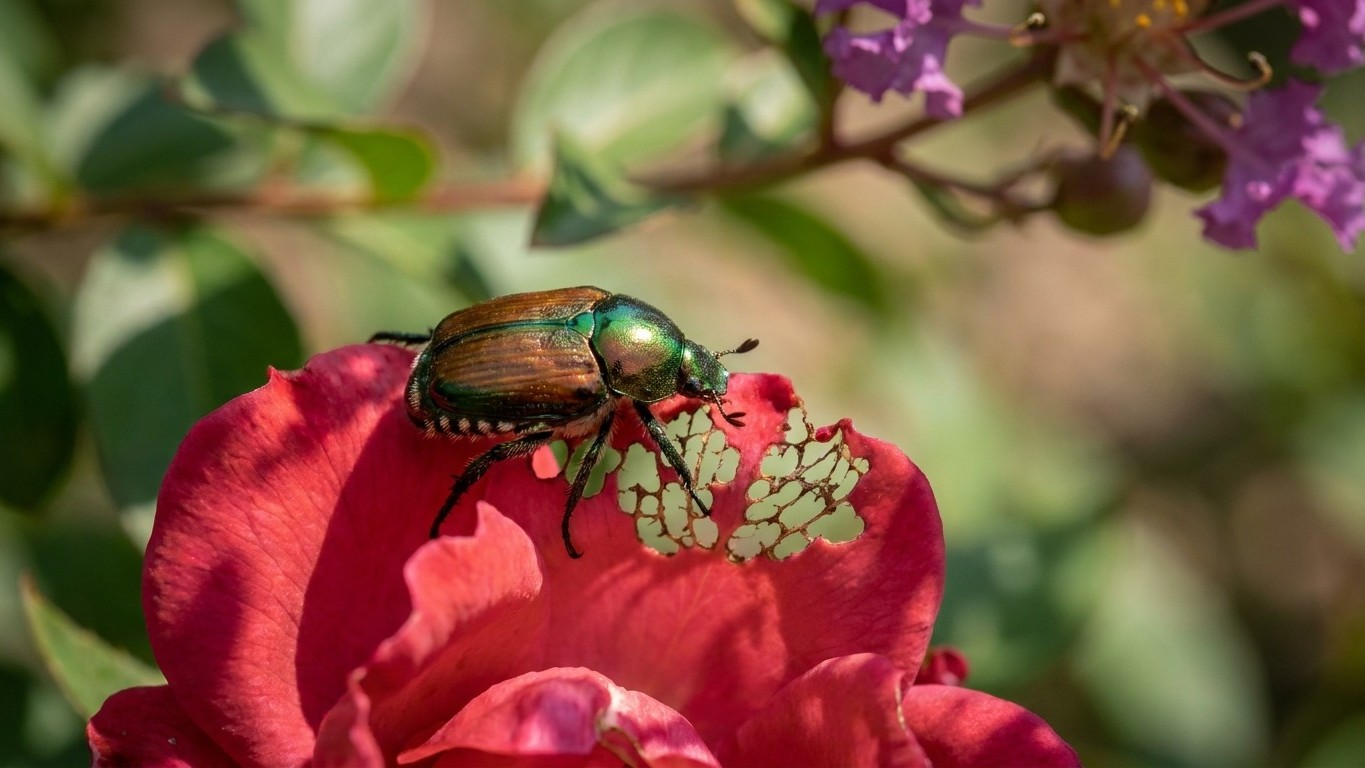
Adult beetles are unmistakable once you know what to look for: about a half-inch long, metallic green body, copper-brown wing covers, with small tufts of white hair along the sides of the abdomen. They feed in groups, which is part of why the damage looks so dramatic so fast. A rose bush that looked fine on Monday can be reduced to lace-like skeletonized leaves by Thursday, with only the veins left behind.
Virginia gardens offer beetles a long buffet. Roses and grapes are favorites, but linden trees, crape myrtles, birch, Virginia creeper, and raspberry canes all attract heavy feeding too. Vegetable gardeners often see damage concentrated on beans and okra. The beetles are drawn to sun-exposed foliage and tend to start at the top of a plant, working down, which is why the upper canopy of a small tree or shrub often looks worse than the lower branches.
Below ground, the grubs cause a different kind of damage that shows up as irregular brown patches in lawns, usually starting in late summer or early fall. A telltale sign is turf that pulls up like loose carpet because the roots have been chewed away. Raccoons, skunks, and birds digging up patches of lawn looking for a grub meal are often the first clue a homeowner gets that a problem is developing underground.
What Actually Stops Japanese Beetles
No single tactic wipes out Japanese beetles for good, since adults fly in from neighboring properties no matter what you do to your own yard. But combining a few methods, timed correctly, keeps damage to a level most Virginia gardens and lawns can tolerate.
Handpicking still works
For a single rose bush or a few fruit trees, knocking beetles into a bucket of soapy water in the early morning, when they’re sluggish from cooler temperatures, remains one of the most effective low-cost controls available. Beetles release a pheromone when disturbed that attracts more beetles, so daily removal during peak season matters more than doing it once a week. It’s tedious, but for a homeowner with a handful of plants, it beats spraying chemicals every few days.
Why beetle traps often backfire
Pheromone traps sold at garden centers use a floral lure and a sex attractant that draw beetles in from a wide radius, sometimes a quarter-mile or more. The problem is that traps typically attract far more beetles than they actually catch, meaning a trap placed near your garden can pull in more insects than would have shown up otherwise. Extension entomologists in Virginia and across the region generally recommend placing traps well away from valued plants, at the far edge of a property, rather than near the roses or grapevines you’re trying to protect.
Sprays and timing
For plants under heavy attack, contact insecticides labeled for Japanese beetles can knock down active adult populations, but timing and coverage matter more than the product itself. Neem oil and pyrethrin-based sprays work on contact and need to be reapplied after rain or every several days during peak activity, since they don’t leave much residual protection. Systemic products applied earlier in the season, before beetles emerge, can offer longer protection on ornamentals but come with more risk to pollinators, so applying them to blooming plants during daylight hours when bees are active should be avoided.
Grub control is where the long game gets won
Because next year’s beetle population depends on this year’s grubs surviving in the lawn, fall is the window that matters most for turf. Grubs are small and close to the surface in late summer, which is when insecticide treatments and biological controls work best. Beneficial nematodes, applied to moist soil in late summer, can reduce grub numbers over a season or two without synthetic chemicals. Milky spore disease, a bacterium that specifically targets Japanese beetle grubs, takes longer to establish (often a couple of years before it reaches full effectiveness) but then persists in soil for years afterward, making it a reasonable option for homeowners willing to think in terms of a multi-season lawn strategy rather than a quick fix.
The U.S. Department of Agriculture’s Animal and Plant Health Inspection Service tracks Japanese beetle distribution and regulated movement of nursery stock as part of a broader effort to slow the pest’s spread into beetle-free regions of the country, a reminder that this isn’t just a backyard nuisance but a pest with real economic weight for agriculture and the nursery trade nationally.
Building a Realistic Season Plan
Virginia homeowners dealing with Japanese beetles tend to do best when they stop thinking of it as a single battle and treat it as two separate jobs on two different calendars. Summer is for protecting what’s currently growing: daily handpicking, targeted sprays on the plants beetles favor most, traps kept well away from the garden. Late summer into fall is for the lawn, when grub populations are shallow enough in the soil to actually reach with nematodes, milky spore, or a properly timed insecticide application.
Skipping the fall grub step is the most common mistake. A homeowner who sprays adults all July but never treats the lawn is essentially feeding next year’s beetle population for free, since a healthy, untreated lawn can support tens of thousands of grubs per acre without much visible damage until the population gets large enough to strip the grass roots bare. Testing a few square feet of turf in late August, by cutting back the sod and counting grubs, gives a fast read on whether treatment is worth the cost that particular year.
One detail that surprises a lot of Virginia gardeners: beetle pressure often varies more by neighborhood microclimate than by which control method a homeowner uses. A yard next to an open field or golf course, both prime egg-laying turf, will typically see heavier beetle traffic than a shaded, tree-covered lot a few streets over, regardless of how diligently either homeowner sprays or picks beetles off by hand.
Related guides
- Japanese beetle in West Virginia: When It Shows Up and What Stops It
- Japanese beetle in Kentucky: When It Shows Up and What Stops It
- Japanese beetle in Connecticut: When It Shows Up and What Stops It
- Japanese beetle in Illinois: When It Shows Up and What Stops It
- Cross-striped cabbageworm in Virginia
- Tarnished plant bug in Virginia
- Japanese beetle in Nevada: When It Shows Up and What Stops It
- Japanese beetle in Missouri: When It Shows Up and What Stops It