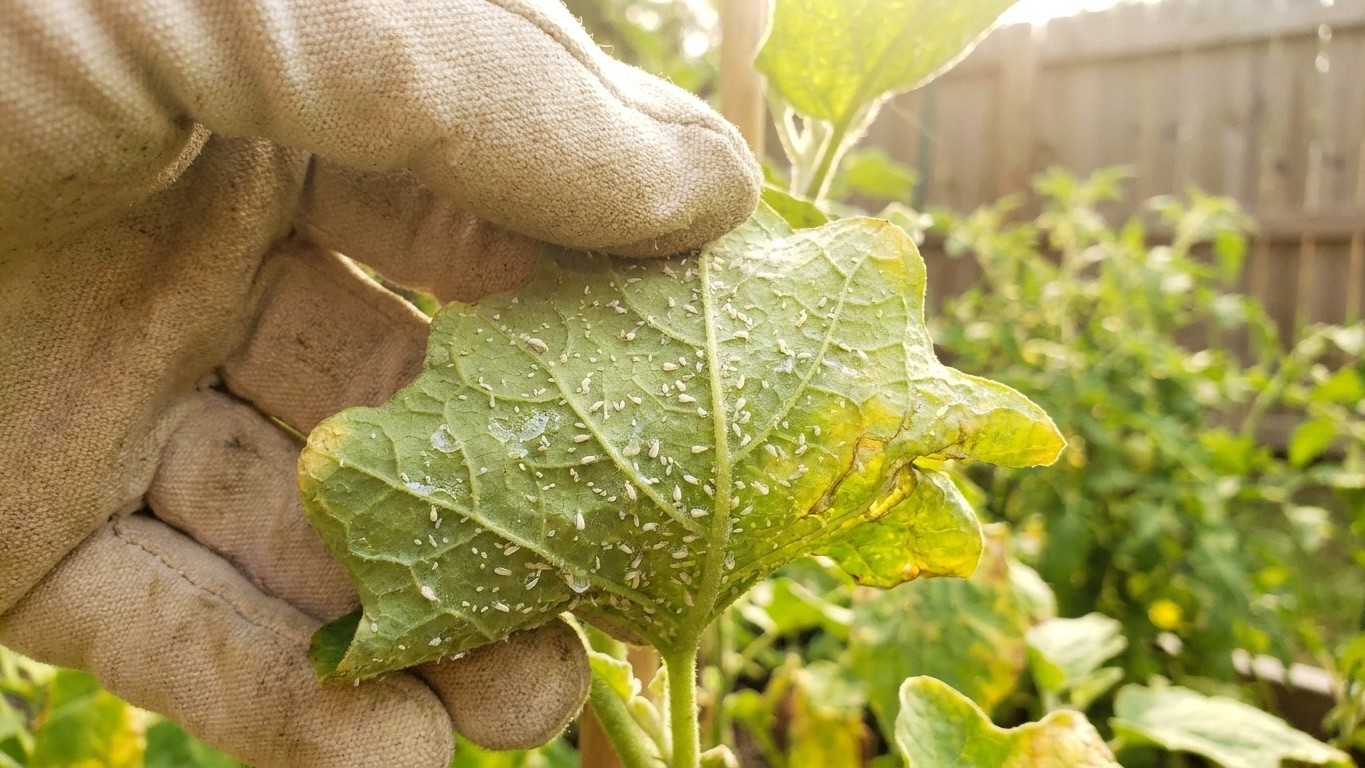

Silverleaf whitefly builds its numbers in South Carolina from spring into fall, with the sharpest jumps once nighttime temperatures stay above 60°F for weeks at a stretch. It doesn’t survive open winters well, so a hard freeze knocks populations back to almost nothing. The most reliable defenses are cheap and physical: inspect transplants before you buy them, get row covers on early, and pull infested leaves the moment you spot the honeydew sheen.
The weeks to watch

Clemson Cooperative Extension’s Home and Garden Information Center doesn’t publish a specific activity window for silverleaf whitefly the way it does for some of the state’s other garden insects. Its tomato and cucurbit pest calendars track tomato fruitworm from early May through four to five generations, stink bugs peaking July through early October, and leaffooted bug running from May into fall. Whitefly isn’t named in that lineup, so the practical answer borrows from the general pattern this insect follows across the warm Southeast: activity from spring through the first hard frost, with the worst buildup during the hottest, most humid stretch of summer.
Spring emergence and early buildup
Adults that survived in a greenhouse, a protected planting bed, or an unusually mild pocket of the Lowcountry start moving onto outdoor plants as soon as daytime highs climb into the 70s. Numbers stay low at this stage, which is exactly why early inspection matters more than any later treatment.
Summer population peak
Warm nights let the insect cycle through generations quickly, and by midsummer a garden that looked clean in May can carry visible colonies on the undersides of squash and tomato leaves. This is the stretch that matches the same July-through-September heat window Clemson calls out for stink bugs and leaffooted bug.
Fall decline with the first cool snap
Populations taper as nights cool, and a frost anywhere near the state’s typical late-February-to-mid-March range for the following spring effectively resets outdoor numbers to near zero until protected transplants reintroduce them the next year.
Reading the calendar from your last frost

South Carolina’s last spring frost falls between February 28 and March 17, based on 1991-2020 NOAA climate normals for the Charleston airport station. That’s a normal, not a promise, and it shifts by location: peninsular Charleston tends to run milder than the airport reading, while the Upstate’s window closes several weeks tighter on both ends. Silverleaf whitefly doesn’t check a calendar. It responds to soil and air warmth, so an early, mild spring lets it establish on transplants sooner, and a cold snap after that window delays everything by exactly as many days as the weather does.
- Start counting from your local last-frost date, not the statewide range. If you garden near Charleston, use a date on the earlier side of February 28 to March 17; in the Upstate, push it later.
- Add roughly two to three weeks after transplanting outdoors, which is the general period it typically takes for nymphs to settle on new foliage and start producing enough honeydew or leaf stippling to notice. That gives you the rough date to have row covers in place and to start checking leaf undersides.
Covers should come off once plants flower and need pollinators, which usually lines up with the point where the physical barrier starts doing less good anyway.
What it attacks, and what the damage looks like

Most gardeners notice the plant before they notice the insect. Leaves develop a pale, stippled or bleached look, get sticky to the touch from honeydew, and often grow a black sooty mold on top of that residue. Squash leaves can take on a silvery, almost bleached cast that gives the insect its common name. Tomato fruit sometimes ripens unevenly, with blotchy patches instead of even red color. Flip a suspect leaf over and you’ll usually find the giveaway: tiny, flattened, pale nymphs clustered on the underside, or a cloud of small white adults that scatter when the plant is disturbed.
The feeding damage itself comes almost entirely from the nymph stage. Nymphs are immobile once they settle, piercing the leaf and drawing sap for days at a stretch, which is what produces the honeydew and the stippling. Adults do less direct feeding damage but are the ones capable of flying to new plants and, in some crops, moving plant viruses along with them. That distinction matters for treatment: anything that only affects flying adults won’t touch the nymphs already anchored on a leaf.
Crops most commonly affected in home gardens and market plots include:
- Tomato
- Squash and other cucurbits (cucumber, melon)
- Sweet potato
- Cotton, where it’s grown
- Poinsettia and hibiscus among ornamentals
How South Carolina sits in this pest’s range

Silverleaf whitefly is established across the warm southern United States, and South Carolina falls well inside that range rather than at its edge. That means presence isn’t really in question here; timing is what varies from one part of the state to another. A coastal garden near Charleston, sitting inside the milder end of that Feb 28-March 17 frost window, can see whitefly activity resume earlier in spring and possibly persist longer into a mild fall than a garden in the Upstate, where colder nights and a tighter frost window both start and end the season faster.
The frost data behind that comparison comes from the Charleston airport station, which is why the caution about local variation matters: a garden inside city limits in Charleston tends to run warmer than the airport itself, and an Upstate garden should expect both ends of the frost window, and by extension the whitefly season, to run several weeks tighter than the statewide range suggests.
What actually works against it

- Inspect before you plant. Turn over a few leaves on any transplant before it goes in the ground. Nurseries and big-box garden centers occasionally sell starts already carrying nymphs, and this single check avoids introducing a colony that’s already established.
- Use reflective mulch early. Metallic or light-colored plastic mulch laid down before or at transplanting can disrupt incoming adults from settling on young plants. It works by disorienting flying whiteflies looking for a place to land, and it stops helping once the plant canopy grows large enough to cover the reflective surface.
- Put up yellow sticky traps for monitoring. These attract and catch adults, which tells you when populations are building nearby. They catch flying insects, not the nymphs already feeding on a leaf underside, so treat them as an early-warning tool rather than a control method.
- Cover transplants with row cover fabric. A physical barrier keeps adults from laying eggs on young plants in the first place. It has to come off once flowering starts and pollinators need access, and it does nothing for a colony that’s already inside the cover.
- Remove and destroy infested leaves promptly. Pulling a few colonized leaves early, before the population spreads to the rest of the plant, is one of the few measures that still works after an infestation has started, as long as it’s caught while it’s still localized.
- Clear old plant debris after harvest. Cucurbit and tomato residue left in the garden can shelter surviving adults and nymphs in protected microclimates. This step is preventive for next season and has no effect once a large population has already flown in from a neighboring yard or greenhouse.
Once nymphs are settled and feeding, covers, traps, and reflective mulch have all done what they can do. At that point, removing the affected foliage is the only measure on this list still capable of reducing the population directly.
Common questions
Does silverleaf whitefly survive South Carolina winters outdoors?
Populations generally don’t persist well through hard freezes in open gardens. Survival is more likely in protected spots such as greenhouses, high tunnels, or unusually mild microclimates near the coast, which is why outdoor numbers tend to reset each winter and rebuild from reintroduced or surviving stock the following spring.
How is silverleaf whitefly different from greenhouse whitefly?
The two look similar to the naked eye but differ in host range and the type of damage they cause; silverleaf whitefly is the one linked to the silvering symptom on squash leaves and uneven tomato ripening, and it tends to build larger outdoor populations in warm climates like South Carolina’s.
Can silverleaf whitefly spread plant diseases in a home garden?
Adults are capable of moving certain plant viruses between plants as they feed and travel, which is one more reason to catch and remove an infested plant early rather than let a colony persist and expand to healthy neighbors in the same bed.